 ultimate-guide
EV Charging Hubs for Business Fleets: 2026 Guide
Table of Contents
- What Defines an EV Charging Hub for Business Fleets?
- Depot Charging vs Workplace Charging: Which Do You Need?
- Load Balancing for EV Charging Hubs: Protecting Your Power Supply
- Grid Capacity and DNO Constraints: Know Before You Build
- Commercial EV Charging Grants UK: What Funding Exists in 2026?
- Building a Fleet Electrification Strategy That Scales
- Common Mistakes to Avoid When Installing a Fleet Hub
- Conclusion: Start Your EV Charging Hub Project with Confidence
- Frequently Asked Questions
Last Updated: September 5, 2026
What Defines an EV Charging Hub for Business Fleets?
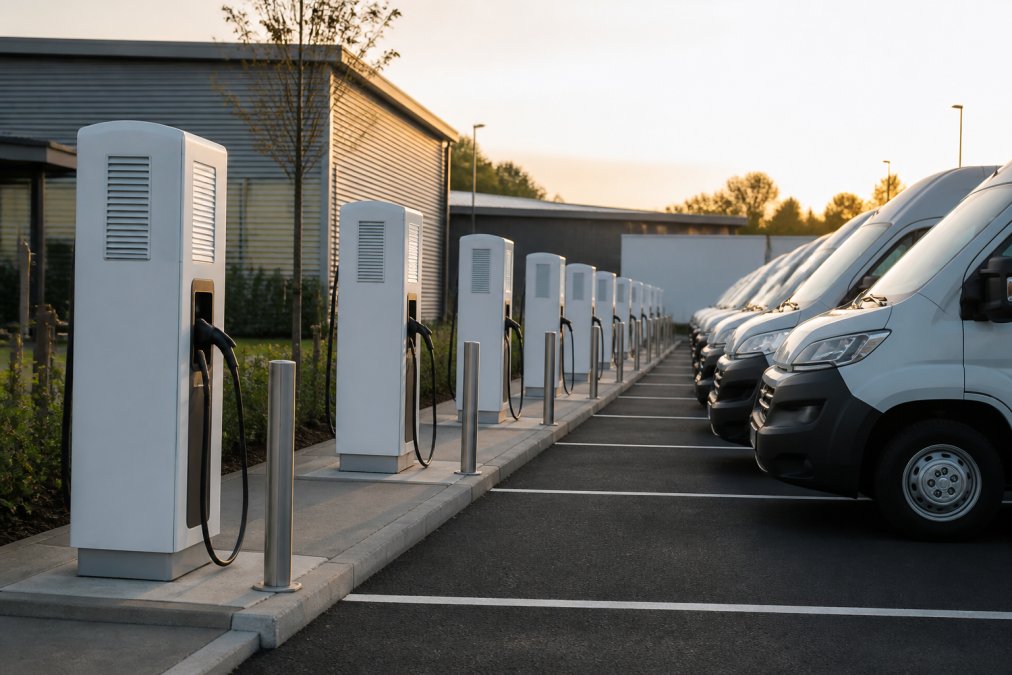
An EV charging hub for business fleets is a dedicated site where multiple vehicles charge simultaneously, typically at a depot, distribution centre, or workplace, using infrastructure designed for predictable, high-utilisation charging rather than ad-hoc top-ups. A hub is planned around the fleet's duty cycle, the vehicles' dwell time, and the power available at the site.
The first question is never about hardware. It is about how many vehicles need charging, for how long, and at what time of day. Those three answers determine everything downstream, from transformer size to cable specification.
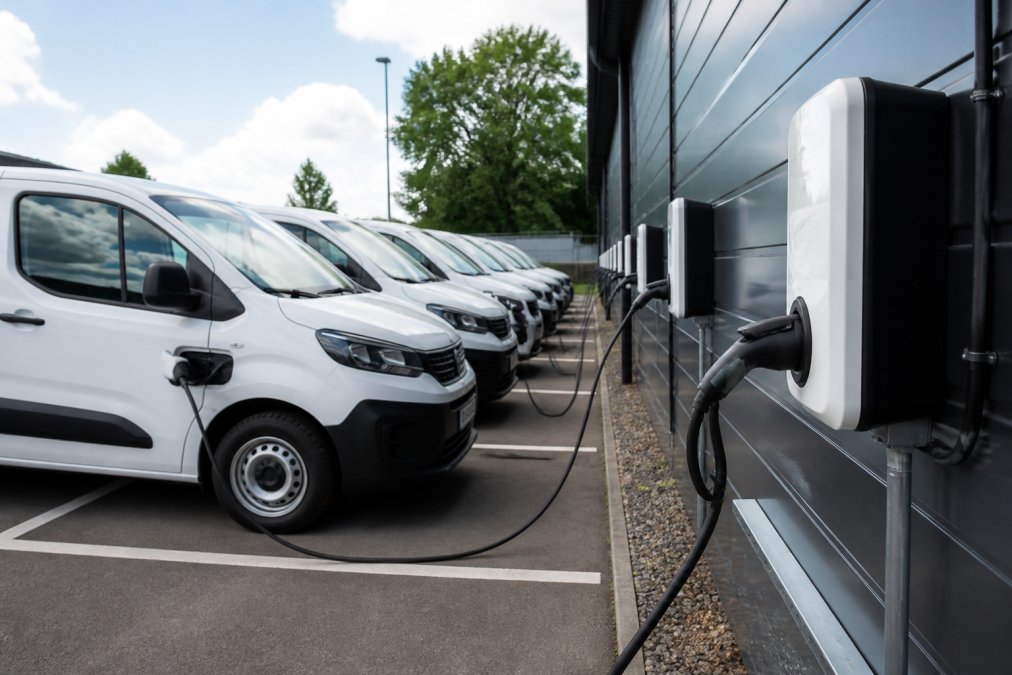
A hub also implies management. Without software to schedule charging, stagger start times, and monitor energy use, you simply have a cluster of chargers. The operational efficiency of a fleet hub comes from the energy management system that controls it.
Depot Charging vs Workplace Charging: Which Do You Need?
Depot charging is the backbone of fleet electrification for vehicles that return to a central site each night. Vehicles typically sit for 6 to 10 hours, making overnight charging with lower-power chargers cost-effective and gentle on the electrical infrastructure.
Workplace charging tops up vehicles during the working day and supports staff who drive electric vehicles. For a business fleet, it rarely replaces depot charging; it complements it. A common approach is to install a small number of workplace chargers for pool cars or employee vehicles while the main hub sits at the depot.
| Charging Scenario | Typical Dwell Time | Best Charger Type | Primary Goal |
|---|---|---|---|
| Depot overnight | 6-10 hours | 7-22 kW AC | Full charge, low cost |
| Depot opportunity | 1-3 hours | 50-150 kW DC | Rapid turnaround |
| Workplace day | 4-8 hours | 7-22 kW AC | Staff and pool cars |
The real question is whether your vehicles return to base. If they do, depot charging is the priority. If vehicles are out all day and return only briefly, you need faster DC infrastructure, which brings higher connection costs and more complex load management.
Load Balancing for EV Charging Hubs: Protecting Your Power Supply
Load balancing prevents your entire site from tripping when every vehicle plugs in at once. Without it, ten chargers starting simultaneously can draw more power than your connection allows, causing fuses to blow and vehicles to charge at a fraction of their capability.
A smart charging system staggers start times and distributes available power across vehicles based on priority, monitoring total site demand and adjusting each charger's output in real time. This is where peak shaving becomes relevant: you flatten the demand curve so your maximum draw stays within your agreed grid connection.
Most fleet managers underestimate load management until they experience a failed overnight charge, leaving a vehicle unable to complete its route. Load balancing is not optional; it is the core engineering that makes a hub function reliably.
Grid Capacity and DNO Constraints: Know Before You Build
Grid capacity is the single biggest constraint on fleet hub deployment. Your local Distribution Network Operator (DNO) controls how much power your site can draw, and upgrading that connection can take months or years depending on regional capacity.
Before any equipment is purchased, a site survey must establish the existing connection size and the cost of reinforcement. Many sites discover their current connection supports lighting and small machinery but nothing close to the demand of a charging hub. The DNO application process requires detailed load profiles and can involve significant lead times.
This is why early engagement with your DNO matters. The Energy Networks Association guidance on connection applications sets out the process for securing additional capacity. In practice, operators should start the connection enquiry before finalising charger specifications, not after.
For fleets facing grid constraints, options include battery storage to buffer demand, solar generation to offset daytime load, and smart charging to shift consumption to off-peak periods. These do not remove the capacity issue, but they reduce the peak draw that drives connection costs.
Commercial EV Charging Grants UK: What Funding Exists in 2026?
Navigating the funding landscape is a critical early step, but the value lies in the details. The most relevant national scheme for most fleet operators remains the Workplace Charging Scheme (WCS), which provides a grant of up to £350 per socket, capped at 40 sockets per applicant across all sites. This covers the costs of purchase and installation of charge points. However, eligibility is not automatic. Your business must have off-street parking, and you must demonstrate a genuine need for the charge points. Crucially, the scheme is open to a range of organisations, including businesses, charities, and public sector bodies, but the specific eligibility criteria and the application portal are managed by the Office for Zero Emission Vehicles (OZEV) and administered through the GOV.UK guidance on the Workplace Charging Scheme.
Beyond WCS, the landscape shifts frequently. The previous Electric Vehicle Chargepoint Grant for businesses was folded into broader schemes, and local authorities often administer their own top-up funds, particularly for depots in air quality management areas. While there is no direct national grant for heavy-duty charging infrastructure as of 2026, support often comes indirectly through the Low Emission Bus Scheme or local Clean Air Zone capital funds. Check the specific criteria for your vehicle class, as a scheme designed for cars and vans will not automatically apply to an HGV fleet.
A more reliable source of financial support is often the energy supplier or charge point operator. Many DNOs offer flexible connection agreements that reduce upfront costs, and some manufacturers provide 'as-a-service' models that capitalise infrastructure cost into a monthly fee, removing the need for a capital grant. This route can be more predictable than waiting for government funding cycles.
The most effective strategy is to layer funding sources. A typical project might combine a WCS grant for a portion of the sockets with a local authority air quality grant for the grid connection upgrade, then offset the remaining cost against operational savings. The cumulative effect can reduce capital outlay by 30-40% for a small depot. The Enhanced Capital Allowance (ECA) scheme can also provide 100% first-year tax relief on qualifying infrastructure, which for a profitable business is often more valuable than a direct grant. Always model the tax benefit against the grant value before committing.
Building a Fleet Electrification Strategy That Scales
A fleet electrification strategy is a phased roadmap connecting vehicle replacement cycles, charging infrastructure, and grid capacity into a single plan. The common failure is treating charging as a one-off purchase rather than an evolving system.
Click HERE for your FREE SURVEY today →
Start with a total cost of ownership model comparing diesel and electric across the full vehicle life, including purchase price, energy costs, maintenance, and charging infrastructure capital. The business case depends heavily on charging behaviour: vehicles charged predominantly at off-peak rates deliver far stronger returns.
Scalability should drive hardware choices. Chargers that support open protocols such as OCPP allow future software upgrades and interoperability with different management platforms. Proprietary systems can lock you into a single vendor and complicate expansion. The Open Charge Alliance documentation on OCPP explains why protocol compliance matters for long-term flexibility.
Design the site for phase two even if you only build phase one. Trenching for additional cabling, leaving spare capacity in the distribution board, and choosing chargers with higher power ratings than currently needed all reduce future expansion costs.
Common Mistakes to Avoid When Installing a Fleet Hub
The most expensive mistakes in fleet hub installation happen before any equipment arrives on site. Underestimating grid connection lead times tops the list, followed closely by oversizing chargers for the available power. The most operationally damaging error is failing to plan for downtime: a hub offline for a single morning is a missed delivery window, a stranded vehicle, and a direct hit to your service level agreement.
Design for Failure, Not Just for Uptime. The first mistake is assuming a charger is a fit-and-forget asset. A typical DC charger has a mean time between failures measured in years, but repair can take days without a service plan. The most effective mitigation is building redundancy into the hub design: installing one or two additional charge points beyond your current fleet size. If a single unit goes offline, you still have enough capacity to charge all vehicles overnight. This 'N+1' redundancy is standard in data centres but often overlooked in fleet depots.
The Maintenance Contract is Not an Optional Extra. Operators often purchase chargers and negotiate a maintenance contract only after the first breakdown. This is backwards. The contract should be signed before the hub goes live and must specify response times. A standard 48-hour response is too slow for a daily fleet. Look for a contract guaranteeing remote diagnosis within four hours and an on-site engineer within 24 hours. The cost difference is often marginal, but the operational impact is significant.
Software is the Hidden Failure Point. Many operators focus on hardware and forget that the energy management system is the most complex component. A software bug can stop the entire hub from communicating, even if every charger has power. Ensure your software supports open protocols like OCPP, allowing you to switch back-end providers without replacing hardware. More importantly, ensure it has a 'fail-safe' mode: if the central server goes offline, chargers should default to a pre-configured schedule that still delivers a full charge, rather than shutting down.
:::tip Conduct a 'dry run' of a failure scenario. Once a month, simulate a charger outage and ask your team to execute the manual process of plugging in vehicles in a priority order. This exposes weaknesses in your operational plan before they become real-world disruptions.
Physical Damage is the Most Common Cause of Downtime. The most frequent reason for a charger going offline is physical: a driver backing into a post, a cable run over, or a connector dropped. These are preventable with site design. Install bollards, use cable management systems, and specify heavy-duty connectors rated for frequent use. A commercial-grade connector is designed for 10,000 insertions, while a domestic one may only last for 2,000. The cost difference is small, but replacement labour is not.
Finally, establish a clear escalation path before the hub goes live. Who do you call first: the charger manufacturer, software provider, or electrical contractor? A single point of contact for all hub issues is essential. Many operators find that working with a single integrator like Smarter Utility, which handles both hardware and software, simplifies this: one phone call, not three.
Conclusion: Start Your EV Charging Hub Project with Confidence
Building an EV charging hub for business fleets rewards careful planning. Operators who succeed start with grid capacity, design for scalability, and treat load management as a core requirement rather than an afterthought.
Most fleet managers are experts in logistics, not electrical infrastructure. That gap is where projects stall. Working with a partner who understands both the technical requirements and the grant landscape makes the difference between a hub that underperforms and one that delivers reliable, cost-effective charging for years.
Smarter Utility provides free, no-obligation surveys to assess your site's suitability, design a tailored charging solution, and guide you through the installation process. Our fully accredited team handles the expert design and installation so your fleet can transition to electric with confidence. Get started with Smarter Utility and secure your charging infrastructure the right way.
Frequently Asked Questions
How do I calculate the power requirements for a commercial EV fleet hub?
Start with your vehicles' battery capacities and daily mileage to determine kWh demand. Total your fleet's overnight charging needs, then factor in the time available for charging during dwell periods. Divide total kWh by charging hours to find the power requirement in kW. A site survey is essential: an assessor will check your existing connection and capacity. For example, ten vans each needing 60 kWh over an eight-hour window require roughly 75 kW of continuous capacity.
Are there government grants available for business fleet charging infrastructure?
Yes. The Workplace Charging Scheme (WCS) provides a discount on the purchase and installation of charge points for eligible businesses, covering up to 75% of the costs, capped at £350 per socket and 40 sockets across all sites. The scheme is administered by the Office for Zero Emission Vehicles (OZEV). Eligibility rules have tightened, so confirm your fleet qualifies before committing to a supplier.
What is the difference between workplace charging and fleet charging hubs?
Workplace charging serves staff and visitors during the day, with shorter dwell times and generally lower power requirements. Fleet charging hubs are dedicated to commercial vehicles, often operating overnight at a depot. These hubs typically need higher power outputs, more robust infrastructure and advanced load balancing to manage multiple vehicles charging simultaneously. Fleet hubs also prioritise operational uptime, so redundancy and maintenance plans matter more than they do for workplace units.
How does smart charging technology optimise fleet energy costs?
Smart charging shifts charging sessions to off-peak hours when electricity rates are lower, reducing operational costs. It also enables load balancing, which prevents the site's power supply from being overloaded when several vehicles charge at once. An energy management system monitors demand in real time, adjusts power output to each vehicle and can integrate renewable generation such as solar PV. This approach lowers your total cost of ownership and reduces strain on the local grid.
This article was written using GrandRanker
Frequently Asked Questions
How do I calculate the power requirements for a commercial EV fleet hub?
Start with your vehicles' battery capacities and daily mileage to determine kWh demand. Total your fleet's overnight charging needs, then factor in the time available for charging during dwell periods. Divide total kWh by charging hours to find the power requirement in kW. A site survey is essential: an assessor will check your existing connection and capacity. For example, ten vans each needing 60 kWh over an eight-hour window require roughly 75 kW of continuous capacity.
Are there government grants available for business fleet charging infrastructure?
Yes. The Workplace Charging Scheme (WCS) provides a discount on the purchase and installation of charge points for eligible businesses, covering up to 75% of the costs, capped at £350 per socket and 40 sockets across all sites. The scheme is administered by the Office for Zero Emission Vehicles (OZEV). Eligibility rules have tightened, so confirm your fleet qualifies before committing to a supplier.
What is the difference between workplace charging and fleet charging hubs?
Workplace charging serves staff and visitors during the day, with shorter dwell times and generally lower power requirements. Fleet charging hubs are dedicated to commercial vehicles, often operating overnight at a depot. These hubs typically need higher power outputs, more robust infrastructure and advanced load balancing to manage multiple vehicles charging simultaneously. Fleet hubs also prioritise operational uptime, so redundancy and maintenance plans matter more than they do for workplace units.
How does smart charging technology optimise fleet energy costs?
Smart charging shifts charging sessions to off-peak hours when electricity rates are lower, reducing operational costs. It also enables load balancing, which prevents the site's power supply from being overloaded when several vehicles charge at once. An energy management system monitors demand in real time, adjusts power output to each vehicle and can integrate renewable generation such as solar PV. This approach lowers your total cost of ownership and reduces strain on the local grid.