 How-to
How to Balance EV Charger Load on a Site
Quick Summary
Load balancing shares a fixed electrical supply between EV chargers and the building's other loads so the total never exceeds the site's safe limit. Chargers slow down when the building is busy and speed up when it is quiet. Sites can use static limits or dynamic control that adjusts in real time.
- Static load management sets a fixed charging limit, which is simple and inexpensive.
- Dynamic systems measure real-time demand and adjust the charger several times a second.
- Log real demand for seven days to capture true 15-minute peaks before sizing.
- Reserve 10-20% of the supply rating as headroom for inrush currents and sudden loads.
- Set the calculated site limit in the controller, not the default, and test fail-safe behaviour.
Table of Contents
- What EV Charging Load Balancing Is
- Static Versus Dynamic Load Balancing
- How Dynamic Load Balancing Works on a Charger
- Measuring Available Site Power and Sizing the Limit
- Managing Multiple EV Chargers at One Site
- Demand Response, Solar and Battery Integration
- Choosing a Solution and Booking Your Free Survey
- Frequently Asked Questions
What EV Charging Load Balancing Is
Load balancing is the practice of sharing a fixed supply of electrical power between several charge points, vehicles and the building's other loads, so that the total never exceeds what the site can safely draw. This guide explains how the approach works for homes and businesses across the UK.
Most sites have a fixed limit, set by the main fuse or service cable rating at home and by the grid connection commercially. Adding a charger that draws 7kW or more can push the property past that limit, especially in the evening when cooking, heating and other appliances already use a large share of the supply. Without control, the result can be tripped breakers, a blown fuse or a costly grid upgrade.
Load balancing solves this by measuring the power the building is using and adjusting the charger's output to fit the spare capacity. The charger slows down when the house is busy and speeds up when it is quiet, so vehicles still charge, often overnight, without anyone managing the process by hand.
Static Versus Dynamic Load Balancing
Static load management sets a fixed charging limit for each charger, for example 16A regardless of what else is running. It is simple and inexpensive, and works well where the spare capacity is known and reliable. Its weakness is that it wastes capacity when the building is quiet and can still overload the supply if demand changes unexpectedly.
Dynamic load balancing measures real-time demand and adjusts the charger continuously, using a meter or sensor at the incoming supply and a control unit that sends commands to the charger. Dynamic systems use more of the available capacity and protect the supply when other loads switch on.
For most homes with a single charger and a modest supply, a static limit may be enough. For sites with several chargers, heat pumps or solar generation, dynamic control is usually the better choice. Start with the highest demand you expect, then select the approach that keeps that demand inside the limit without leaving charging capacity unused.
How Dynamic Load Balancing Works on a Charger
A dynamic system follows a simple cycle. A current transformer or meter on the incoming supply measures how much power the site draws. The control unit compares that figure with the site limit, works out how much capacity is free, and signals each charger how much current it may use. The cycle repeats several times a second, so the charger responds quickly to changes.
The control unit reserves a safety margin, so the total never reaches the limit. If the house suddenly starts an oven or a heat pump, the charger reduces its output within seconds and ramps back up once demand falls. The car keeps charging, only more slowly for a short period.
Good systems also include fail-safe behaviour. If the meter loses its signal, the charger should drop to a safe default rate rather than continue at full power. This is an area where installation quality matters, and it is one reason a professional commissioning check is worth paying for.
Measuring Available Site Power and Sizing the Limit
Before you can balance a load, you need to know how much power is genuinely available, not the nameplate figure on the supply, but the capacity left after the building's own demand and the safety margins a competent installer will apply.
Step 1: Establish the supply rating. For a single-phase domestic supply, the limit is set by the main fuse and the service cable, usually stated in amps on the consumer unit, the meter tails or the supplier's connection documents.
Step 2: Measure the building's real peak, not its assumed peak. The theoretical spare capacity is the supply rating minus the building's maximum demand.
Step 3: Apply a safety margin and a diversity allowance. The safe charging limit is not the full spare capacity. A common pattern is to reserve 10-20% of the supply rating as headroom for inrush currents, meter tolerance and loads that switch on without warning.
Worked example, single charger. A home on a 100A single-phase supply (about 23kVA) logs a seven-day peak of 9kVA.
Worked example, multi-charger allocation. A commercial site on a 200A three-phase supply (about 138kVA) has a measured building peak of 90kVA.
Step 4: Set the limit in the controller, not on paper. The calculated envelope is only useful if it is programmed into the load management controller as the site limit, with the meter's CT ratio and the supply voltage entered correctly.
Watch out: sizing from the main fuse rating alone, without logging real demand, routinely overstates spare capacity on homes with heat pumps or electric showers and understates it on sites with steady overnight base loads.
Businesses should also confirm whether the supply is single-phase or three-phase and how the chargers are distributed across phases; an unbalanced single-phase charger load on a three-phase supply can trip protection on one phase long before the total site limit is reached.
The article works through sizing with a few key figures, which are summarised below for quick reference.
| Item | Value | Note |
|---|---|---|
| Supply example | 100A single-phase (about 23kVA) | Usable charging capacity is less than the kVA rating |
| Recommended headroom | 10-20% of supply rating | Covers inrush, meter tolerance and sudden loads |
| Logging period | Seven days | Captures true 15-minute peaks |
| Home example charger | 7kW (7.4kW at 32A) | Fits with margin on a 9kVA logged peak |
| Commercial supply | 200A three-phase (about 138kVA) | Measured building peak of 90kVA |
| Charging envelope (commercial) | Roughly 27kVA | Enough for three 7kW chargers running together |
Worked example: charging capacity compared with supply limits
Managing Multiple EV Chargers at One Site
Two or more chargers on one supply need a shared limit, and how that limit is enforced depends on the control architecture. There are three common patterns, differing in cost, resilience and site wiring.
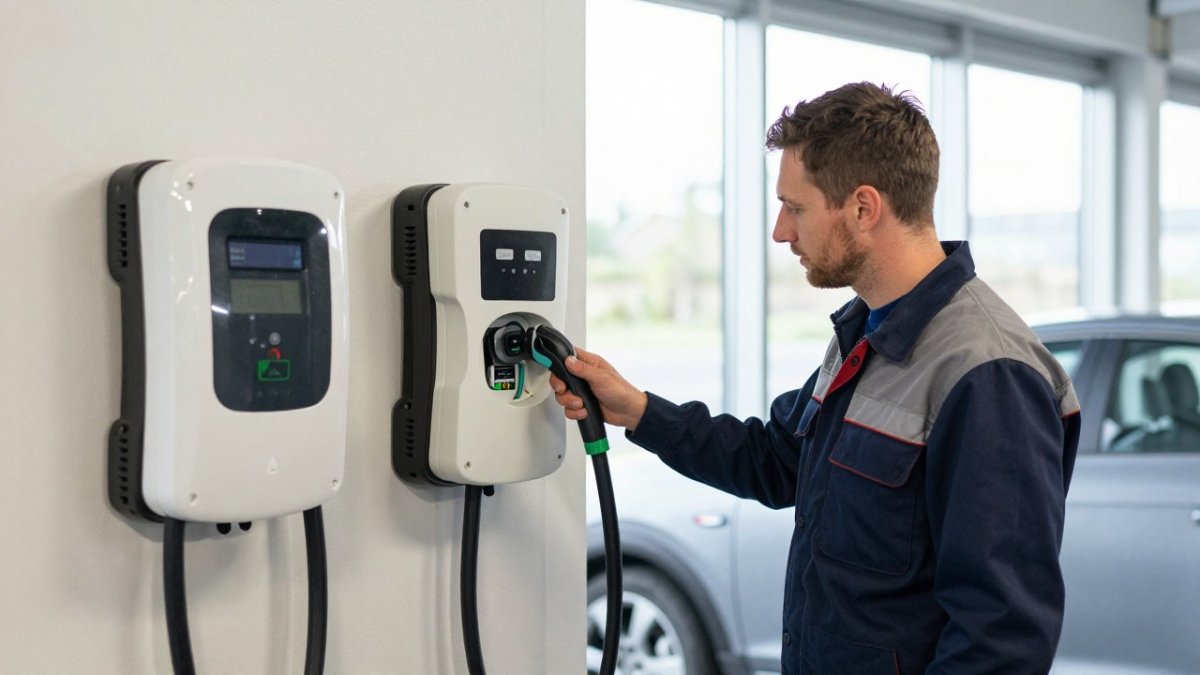
Charger-level (local) control. Each charger has its own current transformer or meter on the incoming supply and decides how much current to draw. This is the simplest and cheapest arrangement for two to four chargers, and it keeps working if the internet goes down because no central device is involved.
Central controller with a single supply meter. A gateway or controller reads one current transformer on the incoming tails, calculates the site's spare capacity, and sends a current limit to every charger over a local network.
Cloud or back-office control. Some systems put the allocation logic in a cloud platform, which suits sites that need reporting, billing, access control and remote diagnostics across multiple locations.
How capacity is shared in practice. A site might install ten chargers but only allow four to run at full output simultaneously. The controller divides the available envelope, say 27kVA, across active sessions, and as vehicles finish and disconnect, the remaining chargers ramp up. This is normal and efficient, because most vehicles do not need full power for the whole time they are connected; a car that arrives at 40% and leaves eight hours later will be full on a shared 4.5kW allocation. The design question is not "how many chargers can run flat out" but "what allocation gets every vehicle to its required state of charge by departure time".
Safety and fail-safe behaviour. The load management system is a control layer, not a substitute for protective devices. Because a safe default cannot compensate for an undersized supply, Linder Electrical Contractors can help assess whether the panel has capacity for an EV charger before installation.
Commercial sites should also check the building's wider electrical load, including lighting, ventilation and any compressors. These share the same supply and are often the reason a site runs out of capacity, and because they are not controlled by the charging system, they must be included in the measured peak that sets the site limit.
Watch out: a controller commissioned with the manufacturer's default site limit, rather than the calculated envelope, can either throttle charging to a fraction of the available capacity or fail to protect the supply when building loads peak.
Demand Response, Solar and Battery Integration
Load balancing becomes more valuable when a site has solar panels or a battery. Solar generation can be directed first to the vehicle or the battery, and surplus power can be used during the day rather than exported at a low rate. A home battery can supply the charger during expensive peak periods and charge when electricity is cheapest.
Demand response programmes reward households and businesses that reduce consumption at times of grid stress. A load management system can respond automatically by pausing or slowing charging, lowering bills and supporting the grid at its busiest times.
Combining charging with solar and storage needs careful design, so the controller understands how each source behaves. If you are considering this setup, Solar Battery Storage Installation explains how the components work together, and Home Battery Storage Installation covers what a battery adds to a home charging setup. A reader weighing this combination should also check Solar Panel and Battery Installation Scotland: How to Tell if Your Home Is a Good Fit before booking an assessment, since not every property suits solar with storage.
Choosing a Solution and Booking Your Free Survey
The right solution depends on your supply, the number of chargers, and whether you plan to add solar or a battery. Compare the options on five points: the control method, how it measures demand, how it handles loss of signal, whether it can expand later, and how it integrates with your chargers.
Pricing depends on the number of chargers, the supply and the installation work, so ask for a quote rather than relying on a general figure.
Smarter Utility offers a free, no-obligation home survey. During the free, no-obligation home survey, the team reviews your property and recommends a suitable solution for your needs. Our installers are fully accredited and approved MCS solar and battery storage installers, and every design is tailored to the site. To book your free survey, contact Smarter Utility today and we will confirm the right setup for your home or business. Before you book, read how to choose a reliable EV installer.
Last Updated: November 16, 2026
Frequently Asked Questions
When is load balancing required for an EV charger?
Load balancing is usually needed when the combined draw of your EV charger and the rest of the property could exceed the supply capacity set by the main fuse or grid connection. A single charger on a large supply often does not need it, but adding a second charger, a heat pump, or a commercial load commonly does. A site survey by a qualified installer will measure available capacity and show whether a balancing system is needed before any charger is fitted.
What is the difference between static and dynamic load balancing?
Static load management sets a fixed charging limit for each charger, so the power available to vehicles never changes. Dynamic load balancing monitors the building's real-time consumption through a meter and adjusts charger output second by second, giving vehicles more power when the rest of the site is quiet. Dynamic systems usually make better use of existing capacity, while static systems are simpler and cheaper to install.
Can load balancing let me install more than one EV charger?
Yes. Load balancing shares a fixed supply capacity between several chargers, so the total draw never exceeds the limit. This is how many homes and business sites add a second charger without upgrading their grid connection. The exact number of chargers depends on the supply size, the charger ratings, and how much other load the building carries, so a survey is the reliable way to confirm the figure for your site.
Does load balancing reduce electricity costs?
It can help avoid the need for a supply upgrade, depending on the site. Smarter Utility's pricing depends on the system chosen, the number of chargers, and the site, so we do not quote fixed figures here. Contact Smarter Utility for a free, no-obligation survey and a quote tailored to your property.