 How-to
Installing an EV Charger in Shared Parking: A Step-by-Step Guide
Table of Contents
- Why Shared Parking Needs a Different Approach
- Step 1: Get Permission from Your Landlord, Factor or Management Company
- Step 2: Confirm Your Parking Space and Cable Route
- Step 3: Check the Building's Electrical Capacity
- Step 4: Plan Load Management for Multiple Users
- Step 5: Agree How Shared EV Charging Costs and Billing Will Work
- Options for EV Charging for Flats Without a Driveway
- Booking Your Free Survey with Smarter Utility
- Frequently Asked Questions
Installing an EV Charger in Shared Parking: A Step-by-Step Guide
Last Updated: November 8, 2026
Why Shared Parking Needs a Different Approach
Learning how to install ev charger in shared parking in Scotland is harder than fitting one on a private driveway. The charger itself is usually the easy part. The real work is agreeing permission, sharing a power supply fairly and splitting costs.
A personal charger may not be permitted where the parking space sits in a shared area, so permission is the first question to answer, not the last.
Shared parking also brings practical problems. Cables may need to cross communal land. The building's electrical supply may be shared between flats. Several residents may want to charge at the same time, and that can overload the supply, which is why anyone learning how to install ev charger in shared parking in Scotland should plan for it early.
Work through these steps in order:
- Get written permission from the landlord, factor or management company
- Confirm the parking space and the cable route
- Check the building's electrical capacity
- Plan load management for multiple users
- Agree how costs and billing will work
Skipping any step often leads to delays, disputes or a charger that cannot be used properly.
Step 1: Get Permission from Your Landlord, Factor or Management Company
Start by asking who controls the parking area. In flats, this is usually the landlord, a factor or a management company. Ask them in writing before you book any work.
What to ask for:
- Written consent to install a charger
- Approval for the exact parking space
- Permission to run cables through shared areas
- Rules on who can use the charger and when
Many residents assume a verbal yes is enough. It is not. A written agreement protects you if ownership changes or a dispute starts later.
Watch out: If the building has an existing charger, check whether it is shared. Adding a second unit without agreement can breach the building rules.
Step 2: Confirm Your Parking Space and Cable Route
Once you have permission, confirm exactly where the charger will go. Measure the parking bay and check it is yours to use. Mark the cable route from the meter or consumer unit to the parking space.
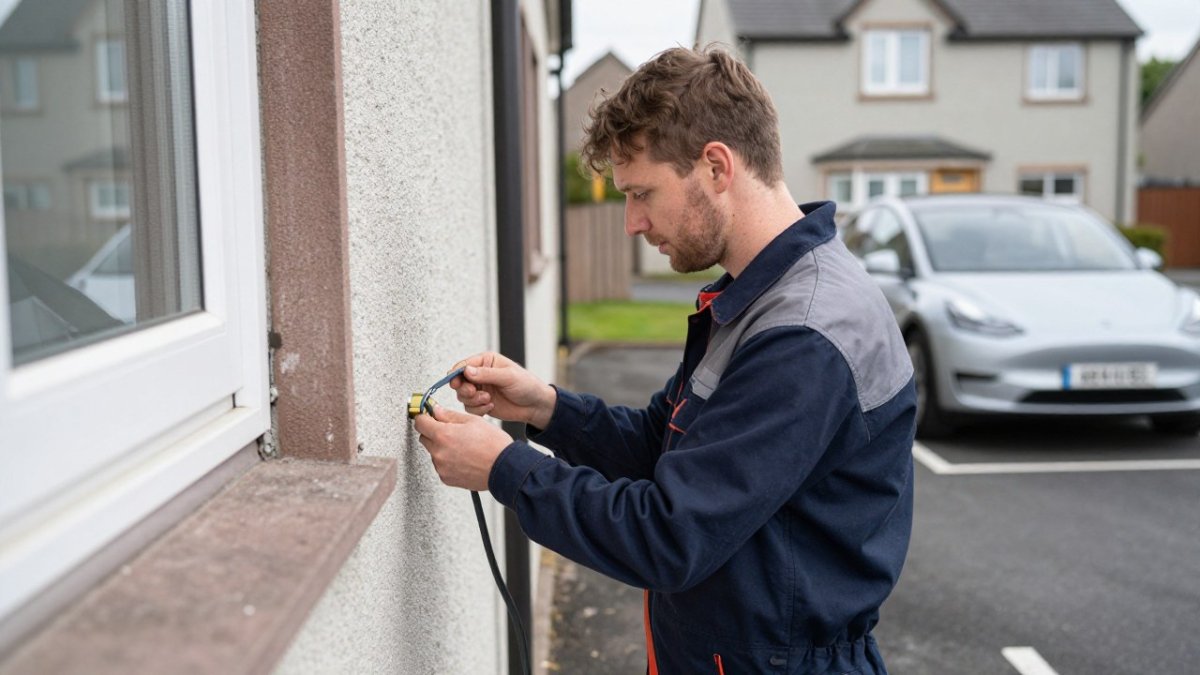
An electrician should inspect the route. They will look for:
- The distance from the power supply to the parking space
- Walls, ducts or ground that the cable must cross
- Any communal areas that need written permission
- Safe mounting height and access for the user
Clear planning here cuts the cost of cable runs and avoids surprises halfway through the job.
Step 3: Check the Building's Electrical Capacity
Electrical capacity is the most common limit in shared buildings. The supply was sized for lighting, heating and cooking, not for several chargers drawing 7 kW or more at once. A single 7 kW charger adds roughly the same load as an electric shower running continuously for hours, so even one unit can push an older supply close to its limit.
Ask a qualified electrician to carry out a capacity assessment. They will typically:
- Record the agreed supply capacity (the kVA figure on the meter or in the connection agreement)
- Measure the current maximum demand using a clamp meter over a representative week
- Check the rating of the consumer unit, main fuse and meter tails
- Calculate the spare capacity available after diversity is applied
A building with a 100 A single-phase supply and electric heating may have little or no headroom for a 7 kW charger without load management. A three-phase supply can give more options because load can be spread across phases.
If the spare capacity is insufficient, there are three routes:
- Load management, limit the charger's output so total demand stays within the existing supply. This is usually the cheapest option and is covered in Step 4.
- Supply upgrade, ask the distribution network operator (DNO) to increase the agreed capacity. In Scotland this is usually Scottish and Southern Electricity Networks (SSEN) or SP Energy Networks, depending on the area (Electricity transmission infrastructure: what’s changed). Upgrades can take months and may require a new cable or transformer, so budget for both cost and time.
- Separate supply, in some buildings a new dedicated connection for the charging bays is cleaner than upgrading the existing supply, particularly where the car park is detached from the building.
Watch out: A DNO upgrade is not a quick fix. Applications, design and delivery can run into many months, and the cost is borne by the applicant, so confirm the spare capacity before you commit to a charger specification.
For anyone planning multiple bays, the capacity question should be answered before choosing charger power. A building that can support four 7 kW chargers with load management may not support four 22 kW units, and the difference in cable size and DNO approval is significant.
The building's spare electrical capacity is the limit that most often decides how many chargers can be installed, so the article sets out the key figures to check.
| Item | Value | Note |
|---|---|---|
| Single 7 kW charger load | About an electric shower running for hours | Adds load even on its own |
| Example supply | 100 A single-phase | Little headroom with electric heating |
| Fix 1: load management | Cheapest option | Limits charger output |
| Fix 2: DNO supply upgrade | Months and applicant-funded | Can need new cable or transformer |
| Fix 3: separate supply | Cleaner for detached car parks | Dedicated connection for bays |
Step 4: Plan Load Management for Multiple Users
Several chargers running at full power at the same time can overload a shared supply. Load management solves this by limiting how much power each charger draws, but the right design depends on how much energy drivers actually need and how long cars sit parked.
A practical sizing method starts with daily mileage. Take a typical resident driving 30 miles a day in a vehicle using about 0.3 kWh per mile. That is roughly 9 kWh of energy needed per day. A 7 kW charger delivers that in about 1.3 hours. If the car is parked overnight for ten hours, even a 3.6 kW limited supply is more than enough. The lesson is that most shared parking does not need high power, it needs enough hours connected.
Use this to size the system:
- Estimate daily energy per vehicle (daily miles × kWh per mile)
- Estimate dwell time (hours the car is usually parked)
- Divide energy by dwell time to get the minimum average power needed
- Add a margin for cold weather and battery conditioning
Common load management approaches include:
- Dynamic load balancing: a controller monitors the building's total demand and shares the spare capacity between active chargers. This is the most efficient option where the supply is tight.
- Scheduled charging: chargers run in set windows, often overnight, so peak demand is spread. This suits buildings where residents park predictably.
- Power caps: each charger has a fixed maximum output, for example 3.6 kW per bay. Simple and cheap, but slower and less flexible.
A common mistake is installing 22 kW chargers without a plan for shared use. Two cars can then drain the supply and trip the breaker for everyone. Matching charger power to actual dwell time avoids paying for capacity nobody needs.
Resilience matters too. If a single controller manages all chargers, a failure can take the whole bank offline. A fallback mode, for example chargers defaulting to a low fixed output if the controller loses communication, can stop residents being left without charging. Keep a maintenance contact visible in the car park and agree who is responsible for resetting faults.
Watch out: Load management settings should be documented and handed to the building manager. If the controller is replaced or reset without the original configuration, the supply can be overloaded on the first busy evening.
For buildings with a mix of short and long dwell times, a combination of one higher-power unit for visitors and several lower-power units for residents often gives the best balance of cost and usability.
Step 5: Agree How Shared EV Charging Costs and Billing Will Work
Shared charging needs clear rules on cost before anyone uses it. Without them, disputes are almost certain.
Decide these points in writing:
- Who pays for installation, and in what shares
- Who pays for the electricity used
- How usage is measured, such as a sub-meter or smart billing
- How maintenance and repairs are paid for
- What happens if a resident moves out
Smart billing systems can record each user's energy use. Sub-metering is simpler but needs more hardware. Choose the method that suits the number of users and the building's set-up.
Options for EV Charging for Flats Without a Driveway
Not every flat has a private space. Residents without a driveway still have options, though each depends on the building.
- Communal chargers: one shared unit in the car park, managed by the building
- Individual chargers on a shared supply: each bay has a unit, with load management
- Public charging: a fallback for residents who cannot get home charging
Some residents also check EV charger installation for flats to see whether a provider handles this type of job. Others look at EV chargers for apartment blocks, which often involve the same permission and capacity questions covered above. For a broader view of the market, you can compare business EV charging providers in Scotland.
The right option depends on the building, the number of residents and the agreement with the owner or manager. For a broader view of the market, you can compare business EV charging providers in Scotland.
Booking Your Free Survey with Smarter Utility
Smarter Utility offers a free, no-obligation survey to check your site before any work starts.
Pricing depends on the charger, the cable run and any supply upgrade, so ask Smarter Utility for a written quote. For repair or maintenance of an existing charger, you can also look at EV charger repair and maintenance.
If you are in Glasgow and ready to move forward, you can find a solar and EV installer in Glasgow and book your free survey.
BUTTON: Book Your Free Survey CARD_TITLE: Ready to charge at home? CARD_TEXT: Smarter Utility offers free, no-obligation EV charger surveys.
Frequently Asked Questions
Can I install an EV charger in a shared car park?
Often yes, but not without agreement. Shared car parks usually belong to a freeholder, factor or management company, and they will need to approve any installation that affects communal electrics or the shared space. Ask in writing before you arrange a survey or quote. Approval may come with conditions on the equipment, the installer, who pays for the works and who is responsible for maintenance. Getting these terms agreed early avoids delays and disputes once the charger is in place.
Who needs to give permission to install an EV charger in shared parking?
Permission usually comes from whoever controls the parking area. In a tenement or block of flats this is typically the factor or the owners' association, and in rented property it may be the landlord. Where the space is part of a shared estate, the management company may also be involved. Check your title deeds, lease or factor's agreement to confirm who has authority. Written consent that names the space, the works and the responsible party is the safest outcome.
How is electricity use measured and paid for in a shared EV charging setup?
There are two common approaches. A dedicated sub-meter on each charger records the energy used and allows individual billing, which is the clearest option for multiple users. Alternatively, charging can be paid for through a card or app system that tracks each session. Whichever you choose, agree the tariff, the billing schedule and who holds the account before installation. This keeps the shared electricity supply fair and transparent for everyone involved.