 comparison
Is Solar Battery Storage Worth It in 2026?
Table of Contents
- How Solar Battery Storage Works in a Home Energy System
- Solar Battery Storage Costs, Payback Period and ROI in 2026
- Smart Export Guarantee Rates 2026: What You Actually Earn
- Retrofitting Solar Batteries to Existing Systems: What You Need to Know
- Battery Options Compared: Key Specs and Considerations
- Smart Home Integration and Grid-Services Revenue
- Pros, Cons and Who Should Install Solar Battery Storage in 2026
- Conclusion
Last Updated: August 16, 2026
Solar battery storage is one of the most significant purchasing decisions a homeowner can make in 2026. At Smarter Utility, we work with homeowners and businesses across Scotland every week, and the same concerns come up repeatedly: will the numbers stack up, how long before I see a return, and what happens as the technology ages? This guide cuts through the noise and gives you a clear-eyed assessment of solar battery storage in 2026, covering costs, real-world performance, smart tariff opportunities, and the battery options currently worth considering.
For the right household, solar battery storage genuinely pays. The key variables are your consumption profile, your current tariff, and whether you're pairing storage with solar photovoltaic panels or using it for grid arbitrage alone.
How Solar Battery Storage Works in a Home Energy System
Solar battery storage captures surplus electricity generated by solar PV panels and holds it for use when generation drops, typically during evenings, overnight, or on overcast days. Without storage, excess solar energy is exported to the grid at rates well below what you pay to import. A battery maximises self-consumption by storing that surplus for later use.
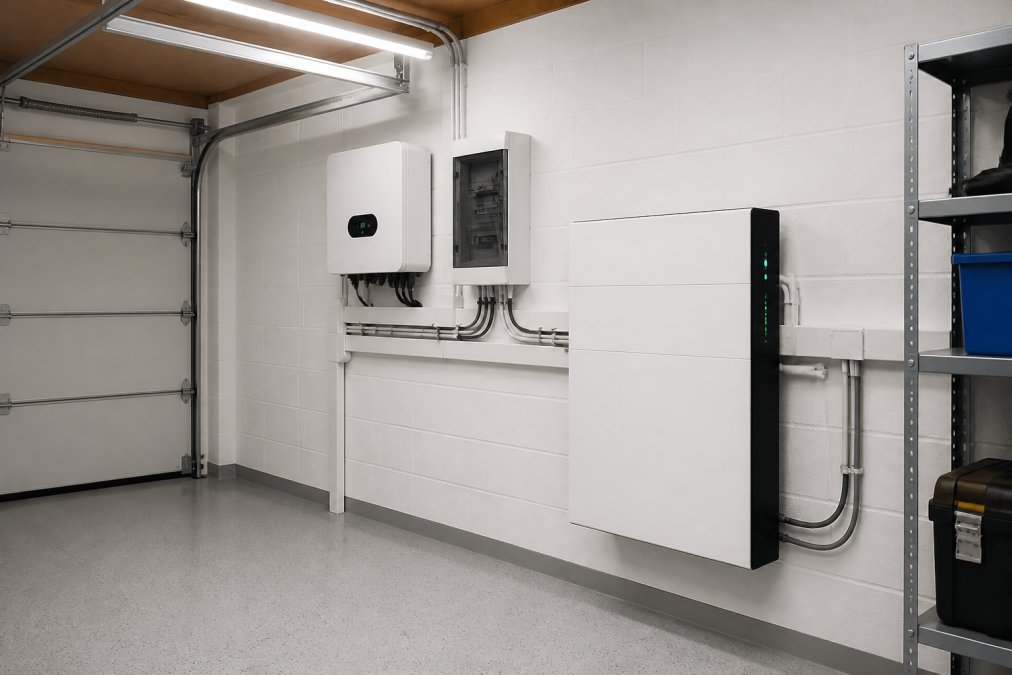
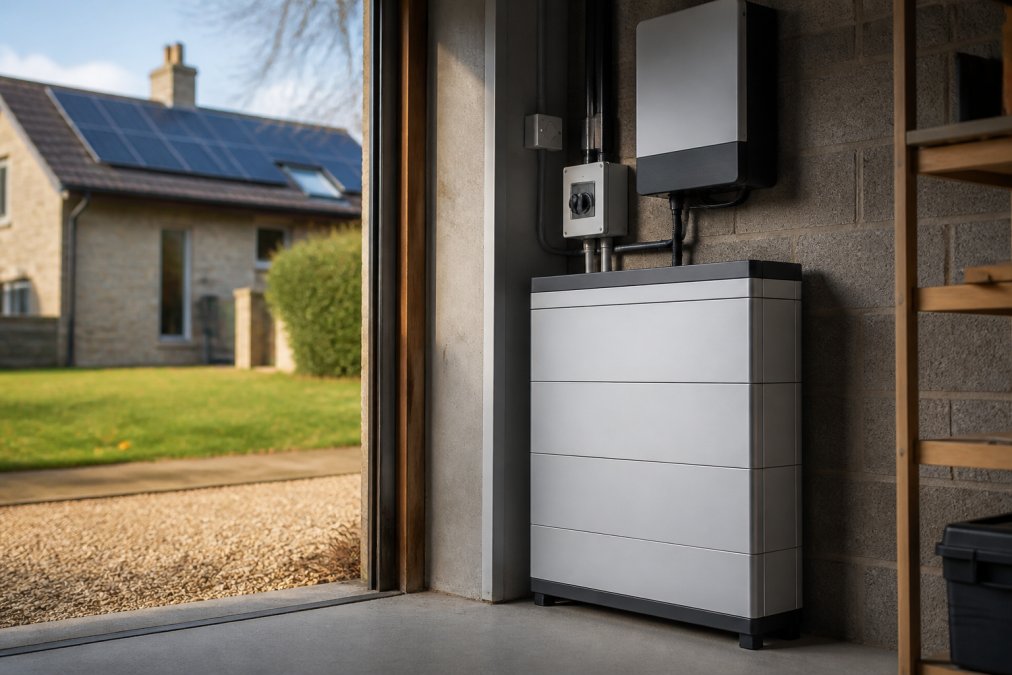
A typical residential setup involves solar panels feeding a hybrid or smart inverter, which charges the battery during peak generation hours. When household consumption exceeds live solar output, the system draws from the battery rather than the grid. A smart inverter manages this automatically, and most modern systems allow remote monitoring via a smartphone app.
Battery Capacity, Depth of Discharge and What the Numbers Mean
Battery capacity is measured in kilowatt-hours (kWh) and describes how much energy the battery can store. Depth of discharge (DoD) is the percentage of total capacity the battery can safely use before recharging. Most lithium-ion and lithium iron phosphate (LFP) batteries operate at 90-100% DoD, meaning a 10 kWh unit delivers close to its stated capacity in practice.
The average UK household uses roughly 8-10 kWh per day. A battery sized at 10-13.5 kWh will typically cover evening and overnight demand for a medium-sized home, assuming the solar array has adequately charged it during daylight hours.
Solar Battery Storage Costs, Payback Period and ROI in 2026
The upfront investment in solar battery storage varies depending on battery capacity, brand, inverter type, and installation complexity. Smarter Utility provides tailored quotes following a free no-obligation survey rather than publishing one-size-fits-all figures. Return on investment comes from three sources: reduced grid imports, Smart Export Guarantee income, and energy arbitrage gains on time-of-use tariffs.
A solar battery payback period calculator divides total system cost by annual savings. Annual savings come from units of solar generation consumed directly, units of battery discharge avoided from grid import, and export income received. Many online calculators use national averages that do not account for Scotland's distinct solar irradiance profile, which is lower than southern England but still commercially viable for south-facing roofs at optimal pitch.
Systems paired with solar PV and used primarily for self-consumption tend to achieve shorter payback periods than batteries used for grid arbitrage alone, because the value of avoided import is higher than export income on most current tariffs.
Off-Peak Tariffs and Energy Arbitrage: Boosting Returns Beyond Solar Alone
Off-peak tariffs charge different unit rates depending on the time of day. Tariffs such as Octopus Energy's Agile and Flux structures allow battery owners to charge during low-cost overnight periods and discharge during peak-price evening hours. This energy arbitrage, buying cheap, using dear, can meaningfully shorten payback periods.
According to Ofgem's guidance on smart tariffs and time-of-use pricing, the rollout of smart meters is enabling more households to access these dynamic pricing structures. Load shifting, the practice of moving high-consumption activities to low-tariff periods, works alongside battery discharge to reduce peak demand charges. This is particularly relevant for households with EV chargers, where overnight charging can represent a significant portion of total consumption.
Smart Export Guarantee Rates 2026: What You Actually Earn
The Smart Export Guarantee (SEG) is the scheme through which licensed energy suppliers pay solar PV owners for electricity exported to the grid. Under the Smart Export Guarantee legislation administered by Ofgem, all licensed suppliers with more than 150,000 customers must offer at least one SEG tariff, though rates vary considerably between suppliers.
SEG rates in 2026 range from a few pence per kWh on fixed tariffs to dynamic rates that track wholesale prices. Export rates are consistently lower than import rates, which is precisely why maximising self-consumption through battery storage makes financial sense. The SEG becomes a secondary income stream rather than the primary financial driver.
To qualify for SEG payments, your solar installation must be carried out by an MCS-accredited installer.
Retrofitting Solar Batteries to Existing Systems: What You Need to Know
Retrofitting solar batteries to existing systems is entirely possible and increasingly common as battery prices continue to fall. The critical technical question is whether your existing solar inverter is compatible with AC-coupled or DC-coupled battery storage.

AC-coupled systems use a separate battery inverter and can be added to virtually any existing solar PV installation, regardless of the original inverter brand. The Enphase IQ Battery 5P is a good example of an AC-coupled solution designed specifically for retrofit scenarios. DC-coupled systems connect the battery directly to the solar array via a hybrid inverter, which typically requires replacing the existing inverter. DC coupling is generally more efficient, but the additional inverter replacement cost affects the overall payback period.
For properties with older solar installations, a thorough survey is essential before committing to a battery retrofit. An MCS-accredited installer should assess your existing inverter's compatibility, your consumer unit's capacity, and whether any upgrades to your electrical infrastructure are required.
Battery Options Compared: Key Specs and Considerations
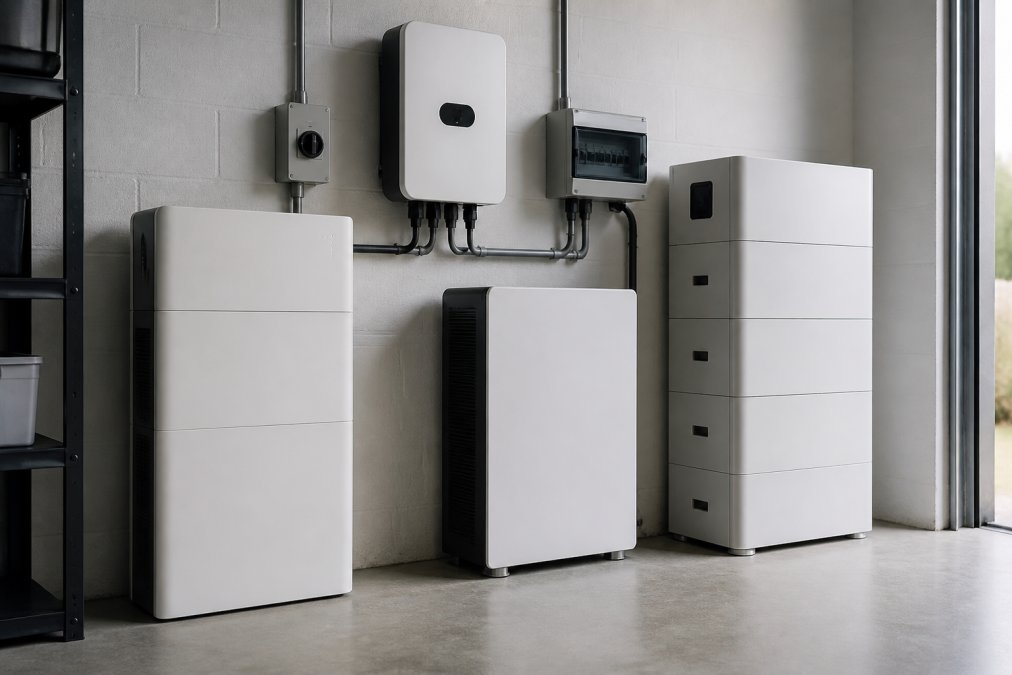
The battery market has matured considerably, but product selection still requires careful attention to chemistry, capacity, warranty terms, and supplier stability.
| Battery | Usable Capacity | Chemistry | Power Output | Best For |
|---|---|---|---|---|
| Tesla Powerwall 2 | 13.5 kWh | NMC Lithium-ion | 5 kW continuous, 7 kW peak | Backup power priority, Tesla ecosystem users |
| GivEnergy All in One | 13.5 kWh | LFP | 7.2 kW peak | Smart tariff integration, all-in-one installs |
| Enphase IQ Battery 5P | 5 kWh per module | LFP | Scalable | Retrofit to Enphase microinverter systems |
| SolaX X-ESS G4 | 3-15 kWh (modular) | LFP | 3-15 kW | High PV oversizing, flexible sizing |
The Tesla Powerwall 2 remains a proven option with a 13.5 kWh usable capacity, 5 kW continuous output, and seamless app-based energy management. It qualifies for 0% VAT when installed in a UK home until 31 March 2027. The GivEnergy All in One offers excellent smart tariff integration, but GivEnergy Ltd filed a Notice of Intention to Appoint Administrators in April 2026, raising legitimate concerns about future warranty support and firmware updates.
Click HERE for your FREE SURVEY today →
The Enphase IQ Battery 5P suits homeowners with existing Enphase microinverter systems. Its modular design allows capacity to be scaled over time. The SolaX X-ESS G4 supports up to 150% PV oversizing, making it well suited to properties with generous roof space looking to maximise generation.
Degradation, Warranty Reality and Long-Term System Efficiency
All lithium-ion and LFP batteries lose capacity over time through repeated discharge cycles. LFP chemistry degrades more slowly than older NMC lithium-ion chemistries, which is one reason LFP has become the dominant choice for residential storage.
Most manufacturers warrant their batteries to retain a certain percentage of original capacity after a defined number of cycles or years. A typical warranty might guarantee 70-80% of original capacity after 10 years or 4,000 cycles. A battery warranted at 13.5 kWh today may deliver closer to 10-11 kWh usable capacity by year ten. Your payback period calculations should account for this gradual reduction in system efficiency rather than assuming constant performance throughout the system's lifespan.
Smart Home Integration and Grid-Services Revenue
Modern battery systems communicate with smart inverters, smart meters, and home energy management platforms to automate charge and discharge decisions in real time. For households on dynamic tariffs, the battery charges automatically when wholesale prices drop and discharges during peak-price windows without manual intervention.
Grid-services revenue is an emerging opportunity. Virtual power plant programmes allow battery owners to aggregate their storage capacity and provide grid balancing services to the National Grid, receiving payments in return. Several UK energy suppliers are running pilot programmes, and the regulatory framework under National Grid ESO's flexibility services documentation is developing to accommodate distributed storage assets.
Grid-services revenue should not be the primary justification for a battery installation. Treat it as a bonus income stream that improves your overall return on investment over the long term.
Pros, Cons and Who Should Install Solar Battery Storage in 2026
The case for solar battery storage is strongest when several factors align: you have an existing or planned solar PV system, your household consumption is weighted towards evenings and mornings, you are on or eligible for a time-of-use tariff, and you value energy resilience as well as bill reduction.
Pros of solar battery storage in 2026:
- Maximises self-consumption of solar generation, reducing reliance on grid imports
- Enables off-peak tariff arbitrage to cut electricity bills independent of solar output
- Provides backup power during grid outages when configured with appropriate gateway hardware
- Reduces household carbon footprint by displacing fossil-fuel grid electricity
- Qualifies for 0% VAT on installation (for residential properties, subject to current HMRC rules)
- Opens access to emerging grid-services revenue streams
- Increases energy independence and resilience
Cons of solar battery storage in 2026:
- Significant upfront installation costs with payback periods typically spanning several years
- Battery degradation reduces system efficiency over time
- Manufacturer financial stability is not guaranteed
- Not all existing solar installations are straightforwardly compatible with battery retrofit
- Payback calculations are sensitive to future electricity price movements
Who should install solar battery storage in 2026:
The strongest candidates are homeowners with south or south-west facing roofs and meaningful daytime solar generation who currently export surplus energy at low SEG rates. Households with EVs benefit particularly, since the battery can coordinate with overnight off-peak charging to minimise total energy costs. Agricultural and rural properties where grid resilience matters operationally represent another clear use case.
The weakest case is a property with north-facing panels, very low consumption, and no access to time-of-use tariffs. In that scenario, the financial return may not justify the capital outlay within a reasonable timeframe.
| Household Type | Solar Battery Storage Verdict | Key Consideration |
|---|---|---|
| Solar PV owner, high evening consumption | Strong case | Maximises self-consumption gains |
| EV owner, home charging | Strong case | Coordinates charging with off-peak rates |
| Rural property, grid resilience priority | Strong case | Backup power value adds to financial return |
| No existing solar, grid arbitrage only | Moderate case | Returns depend heavily on tariff spread |
| North-facing roof, low consumption | Weak case | Payback period likely too long |
Deciding whether solar battery storage is genuinely worth it in 2026 comes down to matching the right system to your specific consumption profile, roof orientation, and tariff access. Getting that match wrong is expensive; getting it right delivers real, compounding returns over the system's lifespan. Smarter Utility offers free no-obligation home surveys carried out by a fully MCS-accredited team, ensuring your battery and solar PV system is sized and specified for your actual energy needs rather than a generic average. Click HERE for your FREE SURVEY today and get a clear picture of what solar battery storage could realistically deliver for your home or business.
Frequently Asked Questions
Is it worth getting a storage battery for solar panels in 2026?
For most households with solar photovoltaic panels, adding battery storage increases self-consumption significantly, reducing the electricity drawn from the grid during peak demand hours. With energy prices remaining high and Smart Export Guarantee rates relatively low, storing surplus generation rather than exporting it typically delivers better returns than exporting alone. The answer depends on your household consumption patterns, available battery capacity, and installation costs, a tailored survey gives the clearest picture.
How long is the payback period for a solar battery system?
Payback periods vary based on system size, household consumption, local generation potential, and the tariffs you access. A solar battery payback period calculator can model your specific situation using kilowatt-hour consumption data and current electricity rates. Broadly, combining solar PV with battery storage and an off-peak tariff tends to shorten the payback period compared to solar panels alone, because load shifting and energy arbitrage reduce grid imports further.
Can a solar battery power a house during a power cut?
Many modern lithium-ion battery systems include a backup power mode that isolates your home from the grid during an outage, maintaining supply to essential circuits. This energy resilience feature requires a compatible smart inverter and correct installation configuration. Not all systems offer full backup by default, some provide only partial backup. Confirming backup capability before purchase is important, particularly for rural or agricultural properties where grid outages occur more frequently.
Do I need a solar battery if I already have a Smart Export Guarantee tariff?
A Smart Export Guarantee tariff pays you for surplus electricity exported to the grid, but 2026 SEG rates from most suppliers remain modest. Storing that surplus in a battery and using it yourself during peak evening hours typically saves more per kilowatt-hour than the export rate pays. Battery storage and SEG are not mutually exclusive, you can export genuine surplus after your battery is full, earning SEG payments on top of your self-consumption savings.
Is a 5 kWh battery enough to run a house overnight?
A 5 kWh battery covers average overnight consumption for a smaller, energy-efficient household, but larger homes or those with electric vehicle charging will likely need more capacity. Depth of discharge matters too, a battery rated at 5 kWh with 90% usable depth of discharge delivers around 4.5 kWh in practice. Sizing should be based on your actual evening and overnight consumption data, which a professional survey can assess accurately.
This article was written using GrandRanker