 comparison
Alternatives to Tesla Powerwall for Homes: 2026 Guide
Table of Contents
- Top Alternatives to Tesla Powerwall for Homes in 2026
- Smarter Utility: Expert Installation and Free Surveys
- FranklinWH aPower 2: High-Capacity Whole-Home Backup
- Enphase IQ Battery: Modular and App-Integrated
- LG Energy Solution RESU: Compact and Versatile
- Generac PWRcell: Scalable Modular Design
- Is Solar Battery Storage Worth It in 2026?
- Solar Battery Installation Costs: What to Expect
- Frequently Asked Questions
Last Updated: September 11, 2026
Top Alternatives to Tesla Powerwall for Homes in 2026
Homeowners searching for alternatives to Tesla Powerwall for homes are usually chasing the same three things: more usable capacity, better warranty terms, and software that actually tells them what their battery is doing. That search is worth taking seriously. Tesla's Powerwall set the benchmark for residential storage, but it is no longer the only credible option, and for many households it is not the best one.
At Smarter Utility, we design and install solar PV, battery storage and EV charging systems across Scotland. Below, we break down the strongest alternatives to Tesla Powerwall for homes in 2026, what each one does well, and where each falls short.
The five systems we cover trade blows on capacity, chemistry and app quality rather than one clear winner. But first, here is what most comparison guides get wrong: they rank batteries by headline capacity and ignore how that capacity behaves in a real Scottish winter, when your photovoltaic system is generating very little and your heat pump is drawing constantly.
Comparison Table: Key Specs and Features
| System | Usable Capacity | Coupling | Warranty | Best For |
|---|---|---|---|---|
| FranklinWH aPower 2 | 15 kWh per unit | AC-coupled | 15 years | Whole-home backup |
| Enphase IQ Battery | Modular | AC-coupled | Standard | Enphase solar owners |
| LG Energy Solution RESU | Compact, high density | AC or DC | Standard | Tight install spaces |
| Generac PWRcell | Modular cabinets | DC-coupled | Standard | Staged expansion |
Capacity figures above are nominal per unit and vary with configuration. As MCS guidance on battery storage installation notes, correct sizing depends on your consumption profile, not the size of the box.
Smarter Utility: Expert Installation and Free Surveys
Smarter Utility is Scotland's leading installer of solar PV, battery storage and EV charging, and we are a fully accredited and approved MCS solar and battery storage installer. Every project starts with a free, no-obligation home survey, so the design is built around your meter readings, roof orientation and future plans rather than a generic package.

If you are weighing up alternatives to Tesla Powerwall for homes, start with the survey, not the spec sheet.
FranklinWH aPower 2: High-Capacity Whole-Home Backup
FranklinWH's aPower 2 is the closest thing on this list to a direct capacity upgrade over a single Powerwall. Each unit delivers 15 kWh of usable capacity, which is meaningfully more than a standard Powerwall, and it pairs that with an integrated energy management system and a 15-year product warranty (franklinwh.com).
For households running a heat pump, an EV charger and a home office off one battery, that headroom matters. The AC-coupled design also makes it a practical retrofit onto an existing photovoltaic system without replacing the inverter.
The trade-off is installation. FranklinWH requires certified partners to commission the system, so you cannot simply buy a unit and wire it in yourself. Where it falls short is flexibility at the small end: if your consumption is modest, you are paying for capacity you will not cycle.
Enphase IQ Battery: Modular and App-Integrated
Enphase's IQ Battery wins on ecosystem, and it is not close. If you already run Enphase microinverters, the IQ Battery integrates at a level the other systems here cannot match, with per-panel monitoring and a genuinely useful app.
The chemistry is lithium iron phosphate, which is a safer and longer-lasting option than older nickel-based cells, and the modular architecture lets you add capacity in steps rather than committing to one large unit. Backup switchover during a grid outage is fast and largely automatic.
The limitation is obvious: the IQ Battery performs best when the rest of your system is Enphase. Bolt it onto third-party solar and you lose much of what makes it worth buying.
LG Energy Solution RESU: Compact and Versatile
Space is the constraint LG Energy Solution's RESU was built to solve. It packs high energy density into a slim, wall-mounted or floor-standing unit, which suits older properties where a utility room is already full.
Compatibility is the other draw. The RESU pairs with many third-party inverters, so it slots into existing setups more easily than most, and its battery management system handles cell balancing and thermal management without much input from you.
What most guides miss is that "compatible" is not the same as "optimal." The RESU needs the right inverter pairing to hit its efficiency figures, and a mismatched pairing quietly costs you round-trip efficiency over the life of the system.
Generac PWRcell: Scalable Modular Design
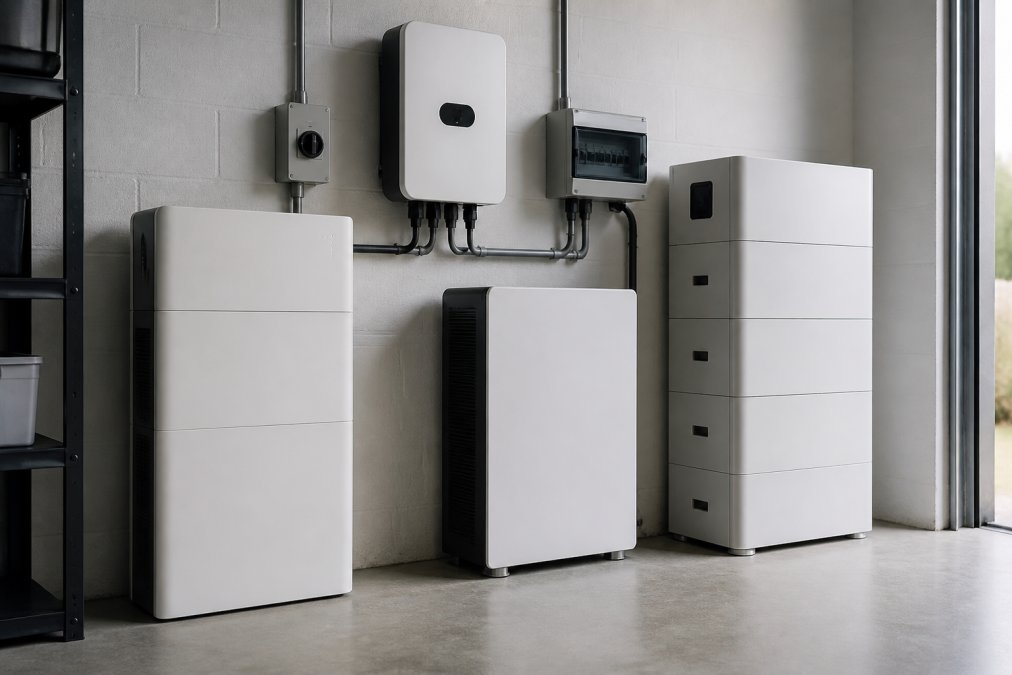
Generac's PWRcell is the pick for anyone who wants to start small and expand. Its modular battery cabinets let you add capacity as your needs grow, whether that is a new EV, a heat pump, or a home extension. solar system designs.
The system is designed for indoor or outdoor installation and managed through the PWRview app, with smart load management prioritising essential circuits during a blackout. Build quality is strong enough for exposed outdoor positions, which matters in rural locations.
Click HERE for your FREE SURVEY today →
The honest drawback is complexity. Modular systems have more components and more commissioning steps than all-in-one units, so installation takes longer and the design work matters more. Get the initial cabinet sizing wrong and expansion becomes awkward.
Is Solar Battery Storage Worth It in 2026?
For most households with a solar array and meaningful evening consumption, yes, but the honest answer is that the financial case rests on three variables, not on the battery brand.
1. Your self-consumption ratio. Every kilowatt-hour you store and use yourself is a unit you are not buying from your supplier at peak rates. A typical household without a battery might self-consume 30-40% of what its panels generate; adding storage can push that towards 70-80%. The gap between those two numbers, multiplied by your import tariff, is the raw annual saving. The mechanism is simple: the battery absorbs surplus midday generation that would otherwise be exported at a low rate and releases it during the evening peak when import prices are highest.
2. Your tariff structure. This is where most guides go quiet. A battery only unlocks its full value on a time-of-use tariff, where the price difference between cheap overnight hours and the 4pm-7pm peak is wide enough to justify cycling the cells. On a flat-rate tariff, the battery is limited to self-consumption savings alone. Before you commit, read the Ofgem guidance on smart tariffs and flexibility and check whether your supplier offers a tariff with a meaningful peak-to-off-peak spread. If the spread is narrow, the payback stretches out considerably.
3. Your evening and overnight demand. A heat pump, an EV charger and a home office running into the evening all raise the value of stored energy. A household that is empty from 9am to 6pm and heats with gas has far less to gain.
The incentive layer most buyers miss
The payback calculation does not stop at tariffs. Depending on where you live, there may be grant funding, rate relief or installer-led schemes that change the arithmetic. The framework for checking is straightforward:
- Start with your local authority. Many councils publish energy efficiency or retrofit grant information, and some administer schemes funded through central government programmes. Eligibility often depends on property type, EPC rating and household circumstances rather than on the battery brand.
- Check whether your installer is accredited. MCS certification is the baseline for any system that may need to demonstrate compliance for a grant, a mortgage lender or an insurer. An unaccredited install can quietly disqualify you from support you would otherwise receive.
- Ask about VAT treatment. Battery storage installed alongside solar PV has historically been treated differently from a standalone battery retrofit. The rules have shifted in recent years, so confirm the current position with your installer rather than relying on a guide written two years ago.
- Look at business rates or landlord schemes if the property is not your sole residence. The incentive landscape for commercial and rental properties is separate and often more generous.
Where battery storage falls short is for households with low evening demand, no solar, or a flat-rate tariff with a narrow peak spread. In those cases the payback period stretches out. The right question is not "is a battery worth it?" but "is a battery worth it for this household, on this tariff, with this consumption profile?" That is a question a survey answers.
Solar Battery Installation Costs: What to Expect
Battery installation costs vary widely, and anyone quoting you a single figure without a survey is guessing. But "it depends" is not a useful answer, so here is the structure behind the number, the components that drive it, the trade-offs between them, and the installation requirements that catch homeowners out.
What you are actually paying for
A battery installation quote is rarely just the battery. It typically bundles:
- The battery unit itself, priced per kilowatt-hour of usable capacity. Cost per kilowatt-hour generally falls as capacity rises, which is why a single larger unit often works out cheaper per unit of storage than two smaller ones.
- The inverter, if a hybrid or new inverter is needed. A hybrid inverter can replace separate solar and battery inverters, sometimes reducing total component count and cost, but only if your existing solar inverter is due for replacement anyway.
- Coupling and wiring. AC-coupled retrofits are usually simpler and cheaper to install than DC-coupled designs, because they work alongside your existing solar inverter rather than replacing it. DC-coupled systems can be more efficient but involve more invasive electrical work.
- Labour and commissioning. Modular systems with multiple cabinets take longer to commission than all-in-one units. Certified-partner requirements on some brands add a step that a general electrician cannot perform.
- Make-good and access. Older properties with limited cable routes, solid walls or a full utility room take longer, and time is the largest variable in most quotes.
Installation requirements and space
Space is the constraint that most guides underplay. A battery needs a position that is dry, ventilated and, depending on the unit, either indoors or rated for outdoor exposure. Some systems are wall-mounted and slim; others are floor-standing cabinets that need a clear footprint and clearance for airflow and servicing.
Three practical checks before you commit:
- Is there a suitable wall or floor position near your consumer unit and inverter, with room for a technician to work?
- Is the location protected from extremes? A garage that freezes in winter or an outbuilding that overheats in summer can affect performance and warranty terms.
- Can the cable route be run without lifting floors or chasing walls? If not, budget for the disruption.
The trade-offs that move the price
| Decision | Cheaper option | More expensive option | What you gain |
|---|---|---|---|
| Coupling | AC-coupled retrofit | DC-coupled redesign | Higher round-trip efficiency, tighter integration |
| Inverter | Keep existing | Add hybrid inverter | Fewer components, better load management |
| Capacity | Smaller single unit | Larger or modular system | More backup, more load shifting |
| Installation | Standard position | Complex access or outdoor-rated | Flexibility where space is tight |
Pricing for Smarter Utility's systems depends on your property, consumption and specification, so we do not publish fixed figures. A free survey gives you an accurate quote and a design that matches what you actually need.
Frequently Asked Questions
What is the best alternative to a Tesla Powerwall for a home in the UK?
The best alternative depends on your priorities. For high-capacity whole-home backup, the FranklinWH aPower 2 offers 15 kWh usable capacity and a 15-year warranty. If you already have Enphase solar, the Enphase IQ Battery integrates seamlessly. For compact spaces, the LG Energy Solution RESU is a strong choice. In the UK, working with an MCS-certified installer like Smarter Utility ensures the system meets local standards and qualifies for grid connection.
How much does solar battery installation cost in the UK?
Solar battery installation costs vary based on battery capacity, inverter compatibility, and whether you are retrofitting or installing alongside new solar panels. Exact figures depend on your specific requirements. Smarter Utility offers a free, no-obligation home survey to provide a tailored quote without hidden fees.
Is solar battery storage worth it in 2026?
For many households, yes. A battery lets you store excess solar energy for evening use, cutting reliance on peak-rate grid electricity. With rising energy prices and the Smart Export Guarantee paying for exported power, a well-sized battery can reduce bills and payback periods have shortened. However, savings depend on your energy usage patterns and tariff. A professional assessment helps determine if it is worth it for your home.
How do I choose the right battery capacity for my home?
Start by reviewing your daily electricity consumption in kilowatt-hours (kWh), ideally from a smart meter. A typical UK home uses 8-10 kWh per day, so a battery with 5-10 kWh usable capacity often suffices. Consider future needs like EV charging or a heat pump. Smarter Utility can size the system accurately during a free survey.
What should I look for when comparing solar battery warranties?
Check the warranty period, typically 10 years, and whether it covers parts, labour, and capacity degradation. Some manufacturers, like FranklinWH, offer 15-year warranties. Also verify the cycle life (e.g., 6,000 cycles) and depth of discharge (DoD). Ensure the warranty is backed by a UK presence for easier claims. Smarter Utility only installs batteries with robust warranties and provides ongoing support.