 How-to
Selecting the Right EV Chargers for Heavy Duty Fleets
Quick Summary
The right EV chargers for heavy duty fleets depend on each vehicle's daily mileage, energy use and dwell time. Size chargers per vehicle using the worst-case route, then match AC or DC power to how long each vehicle sits idle, and check the site's electricity supply before ordering.
- Record worst-case daily mileage and dwell time for each vehicle, not just averages.
- Divide daily energy need by hours the vehicle is plugged in, not hours it is parked.
- Add a 15-20% safety margin for battery ageing, cold weather and HVAC load.
- Use AC for long overnight depot dwell and DC for short turnarounds.
- Check grid capacity early, because the electricity supply is often the biggest limit.
Table of Contents
- Start With Your Vehicles and Duty Cycles
- Working Out EV Charger Power Requirements for Trucks
- Choosing Between AC and DC Charging
- Depot Charging for Electric Vehicles: Site and Electrical Planning
- Managing Charging With Fleet Charging Management Software
- Understanding Electric Fleet Charging Costs
- Planning for Resilience, Uptime and Future Growth
- Booking Your Free Survey to Size Your Fleet Charging Hub
- Frequently Asked Questions
Selecting the Right EV Chargers for Heavy Duty Fleets
Last Updated: November 7, 2026
Choosing EV chargers for heavy duty fleets is harder than picking a car charger. Trucks and buses have large batteries, long shifts and tight schedules, so the wrong charger can leave vehicles unready when they are needed. The International Energy Agency reports that charging access for medium- and heavy-duty vehicles in the United States grew by over 30% to 400 charging points, showing how fast this market is moving IEA Global EV Outlook 2026, electric vehicle charging chapter.
Start With Your Vehicles and Duty Cycles
Your vehicles and how they work set every other decision. Begin by listing each vehicle type, its typical route and the time it sits idle each day.
Daily Mileage, Energy Use and Dwell Time
Three numbers matter most for every vehicle in your fleet:
- Daily mileage: how far each vehicle drives in a normal day
- Energy use: how much electricity each vehicle needs per mile or kilometre
- Dwell time: how long a vehicle stays parked at the depot between shifts
Dwell time is often the most useful figure. A bus parked for eight hours overnight can charge slowly and still be ready. A delivery vehicle with a two-hour turnaround needs much faster charging.
Watch out: plans built on average mileage fail when one route runs longer than expected. Record the worst-case day, not just the average.
Working Out EV Charger Power Requirements for Trucks
Charger power decides how quickly a vehicle recovers its range, and for heavy-duty vehicles the numbers are an order of magnitude above cars. Energy use varies widely by vehicle type, route, load and weather, so use the figures published for your own vehicles. Get the sizing wrong and you either buy chargers that cannot turn a vehicle round in time or pay for capacity the fleet never uses.
A Worked Charger-Sizing Method
Use this method vehicle by vehicle rather than fleet-wide, because the worst-case route sets the requirement:
- Daily energy need: daily mileage multiplied by energy use per mile. A tractor unit doing 180 miles at 2.2 kWh per mile needs about 396 kWh.
- Usable energy per charging window: divide by the hours the vehicle is actually plugged in, not the hours it is parked. A vehicle parked for nine hours but available to charge for seven gives seven hours.
- Average power: 396 kWh ÷ 7 hours ≈ 57 kW. Round up to the next standard charger size.
- Safety margin: add 15-20% for battery ageing, cold weather and HVAC load, giving roughly 68 kW, so specify 80 kW rather than 60 kW.
- Check the battery can accept it: confirm the vehicle's maximum charge rate and state of charge curve. A 400 kWh battery limited to 1C accepts 400 kW at peak but tapers sharply above 80% state of charge, so the last 20% takes disproportionately long.
Watch out: sizing on average mileage leaves vehicles short on the two or three days a month when routes run long, and those are the days that disrupt dispatch.
Matching Charger Power to Dwell Time
Dwell time is the constraint that decides AC versus DC more than any other factor:
- Overnight depot (8-12 hours): 22-50 kW AC or low-power DC per vehicle is usually enough for a 300-500 kWh battery.
- Shift change (2-4 hours): 100-150 kW DC per vehicle.
- Rapid turnaround (under 1 hour): 250-350 kW DC, and only where the vehicle and site can support it.
Multiply the per-vehicle figure by the number of vehicles charging simultaneously, then apply load management. Ten bays at 80 kW is 800 kW of connected load, but a well-managed site might only need 400-500 kW of supply because not every vehicle draws full power at once.
Megawatt Charging and Connector Standards
The Megawatt Charging System (MCS) standard, developed through CharIN with UK input, targets up to 1.2 MW and is aimed at long-haul trucks and coaches that need a meaningful charge within a statutory drivers' break. MCS uses a different connector from CCS2, so specify chargers and vehicles with the connector you intend to standardise on, and check whether a charger is MCS-ready or needs a field upgrade.
Battery Health and Charging Strategy
Charging power affects battery life as well as schedule. Frequent high-power charging, charging to 100% and leaving the battery full in hot weather all accelerate degradation. Charging to a moderate level overnight and reserving fast charging for vehicles that genuinely need it can help limit battery wear.
The worked example below shows how the sizing steps play out in practice.
| Step | What to do | Worked figure |
|---|---|---|
| Daily energy need | Daily mileage × energy use per mile | 180 miles × 2.2 kWh ≈ 396 kWh |
| Usable charging window | Divide by hours plugged in, not parked | 7 hours available |
| Average power | Energy ÷ charging hours, round up | ≈ 57 kW, round to standard size |
| Safety margin | Add 15-20% for ageing and cold | Specify 80 kW rather than 60 kW |
| Battery check | Confirm max charge rate and taper | Taper above 80% state of charge |
Choosing Between AC and DC Charging
AC charging sends alternating current, and the vehicle converts it to battery power. DC charging sends direct current straight to the battery, which allows much higher power.
Most fleets find AC suits long dwell times, such as overnight depot charging, because it is cheaper to install and easier on batteries. The same planning around dwell times and power capacity applies when assessing electrical infrastructure requirements for forklift fleets.
Depot Charging for Electric Vehicles: Site and Electrical Planning
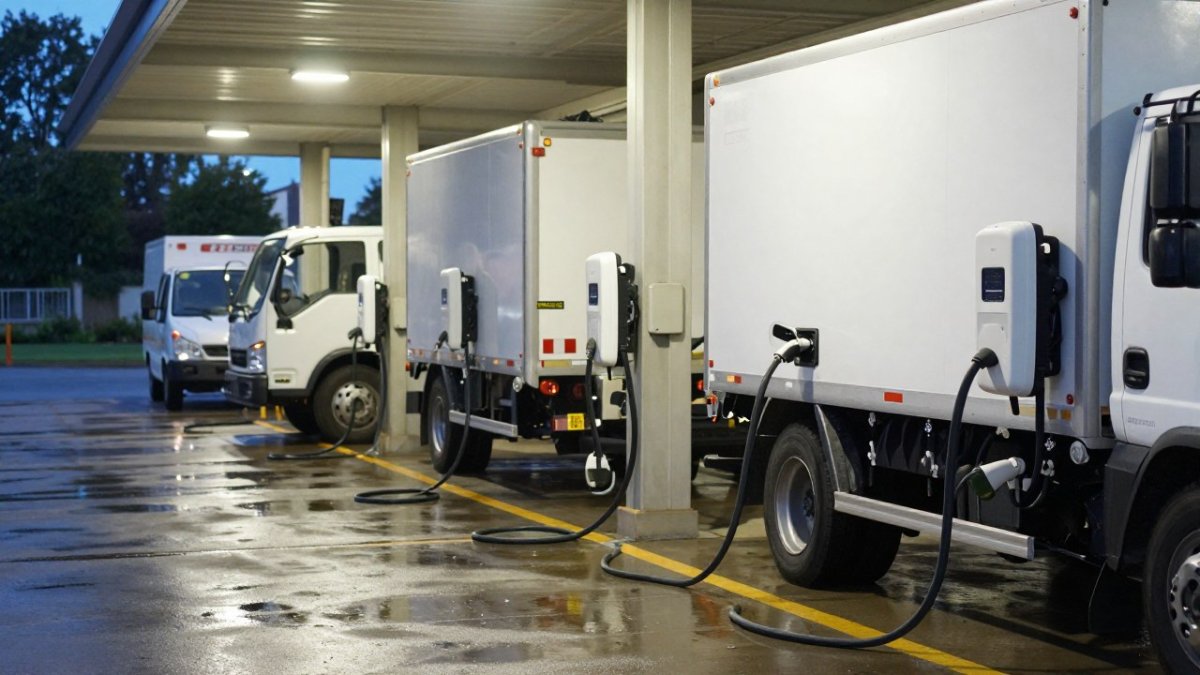
Most heavy fleets charge at a depot, so the site is where the real planning happens.
!Electric delivery trucks parked in a depot yard with charging cables connected to wall-mounted chargers at dusk
Grid Connection, Capacity and Power Upgrades
The biggest limit on a depot is usually the electricity supply, not the chargers. Ten chargers at 50 kW each need 500 kW of capacity, so check the site's existing supply before you order equipment. Grid connection upgrades can take time, so it is worth raising them early. Our guide to planning fleet EV charging infrastructure in Scotland covers the local steps involved.
Managing Charging With Fleet Charging Management Software
Charging software decides when each vehicle charges, how much power it gets and what it costs. Good software helps you avoid peak tariffs and keep total load within your site limit. Our smart charging software for commercial electric fleets guide walks through what to look for in fleet charging management software.
Look for these features:
- Load management that keeps total power within the supply limit
- Scheduling that charges vehicles when electricity is cheapest
- Reporting on energy use per vehicle and per route
- Open protocols so the software works with chargers from different makers
Understanding Electric Fleet Charging Costs
Charging costs have four parts, and fleets that model only the first two usually underestimate the total: the chargers and their installation, the electricity you buy, the network and capacity charges, and ongoing maintenance and software. Compare quotes on the same basis and ask each supplier to show their assumptions, because a headline pence-per-kWh figure rarely reflects what a heavy-duty site actually pays.
Hardware and Installation
Installed cost depends on cable runs, groundworks, transformer upgrades and whether the site needs a new substation. Get a site survey before comparing prices, as pricing depends on the specific site and works required.
Electricity, Tariffs and Demand Charges
Electricity is a major operating cost. Many commercial tariffs combine a unit rate with a standing charge and may include a demand charge based on maximum import. A site that pulls 500 kW for one hour a month can pay a demand charge as if it pulled 500 kW all month.
Time-of-use tariffs reward charging overnight and penalise late-afternoon top-ups. Ask your supplier to model your real load profile, not a generic one.
Grants and Support
Grant schemes change, so check current eligibility with the relevant scheme administrator before you build a business case.
Total Cost of Ownership
Build the business case over the life of the vehicle, not the life of the charger. Include:
- Energy: annual mileage × kWh per mile × your blended tariff, not the headline rate
- Demand charges: modelled on your managed peak, not your connected load
- Hardware and installation: depreciated over 7-10 years
- Maintenance and software: ongoing costs for servicing and any software subscription per charger
- Battery degradation: a mid-life replacement allowance, which can be a five-figure sum per vehicle
- Downtime: the cost of a route not running because a charger failed
Scheduled overnight charging can cost less than daytime top-ups, and demand charges can be a significant controllable cost. Watch out: a business case built on the cheapest unit rate alone can be undone by a demand charge triggered by one unmanaged fast-charge session.
Planning for Resilience, Uptime and Future Growth
A charger that fails on a busy morning can stop a whole route. Plan for this before it happens.
- Install spare capacity so one failed charger does not stop the fleet
- Choose equipment with a clear service and warranty plan
- Leave room on site for more chargers as the fleet grows
- Review your charging plan each year as vehicles and routes change
Booking Your Free Survey to Size Your Fleet Charging Hub
Every fleet is different, and the right charger mix depends on your vehicles, routes, site and supply. Smarter Utility offers a free, no-obligation survey to size your charging hub properly. Our team will assess your site and recommend a charging plan that fits. You can book a commercial EV charger installation for businesses to start that conversation. If you run a manufacturing or contract fleet, our EV chargers for manufacturers service covers the specific demands of that work.
Frequently Asked Questions
How do you choose EV chargers for a heavy-duty fleet?
Start by recording each vehicle's daily mileage, energy use per kilometre and the hours it sits idle at base each day. Those figures set the energy each vehicle needs overnight. Match that energy to the charger power that can deliver it within the dwell time, then check whether your site's electrical supply can support the total load. Install a mix of charger types where routes differ, and confirm that the chargers are compatible with your vehicles' connectors before ordering. Smarter Utility offers free, no-obligation surveys to help fleet managers in Scotland work through these figures. Current pricing depends on quantity, site works and delivery, so request a quote for your specific fleet.
What charging power do electric trucks need?
Charging power depends on battery size, how quickly the vehicle must be turned around and how long it is parked. Overnight depot charging often works well at lower power levels spread across many hours, while daytime top-ups on a tight schedule need higher power. Divide the energy a truck needs by the hours available to get a minimum average power per vehicle, then add headroom for delays and battery ageing. Vehicle manufacturers publish maximum accepted charging rates, and the charger cannot push more than the vehicle will take, so check both specifications before choosing.
What is the difference between AC and DC charging for fleet vehicles?
AC charging sends alternating current to the vehicle, which converts it to direct current onboard. It is generally lower in power, lower in installation cost and well suited to long overnight dwell times at a depot. DC charging converts the current in the charger and delivers it straight to the battery, allowing much higher power for fast turnarounds. Most fleets use AC for the bulk of nightly charging and reserve DC for vehicles that need rapid top-ups during the working day. Your choice should follow the duty cycle of each vehicle rather than a single standard for the whole fleet.