 How-to
Is Solar Thermal Worth It With an Air Source Heat Pump?
Last Updated: November 22, 2026
Quick Summary
Integrating solar thermal with an air source heat pump works by using roof-mounted solar collectors to pre-heat water before it reaches the heat pump's hot water cylinder, so the heat pump starts from a warmer base and runs less often. The controls prioritise solar heat first, and the heat pump only fires when stored solar heat runs out.
- A twin-coil cylinder is required, with one coil for the solar collector loop and one for the heat pump.
- Size the solar coil for roughly 0.4-0.6 kW per square metre of collector aperture area.
- Allow 40-60 litres of store volume per square metre of collector aperture, with a minimum of around 150 litres.
- Schedule legionella cycles for early morning or late evening when solar gain is low, so the heat pump does the work.
- Solar thermal is more efficient at converting daylight into usable heat, but its output is limited to hot water.
Table of Contents
- How does integrating solar thermal with air source heat pumps work?
- Solar-assisted heat pump: how the two heat sources share the load
- Solar thermal hot water cylinder compatibility and sizing
- Solar PV vs solar thermal with a heat pump: which earns its roof space?
- Solar thermal retrofit with an air source heat pump: step-by-step checks
- Control strategy, running costs and realistic savings
- Book a free survey before you commit to a hybrid design
- Frequently Asked Questions
How does integrating solar thermal with air source heat pumps work?
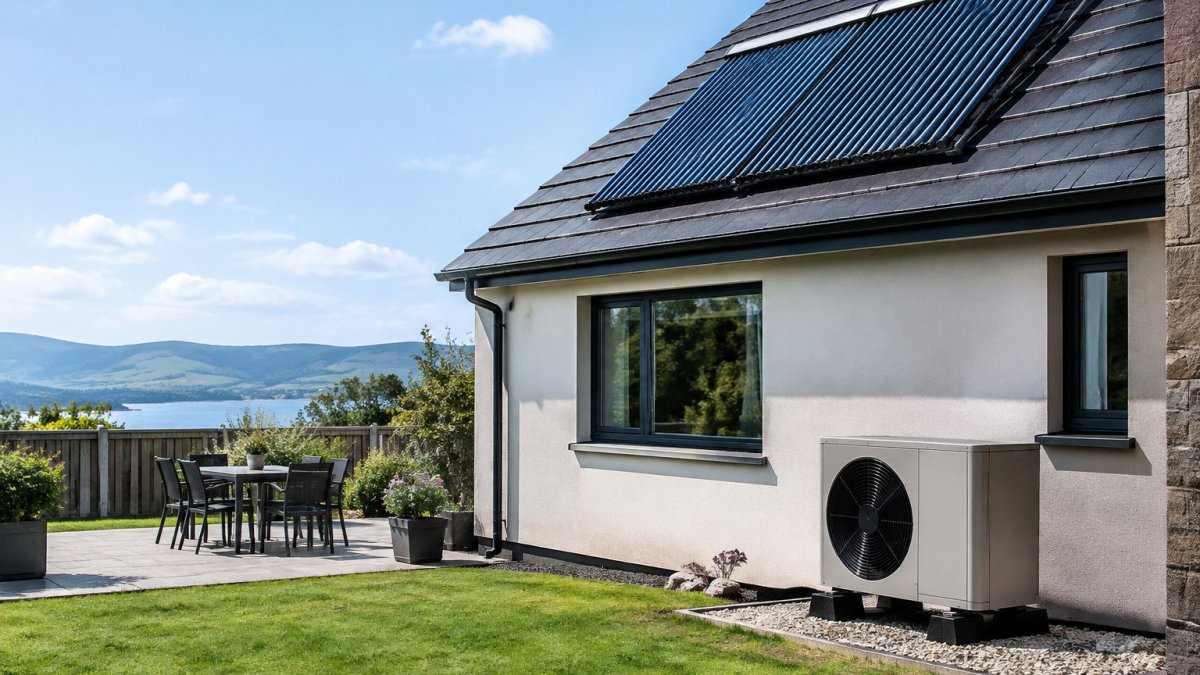
Integrating solar thermal with air source heat pumps works by using roof-mounted solar collectors to pre-heat water before it reaches the heat pump's hot water cylinder, so the heat pump starts from a warmer base and runs less often. These hybrid systems are designed for homes and businesses that want lower running costs from two renewable sources feeding one heating and hot water system.
The idea is simple. Solar thermal panels absorb heat from daylight and transfer it to a fluid in a sealed collector loop. That heat goes into a thermal store, and the heat pump tops up whatever the panels cannot supply. On dull days, the heat pump carries the full load on its own.
The two technologies complement each other well. A review of coupled solar and air source heat pump systems notes that pairing the two can address the intermittency of solar energy, because the heat pump keeps working when the sun does not.
What you get is a low-carbon heating system with two heat sources sharing the work across the year.
Solar-assisted heat pump: how the two heat sources share the load
A solar-assisted heat pump is a system where solar thermal collectors and an air source heat pump both feed the same heating and hot water demand, with controls deciding which source runs first.
The sharing logic matters more than the hardware. In practice, the controls follow a priority order:
- Solar thermal runs first whenever the collector loop is hotter than the store
- The heat pump only fires when stored solar heat runs out
- Backup heating covers the coldest peaks
Hydraulic design: collector loop, buffer tank and heat pump connection
The practical design has four parts, and the flow path through them is what makes or breaks the system:
- Collector loop. A sealed, glycol-filled loop runs from the roof panels to a solar pump station. The station contains the circulation pump, a flow meter, a pressure gauge, an expansion vessel, a pressure-relief valve and a non-return valve. A differential-temperature controller switches the pump on when the collector sensor is hotter than the store sensor by a set margin (commonly 6-10 °C) and off when the margin collapses.
- Solar heat exchanger or coil. The collector loop transfers heat to the cylinder or thermal store through a coil or a plate heat exchanger. A plate heat exchanger gives a tighter temperature approach and suits a buffer tank; an immersed coil is simpler and common on twin-coil cylinders.
- Thermal store or buffer tank. The store holds solar heat and stratifies, with hot water at the top and cooler water at the bottom. Stratification is what lets the heat pump draw from the coolest part of the store and condense at a lower temperature, which improves its efficiency.
- Heat pump connection. The heat pump connects to the store through its own coil or a plate heat exchanger, or directly to the heating circuit via a three-port valve. A diverter valve decides whether heat-pump output goes to the cylinder or to space heating.
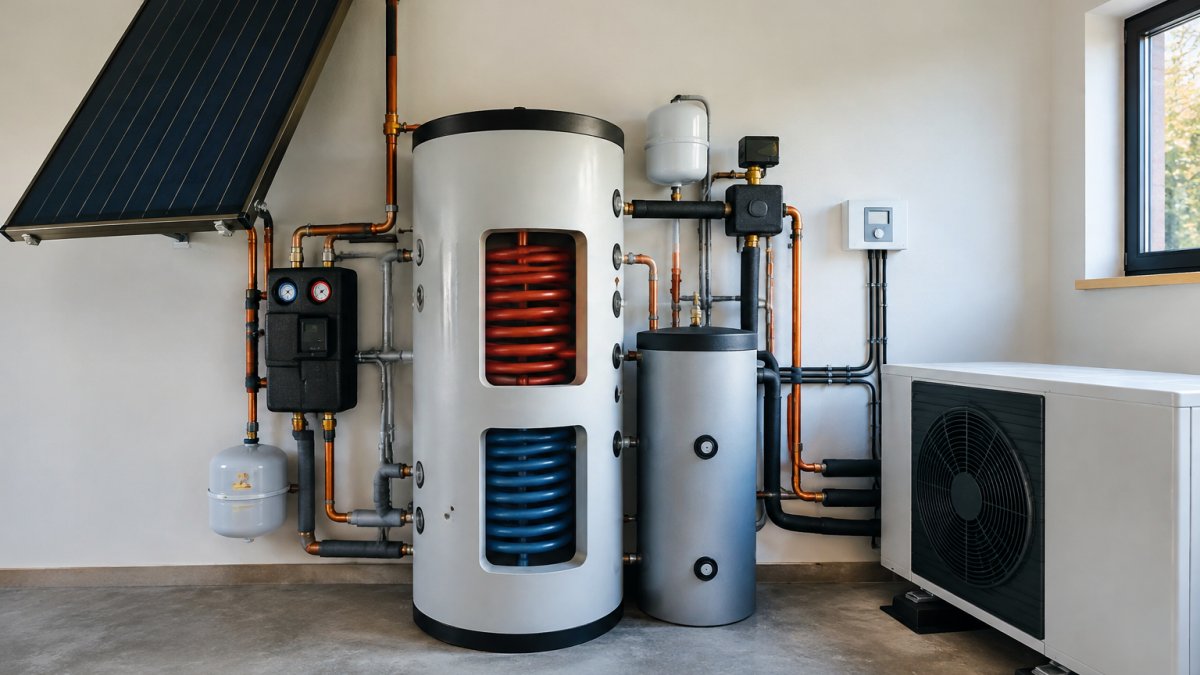
A workable arrangement for a twin-coil cylinder is: solar collector loop → solar pump station → lower solar coil; heat pump → upper heat-pump coil; cylinder → hot-water outlet via a thermostatic mixing valve.
Controls and sensors
A typical control set is:
- Collector temperature sensor on the panel flow
- Store temperature sensors at top and bottom
- A heat-pump enable signal from the store thermostat
- A frost/defrost sensor on the heat pump outdoor unit
- A legionella schedule in the cylinder thermostat or a separate timer
The controller should hold the heat pump off while the store is above its set point, and bring it on only when the top sensor falls below the set point minus a hysteresis band.
Watch out: if the solar coil is plumbed into the top of the cylinder instead of the bottom, solar heat will satisfy the heat-pump thermostat and the heat pump will never run, leaving the household short of hot water on dull days.
Defrost and legionella interaction
An air source heat pump periodically reverses to defrost its outdoor coil, drawing heat from the system water. If the store is small and solar has already cooled it, defrost can pull the store temperature down and trigger unnecessary backup heating.
Solar thermal hot water cylinder compatibility and sizing
Cylinder compatibility is the first thing to check, because a standard single-coil cylinder cannot take both heat sources. You need a twin-coil cylinder, with one coil for the solar collector loop and one for the heat pump.
Coil heat-transfer capacity
The solar coil is usually the limiting component. A coil that is too small cannot transfer the collector's output at a useful temperature, so the collector loop runs hot and the panels stagnate.
The heat-pump coil is sized differently: it must pass the heat pump's full output at the flow temperature the heat pump will run at.
Store volume
Sizing follows the household, not the roof. A larger cylinder stores more solar heat for evening use, but an oversized store loses heat and wastes space. Undersized, and the solar contribution shrinks to almost nothing.
A practical starting point is 40-60 litres of store volume per square metre of collector aperture, with a minimum of around 150 litres for a small solar thermal system.
Temperature limits and stratification
Cylinder thermostats and controls should keep the store below the solar system's stagnation temperature where possible, and the collector loop must have a pressure-relief valve and an expansion vessel sized for stagnation.
When a buffer tank is appropriate
Watch out: fitting solar collectors to a cylinder that is too small to absorb the heat is the most common retrofit error we see.
Solar PV vs solar thermal with a heat pump: which earns its roof space?
Solar PV usually earns the roof space ahead of solar thermal when a heat pump is planned, because PV generates electricity that can run the heat pump, the lights and an EV charger, while solar thermal only makes heat. Solar thermal is more efficient at converting daylight into usable heat, but its output is limited to hot water.
The comparison comes down to what you want from the roof:
| Factor | Solar thermal | Solar PV |
|---|---|---|
| Output | Heat for hot water | Electricity for everything |
| Best match | High hot water use | Heat pump plus EV charging |
| Storage | Hot water cylinder | Battery or grid export |
| Flexibility | Limited to heating | Runs any appliance |
For most homes with a heat pump, PV plus a battery is the stronger all-round choice. Solar thermal wins where hot water demand is high and roof space is generous.
If you want the practical how-to for pairing panels with a heat pump, our guide on integrating solar panels with heat pumps walks through the design choices.
Solar thermal retrofit with an air source heat pump: step-by-step checks
A solar thermal retrofit with an air source heat pump is feasible on most existing systems, but it needs checks before anyone drills into the roof. Work through these in order:
- Confirm the cylinder is twin-coil or can be replaced
- Check roof orientation, pitch and shading for the collectors
- Verify the heat pump has capacity to top up the store
- Review pipe routes between roof, cylinder and plant room
- Confirm the controls can prioritise solar over the heat pump
- Check structural loading and weatherproofing at the roof fixings
The order matters. Cylinder and controls usually decide whether the project stacks up, long before panel choice comes into it.
If a heat pump is coming later, design the solar side now so it is ready. Our article on solar system design for future heat pumps covers how to plan for that upgrade.
Control strategy, running costs and realistic savings
Control strategy decides how much you actually save. The controller should prioritise solar heat, hold the heat pump back until the store drops below a set temperature, and use weather compensation to match flow temperature to outdoor conditions. Poorly set controls can wipe out the benefit of the panels entirely.
Running costs depend on how much of the hot water load solar covers across the year. Summer coverage is high; winter coverage is modest. Realistic savings come from the shoulder months, not from deep winter.
Grant funding can offset installation costs. Our guide on how to apply for Home Energy Scotland grant funding explains the current process and eligibility.
Book a free survey before you commit to a hybrid design
A hybrid design should be measured, not guessed. Before committing, book a free survey so an accredited installer can check your cylinder, roof, heat pump and controls together. Smarter Utility is a fully accredited and approved MCS solar and battery storage installer, and offers a free, no-obligation home survey with a tailored system design.
A free, no-obligation home survey helps you make an educated decision about solar energy. You can book your free home energy survey today.
Two renewable heat sources can work well together, but only when the cylinder, controls and hydraulics are designed as one system. Smarter Utility designs and installs solar PV, battery storage and EV charging across Scotland, backed by MCS accreditation and a free home survey. Get started with Smarter Utility and book your free survey to find out whether a hybrid system suits your property.
Frequently Asked Questions
Can solar thermal be integrated with an air source heat pump?
Yes, but the two technologies must be designed as one system rather than bolted together. The solar collector loop feeds a twin-coil or thermal-store cylinder, and the heat pump tops up the remaining demand through its own coil or a buffer tank. Correct sizing and control priority decide whether the combination performs well.
What type of hot water cylinder is needed for solar thermal and a heat pump?
You need a cylinder with two independent heat exchanger coils: a lower coil sized for the solar collector loop and an upper coil for the heat pump. Solar thermal hot water cylinder compatibility depends on coil surface area, cylinder volume and stratification, so a standard single-coil cylinder rarely works well. For a typical home, plan the solar coil for the collector array's output and keep the heat-pump coil sized to the unit's output. A thermal store or buffer tank can separate the two sources where a twin-coil cylinder will not fit.
Can solar thermal reduce an air source heat pump's running costs?
It can, when the solar loop preheats domestic hot water or lifts the return temperature before the heat pump sees it. The saving comes from hours when the compressor does not run, not from a fixed percentage. Performance can fall when solar thermal is added without matching the controls to the heat pump, so the control strategy matters as much as the collector area. Realistic savings depend on your hot water use, roof orientation and cylinder size, which is why a survey should come before any quote.
What should I check before a solar thermal retrofit with an air source heat pump?
Check four things first: roof space and orientation for the collectors, cylinder location and whether a twin-coil or thermal store will fit, the existing heat distribution (radiators or underfloor) and its flow temperature, and the control system's ability to prioritise solar before the heat pump. Combining the two addresses solar intermittency, but only if the hydraulic design and controls are right. Book a free, no-obligation home survey before committing to any design.