 comparison
SmartHomeCharge Alternative for Scottish Households
Table of Contents
- Why Scottish Households Need a Different Approach to Home EV Charger Installation
- Home Energy Scotland Grants: What EV Charger Funding Is Available
- Home EV Charger Installation Cost: What to Budget in Scotland
- Comparing Home EV Charger Options: Ohme, Zappi, Hypervolt and Project EV
- Solar PV and EV Charger Integration: Maximising Self-Generated Energy
- Why a Local Accredited Installer Matters More Than a National Platform
- Which Home EV Charger Option Is Right for Your Household?
- Conclusion
Last Updated: August 17, 2026
Why Scottish Households Need a Different Approach to Home EV Charger Installation
Finding a genuine smarthomecharge alternative for Scottish households is harder than it looks. National platforms work well in terraced Manchester streets but struggle when your property sits at the end of a single-track road in Perthshire, your grid connection runs through ageing Distribution Network Operator infrastructure, or your roof already generates solar power you want to integrate.
At Smarter Utility, we work with Scottish homeowners daily and consistently hear the same frustration: the gap between what generic national installers offer and what properties here actually need is substantial. The geography is different. The funding landscape is different. And the opportunity to integrate EV charging with solar PV and battery storage is significantly greater.
This guide covers available grants, realistic costs, the best charger hardware for different household types, and why the installer relationship matters as much as the hardware itself.
Home Energy Scotland Grants: What EV Charger Funding Is Available
Grant funding for home EV charger installation is available through the Scottish Government with terms meaningfully better than elsewhere in the UK. The primary route is through Home Energy Scotland, the Scottish Government's official advice and funding service, which administers interest-free loans and cashback offers for low-carbon technology.
The UK Government's Electric Vehicle Homecharge Scheme, administered by the Office for Zero Emission Vehicles, provides grant funding toward installation costs for eligible applicants. Scottish residents may also access additional support through devolved programmes unavailable to households further south.
Eligibility Criteria and How to Apply
Eligibility generally requires that you own the property or have landlord permission to install a charge point, have off-street parking, and that the charger meets technical standards set by the Office for Zero Emission Vehicles. Chargers must be smart-capable, able to communicate with the grid and respond to demand signals.
The application process typically runs through an approved installer who submits the claim on your behalf. Choosing an accredited installer is not just quality assurance, it is a prerequisite for accessing grant funding. Installers not registered under the relevant scheme cannot submit claims.
Remote and Island Properties: Additional Considerations
Island and remote rural properties face logistics that national platforms rarely address honestly. Lead times for equipment delivery are longer. Scaffolding or specialist access equipment may be needed. DNO notification can take weeks rather than days when the local network is under strain.
Some island properties rely on community energy schemes or off-grid systems entirely. EV charger installation must be designed around local generation capacity rather than assumed grid availability. This requires an installer who understands your specific connection constraints, not a call centre booking system.
Home EV Charger Installation Cost: What to Budget in Scotland
Home EV charger installation cost varies more in Scotland than most online calculators suggest. A standard 7.4kW AC charge point in a straightforward property typically costs less than one requiring longer cable runs, consumer unit upgrades, or additional earthing. Contact a local accredited installer for a property-specific quote rather than relying on national averages.
Budget for unit price, installation labour, any required electrical upgrades, and protective devices your property requires. Some chargers eliminate the need for a separate earth rod through built-in protection technology, reducing both cost and installation complexity.
Grid Capacity, DNO Notification and What It Means for Your Quote
DNO notification is the process of informing your Distribution Network Operator that you are adding a significant new electrical load. For most 7.4kW single-phase chargers, this is a notification rather than an application requiring approval.
However, if your property is in an area where the local network is already stressed, or if you are installing a higher-powered three-phase charger, the DNO may require formal assessment. This can add time and cost. According to Ofgem's guidance on network connections for low-carbon technology, DNOs must facilitate connections for low-carbon technologies, but timelines vary by operator and local conditions.
A good local installer will check your DNO's capacity map before quoting, rather than discovering constraints on installation day.
Comparing Home EV Charger Options: Ohme, Zappi, Hypervolt and Project EV
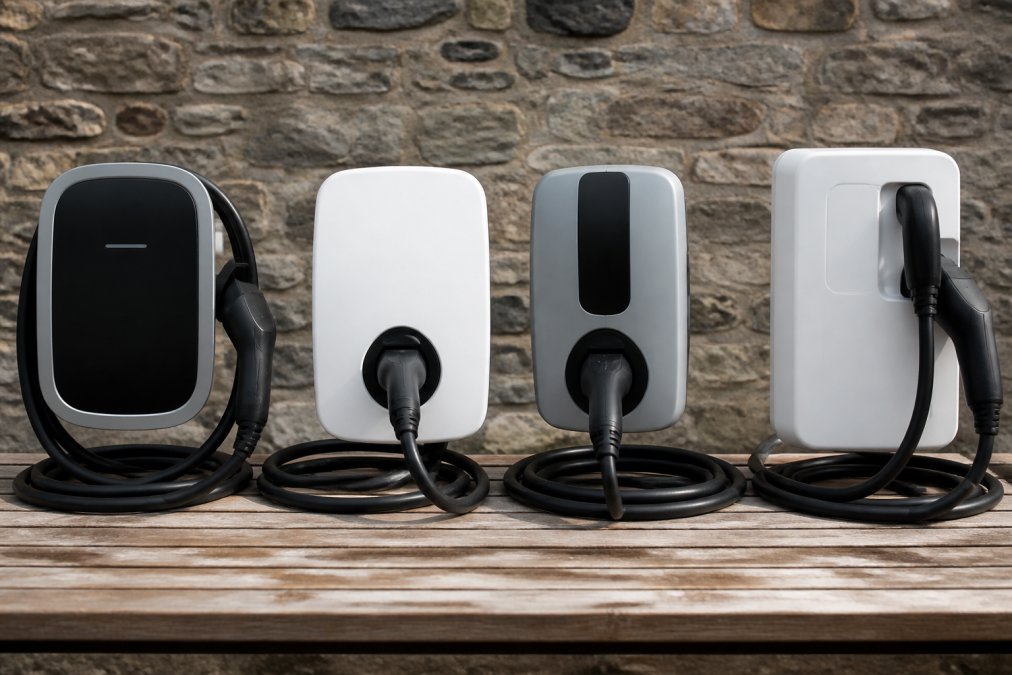
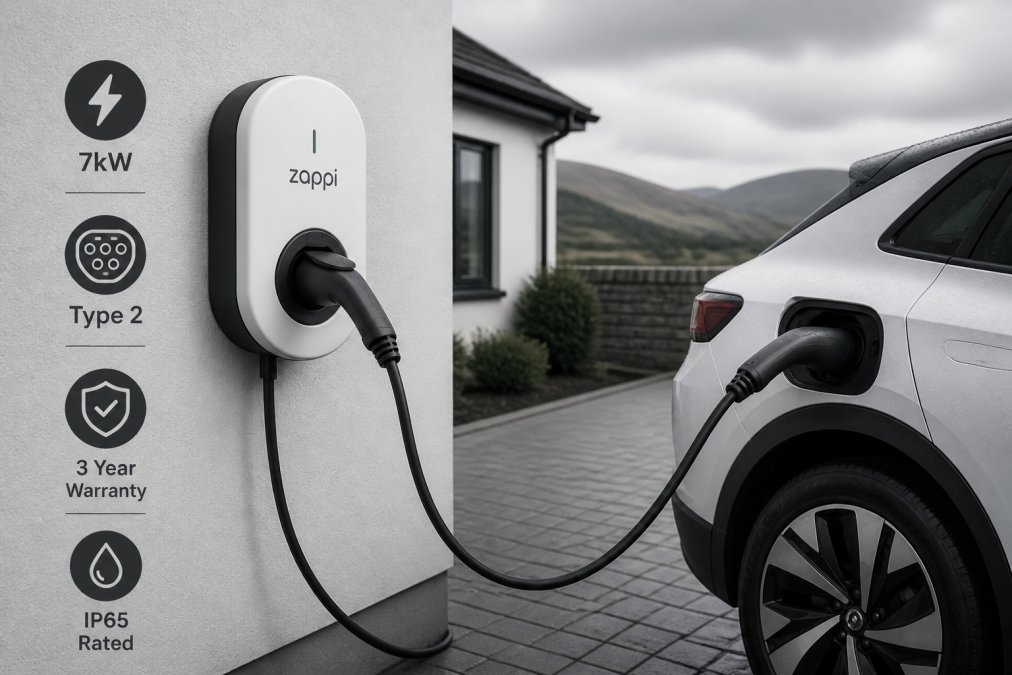
The four chargers below represent the most relevant hardware options for Scottish households in 2026. Each suits a different household profile.
| Charger | Best For | Key Feature | Tethered Option |
|---|---|---|---|
| Ohme Home Pro | Tariff-integrated charging | Built-in 4G, LCD screen | Yes (5m or 8m) |
| Myenergi Zappi | Renewable energy households | Solar/wind PV integration | Yes/No (both) |
| Hypervolt Home 2.0 | Smart home integration | Alexa control, dynamic load balancing | Yes |
| Project EV Pro Earth | Simplified installation | No earth spike required | Available on select models |
Ohme Home Pro: Best for Tariff Integration
The Ohme Home Pro is the strongest choice for households on EV-specific electricity tariffs. Its built-in 4G SIM maintains reliable grid connection without depending on home Wi-Fi, which matters in rural properties with inconsistent broadband. The on-device colour LCD screen lets you check charging status without opening an app.
Tariff integration is its defining capability. It automatically schedules charging during the cheapest or greenest periods, allowing households on time-of-use tariffs to reduce per-kilowatt-hour charging costs without manual management.
The main limitation: 4G connectivity is free for three years, after which a subscription applies.
Myenergi Zappi: Best for Renewable Energy Households
The Zappi is the charger most Scottish households with solar PV choose. It is designed to prioritise self-generated energy. Its three charging modes, ECO, ECO+, and FAST, let you dial in how aggressively you draw from panels versus the grid.
In ECO+ mode, the Zappi holds back grid import until there is sufficient panel surplus, then charges at whatever rate the surplus allows. This maximises self-consumption of renewable energy and reduces grid reliance for EV charging. It is available in 7kW single-phase and 22kW three-phase configurations.
To build a fully integrated home energy ecosystem, you may want additional Myenergi products such as the Eddi power diverter or Libbi battery storage, which add value but also cost and complexity.
Hypervolt Home 2.0: Best for Smart Home Integration
The Hypervolt Home 2.0 stands out on build quality and smart home integration. Alexa voice control is built in, dynamic load balancing prevents overloading your consumer unit during high household demand, and software updates are delivered over-the-air at no charge.
Solar charging compatibility is included as standard without additional hardware. The unit is available with 5m, 7.5m, or 10m tethered Type 2 cables for flexible parking positions.
Click HERE for your FREE SURVEY today →
The main dependency is a stable Wi-Fi connection for full smart functionality.
Project EV Pro Earth: Best for Simplified Installation
Project EV's Pro Earth technology eliminates the need for a separate earth spike during installation, reducing both time and cost for properties with concrete driveways, solid rock substrates, or limited external access.
The unit is compatible with solar panel systems and includes dynamic load balancing and app-based control for off-peak charging scheduling. RFID models include cable locks for untethered cables, adding security for shared parking.
Confirm the specific capabilities of your quoted unit before committing, as not all advanced features are available across every model.
Solar PV and EV Charger Integration: Maximising Self-Generated Energy
Pairing solar PV with an EV charger is one of the highest-return combinations available to Scottish homeowners. Electricity generated on your roof costs a fraction of grid electricity, and an EV is a large, predictable load that can absorb surplus generation during daylight hours.
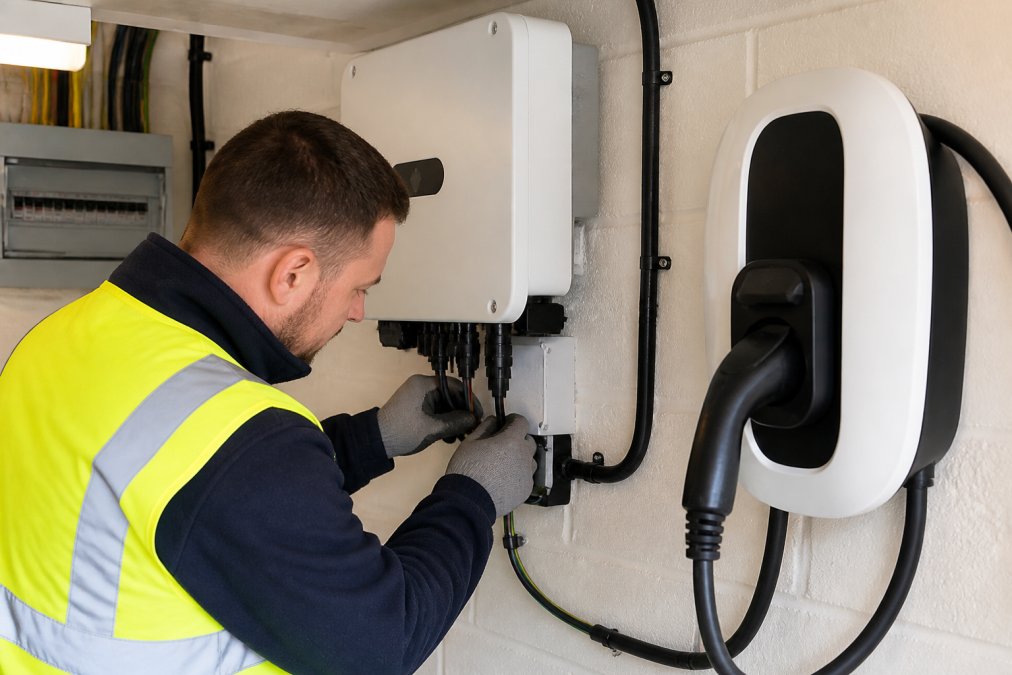
The key is hardware compatibility. Not every EV charger communicates with solar inverters or energy management systems. The Zappi and Hypervolt handle this natively. The Ohme Home Pro and Project EV Pro Earth offer solar compatibility, though integration levels vary. Before selecting a charger, confirm with your installer that it is compatible with your inverter's communication protocol.
According to the Energy Saving Trust's guidance on home EV charging and solar integration, households combining solar PV with smart EV charging substantially reduce grid-drawn charging, particularly during summer months.
Off-Peak Tariff Integration for Non-Utility Customers
Many Scottish households are on standard variable or fixed-rate contracts without dedicated EV overnight rates. For these households, smart charging still delivers value through a different mechanism.
Rather than automatically scheduling to a cheap overnight window, you configure the charger's app to charge during your tariff's cheapest hours or when solar generation is highest. The Ohme Home Pro, Hypervolt, and Project EV all support manual schedule configuration. The Zappi responds dynamically to real-time solar output rather than fixed schedules, which is more effective for households with on-site generation.
If considering a tariff switch to maximise EV charging savings, the Ofgem consumer guide to switching energy tariffs provides a clear overview of your rights and switching process.
Why a Local Accredited Installer Matters More Than a National Platform
The biggest practical difference between a national booking platform and a local accredited installer is not price. It is accountability and context.
A national platform coordinates installation through subcontractors who may have no familiarity with your local DNO's requirements or incentive to flag potential complications. A local accredited installer carries ongoing responsibility for their work, knows which DNOs are processing notifications quickly, understands earthing requirements for older Scottish properties, and can advise on consumer unit upgrades before installation day.
For grant applications, working with an accredited installer is mandatory. The Office for Zero Emission Vehicles requires that installations are carried out by approved contractors for grant funding to be released.
Which Home EV Charger Option Is Right for Your Household?
The right smarthomecharge alternative depends on three variables: your existing energy setup, parking situation, and charging plans.
| Household Type | Recommended Charger | Key Reason |
|---|---|---|
| Solar PV household | Myenergi Zappi | Best self-consumption integration |
| Time-of-use tariff user | Ohme Home Pro | Automatic tariff-based scheduling |
| Smart home / Alexa user | Hypervolt Home 2.0 | Native voice control, load balancing |
| Difficult installation site | Project EV Pro Earth | No earth spike required |
| Any of the above | Smarter Utility survey first | Tailored recommendation for your property |
No single charger is universally best. The Zappi wins for renewable energy households. The Ohme wins for tariff optimisation. The Hypervolt wins on smart home integration. The Project EV wins where installation complexity is the primary constraint.
What all four share is the need for correct specification and installation to deliver full capability. Hardware choice and installation quality are inseparable.
The smarthomecharge alternative for Scottish households that consistently delivers is not a single product, but the combination of the right hardware, the right installer, and clear understanding of your property's specific constraints and opportunities. For households planning to add solar PV, battery storage, or both alongside an EV charger, system design becomes more complex and the value of getting it right increases proportionally.
The challenge most Scottish households face is not a shortage of EV charger options, but finding an installer who understands the full picture: grant eligibility, DNO constraints, solar integration, and property-specific logistics. Smarter Utility is Scotland's leading installer of solar PV, battery storage, and EV charging solutions. As a fully accredited MCS-approved installer, we handle grant applications, system design, and installation as a single coordinated service. Our free, no-obligation home survey gives you a clear, tailored recommendation before you commit to anything. Get started with Smarter Utility and power your home and vehicle on your own terms.
Frequently Asked Questions
Are there specific grants for EV chargers available to Scottish households?
Home Energy Scotland, funded by the Scottish Government and administered by the Energy Saving Trust, offers interest-free loans and cashback for energy-efficiency measures including EV charging infrastructure. Eligibility depends on property type, ownership status, and whether the installation forms part of a broader renewable energy upgrade. Contacting Home Energy Scotland directly or speaking to an accredited local installer is the fastest way to confirm what funding you qualify for before committing to any purchase.
How does solar PV integration affect my choice of EV charger?
Solar PV and EV charger integration changes the hardware you need. Chargers such as the Myenergi Zappi have dedicated ECO and ECO+ modes that read your solar generation data in real time and prioritise charging with surplus electricity rather than drawing from the grid. Standard smart chargers without this feature will default to grid power even when your panels are generating. If you have solar panels or plan to install them, choosing a charger with built-in solar compatibility avoids a costly hardware swap later.
What should I look for in a home EV charger installation quote?
A thorough quote should itemise the charger unit, labour, any cabling runs, consumer unit work, and DNO notification fees if required. Ask whether the installer is OZEV-approved, holds the relevant NICEIC or NAPIT registration, and can confirm compliance with BS 7671 wiring regulations. Quotes that bundle everything into a single figure without breakdown make it difficult to compare fairly. Also check whether the price includes commissioning, app setup, and a post-installation test certificate.
Do I need a smart charger for my electric vehicle?
Since June 2022, all new home charge points sold in Great Britain must meet the Office for Zero Emission Vehicles smart charging regulations. This means any charger installed today must include off-peak scheduling, load balancing capability, and data reporting as standard. A smart charger is therefore not optional for new installations. The practical benefit is that smart features, including app-controlled charging and tariff integration, also reduce your home EV charger installation cost over time through lower overnight electricity rates.
Why choose a local installer over a national online provider?
National online platforms typically act as brokers, passing your job to a subcontractor whose familiarity with local grid constraints, DNO requirements, and rural access challenges varies widely. A local accredited installer surveys your property directly, assesses your consumer unit, checks grid capacity, and handles DNO notification as part of the process. For properties on islands or in areas with constrained grid infrastructure, this local knowledge directly affects whether the installation goes smoothly or faces delays.
This article was written using GrandRanker