 ultimate-guide
Commercial Solar Installation Costs in 2026
Table of Contents
- Commercial Solar Installation Costs: What Affects Your Quote
- System Sizing and Output: Calculating Your kWp Requirements
- Commercial Solar Panel Grants and Financial Support
- Business Solar Panel ROI Calculator: Payback Periods and Returns
- Commercial Solar Battery Storage Benefits and Integration
- Installation Timeline, Grid Connection, and Planning Requirements
- Long-Term Maintenance Costs and System Performance
- Conclusion
Last Updated: August 22, 2026
Commercial Solar Installation Costs: What Affects Your Quote
Understanding the true cost of commercial solar installation requires looking beyond headline figures. At Smarter Utility, we've helped businesses across the region navigate this decision, and what we've learned is that price depends on far more than panel count or system size.

Commercial solar installation costs typically reflect six major variables: your system's kilowatt-peak (kWp) capacity, roof condition and structural integrity, grid connection complexity, equipment quality, installation labour, and your location within the region. A small business with a straightforward roof might see one quote; a facility with structural complications or remote grid access will see another entirely.
The real opportunity lies in understanding which factors you can control. Your roof's structural assessment determines whether reinforcement is needed before installation. Your energy consumption profile shapes the system size that makes financial sense. Your distance from the nearest DNO (Distribution Network Operator) connection point affects grid application costs. These aren't hidden fees, they're legitimate variables that separate a realistic quote from an unrealistic one.
System Sizing and Output: Calculating Your kWp Requirements
The kilowatt-peak rating of your commercial solar system is the single most important number in your quote. This measure reflects the maximum power output under ideal conditions, and it directly determines both your installation cost and your energy yield.
Sizing your system correctly requires three inputs: your annual energy consumption in kilowatt-hours, your available roof or ground-mount space measured in square metres, and your energy goals, whether you're aiming for partial offset or near-complete energy independence.
A typical commercial rooftop array produces between 150-200 watts per square metre of installed PV system (peer-reviewed research). This means a 50 kWp system requires roughly 250-330 square metres of usable roof space. Ground-mounted systems offer more flexibility but require planning permission and structural assessment of the installation site. Carport PV installations, increasingly popular for businesses with parking facilities, combine functionality with energy generation, though they carry their own structural and electrical complexity.
Most businesses find that a system sized to cover 60-80% of annual energy consumption offers the best financial return. Oversizing beyond this point extends payback periods unnecessarily. Undersizing leaves money on the table by missing revenue from export tariffs and grid support payments. The sweet spot depends on your specific energy consumption profile, peak load timing, seasonal variation, and whether you operate year-round or seasonally.
Commercial Solar Panel Grants and Financial Support
The financial support landscape for commercial solar has shifted significantly. Direct grants for business installations are limited compared to residential schemes, but several pathways remain available for qualifying businesses.
The main opportunity lies in Capital Allowances under the UK tax system. Businesses can claim 100% first-year allowance on solar PV equipment, reducing corporation tax liability in the year of installation (gov.uk). For a 50 kWp system costing £40,000-60,000 (equipment and installation), this translates to meaningful tax savings depending on your profit level and tax rate. This isn't a grant, it's accelerated depreciation, but it reduces your effective installation cost substantially.
The Smart Export Guarantee (SEG) creates ongoing revenue rather than upfront support. Businesses exporting excess power to the grid receive payments from their energy supplier, typically 5-15p per kilowatt-hour depending on the supplier and contract terms (ofgem.gov.uk). Over a 25-year system lifespan, SEG payments can represent 15-25% of total financial return. The scheme is voluntary for suppliers but widely adopted, making it a reliable income stream.
Some businesses qualify for enhanced support through rural development schemes or agricultural business support if they operate in qualifying areas. These are administered regionally and eligibility is strict. Checking with your local authority or a specialist consultant is worthwhile if you operate a farming or land-based business.
The real financial lever, however, is return on investment calculation. Unlike residential installations driven by energy bill savings, commercial solar returns depend on your specific tariff, consumption pattern, and whether you can utilise Capital Allowances. A business paying 30p per kilowatt-hour sees faster payback than one paying 18p. A business with stable year-round consumption sees better returns than one with seasonal peaks.
Business Solar Panel ROI Calculator: Payback Periods and Returns
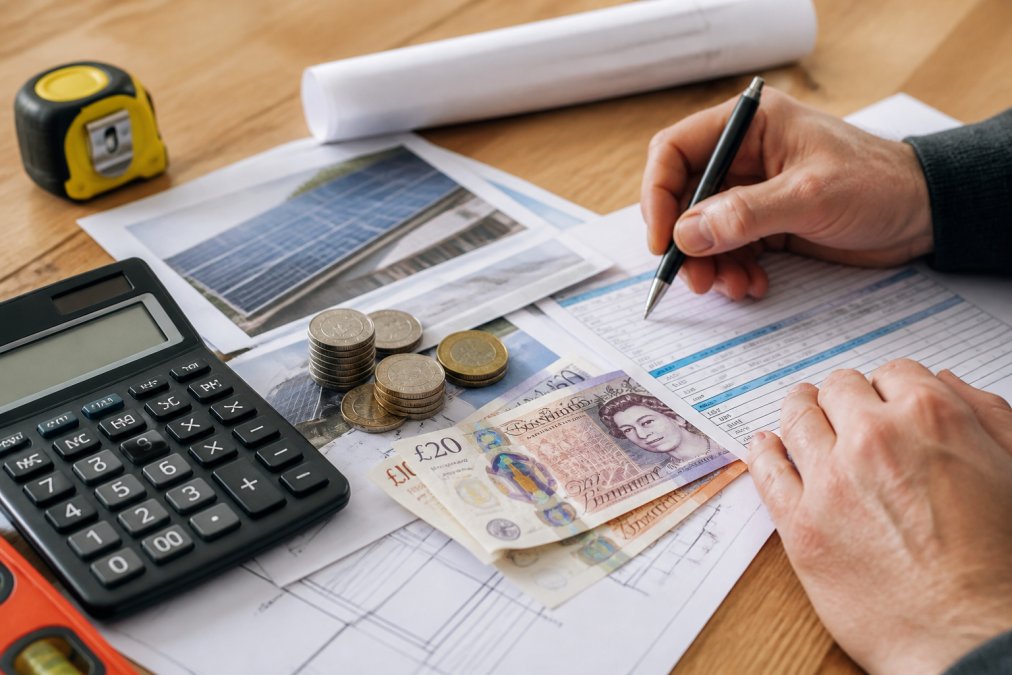
Calculating your return on investment requires five specific data points: your total installation cost, your annual energy consumption in kilowatt-hours, your current electricity tariff in pence per kilowatt-hour, your expected annual system output (which your installer should provide), and your expected SEG export rate.
Basic ROI calculation:
Annual energy savings = (Annual system output in kWh) × (Your electricity tariff in £/kWh)
Annual SEG income = (Exported power in kWh) × (SEG rate in £/kWh)
Total annual benefit = Energy savings + SEG income + Tax allowance benefit (if applicable, spread across installation year)
Payback period (years) = Total installation cost ÷ Total annual benefit
For a typical commercial installation, a 40 kWp system costing £50,000, generating 35,000 kWh annually on a business paying 28p per kilowatt-hour with 15% export at 10p per kWh, the maths look like this:
Energy savings: 35,000 kWh × £0.28 = £9,800 annually SEG income: 5,250 kWh × £0.10 = £525 annually Total annual benefit: £10,325
Payback period: £50,000 ÷ £10,325 = 4.8 years
After payback, the system generates nearly pure profit for its remaining 20+ year lifespan, assuming maintenance costs of £200-400 annually.
The variables that most affect ROI are electricity tariff (higher tariff = faster payback), system efficiency (better inverters and panel quality = more output), and installation cost (competitive pricing directly shortens payback). These are the levers worth negotiating when comparing quotes.
Click HERE for your FREE SURVEY today →
Commercial Solar Battery Storage Benefits and Integration
Battery storage transforms a solar installation from a daytime-only energy source into a flexible asset that captures value across the full 24-hour cycle. For commercial operations, this means several distinct financial benefits.
The primary benefit is time-shifting: storing daytime solar generation for use during peak tariff hours or evening operation. A business with time-of-use tariffs, common for larger commercial accounts, might pay 35p per kilowatt-hour during peak hours (typically 4-9 PM) and 12p per kilowatt-hour during off-peak. Battery storage allows you to generate at daytime rates and consume at peak rates, capturing the tariff spread. Over time, this spread often exceeds the cost of battery ownership.
A secondary benefit emerges from demand charge management. Some commercial tariffs include demand charges based on your highest consumption spike in any half-hour period each month. A battery system can flatten these peaks by discharging during high-consumption moments, reducing your demand charge liability. For energy-intensive businesses, this alone can justify battery installation.
Grid support payments, increasingly available through schemes like Frequency Response services, allow batteries to earn revenue by providing grid stability services. These payments are typically modest (£50-200 per kWh of capacity annually) but represent genuine additional income requiring no effort from the business.
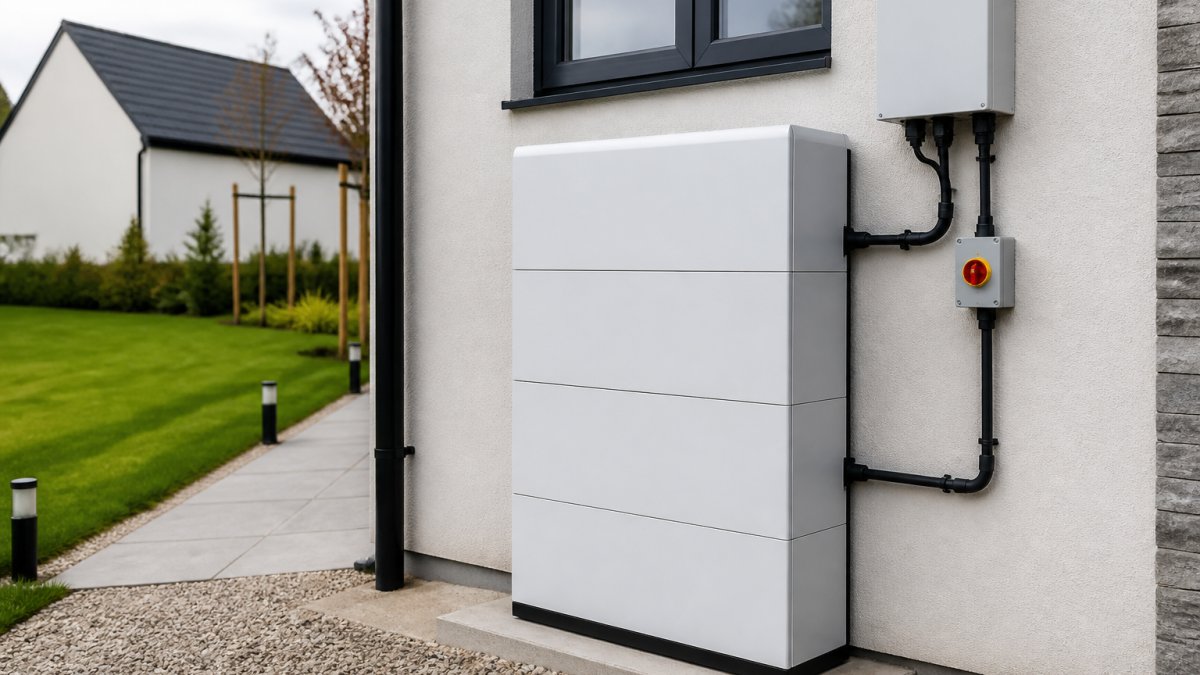
Battery systems suitable for commercial applications range from 10 kWh to 100+ kWh capacity, with costs typically £500-800 per kWh installed. A 50 kWh system costs roughly £25,000-40,000. Integration with your existing solar array requires compatible inverter architecture and control systems, this is why battery decisions should be made during initial system design, not retrofitted later.
Installation Timeline, Grid Connection, and Planning Requirements
The timeline from initial survey to system operation typically spans 8-16 weeks for commercial installations, though this varies substantially based on grid connection complexity and planning requirements.
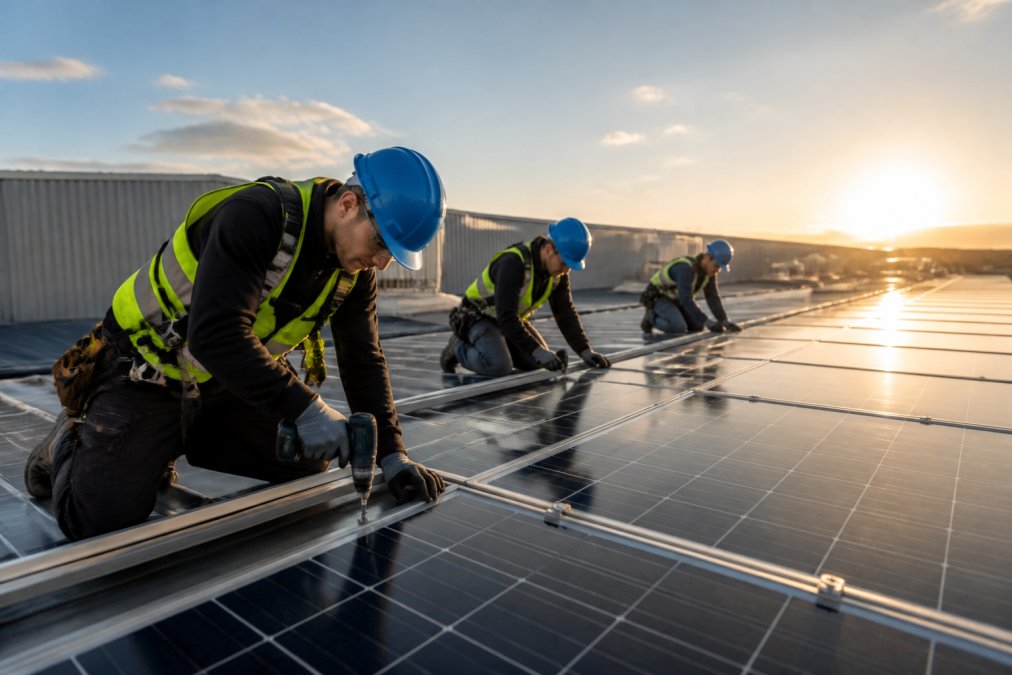
The first phase, design and approvals, takes 2-4 weeks. This includes your structural survey (confirming roof can support the array weight), electrical design (ensuring your distribution board and cabling can handle the system), and grid application submission to your local DNO. The DNO assessment is where timeline uncertainty typically emerges. Standard applications receive a response within 4-6 weeks, but complex grid scenarios can extend this to 12+ weeks.
Your roof structure assessment is critical here. Commercial buildings vary enormously in construction. A modern steel-framed warehouse with a flat concrete roof typically supports solar installation straightforwardly. An older property with timber joists or a heritage-listed building may require structural reinforcement, adding both cost and timeline. This is why the initial survey is non-negotiable, it reveals whether you're looking at a 10-week project or a 20-week one.
Planning permission requirements depend on your specific location and building type. Most commercial solar installations fall under Permitted Development rights, meaning no planning application is necessary. However, listed buildings, conservation areas, and some council jurisdictions require formal permission. Your installer should clarify this during the survey stage. If permission is required, allow an additional 8-12 weeks.
Building Regulations approval is required for all installations. This involves electrical certification and structural sign-off. Most installers handle this as part of their service, but confirm this explicitly in your contract. The approval process typically takes 2-3 weeks once documentation is submitted.
The actual installation, mounting, wiring, inverter setup, and testing, takes 3-5 days for a typical 40-50 kWp system. Grid connection and handover takes a further 1-2 weeks after installation completion.
Long-Term Maintenance Costs and System Performance
Commercial solar systems require minimal active maintenance, but understanding what's involved helps you budget accurately and protect your investment.
Annual maintenance typically includes a professional inspection (visual check for panel damage, inverter status, electrical connections), cleaning of panels if dust or debris accumulation is significant, and firmware updates for monitoring systems. For most commercial installations, this costs £200-400 annually. Dusty environments (near quarries, industrial zones, or roads with high traffic) may require more frequent cleaning, pushing costs to £600-800 annually.
System performance degrades gradually over time, typically 0.5% annually for the first year, then 0.3% annually thereafter. This is normal and factored into ROI calculations. After 25 years, your system will operate at roughly 80-85% of original capacity. This doesn't mean it stops working; it means a system that generated 35,000 kWh in year one generates approximately 28,000-30,000 kWh in year 25.
Inverter replacement is the most significant long-term cost. Modern commercial inverters typically last 10-15 years before requiring replacement. A replacement inverter for a 40-50 kWp system costs £4,000-8,000 installed. This is a known future expense worth factoring into your financial model.
Panel warranties typically cover 90% output retention for 12 years and 80% for 25 years. Inverter warranties are typically 5-10 years, with extended warranties available. Battery warranties vary but typically guarantee 70-80% capacity retention over 10 years.
The monitoring systems Smarter Utility provides with installations give you real-time visibility into system performance. This allows early detection of problems, a malfunctioning inverter, a shaded panel, or an electrical fault, before they significantly impact output. Proactive monitoring typically extends system lifespan and maximises cumulative energy generation.
Conclusion
Commercial solar installation costs in 2026 reflect genuine complexity: your specific building, energy consumption, grid situation, and financial circumstances all shape what you'll actually pay and what return you'll achieve. The businesses getting the best outcomes aren't those seeking the lowest quote, they're those who understand what they're paying for and why.
At Smarter Utility, our approach starts with a free, no-obligation survey that uncovers the real variables affecting your installation. We provide MCS-certified design and installation, handle your grid applications, and design systems tailored to your actual energy needs rather than maximising panel count. Our team manages the structural assessment, planning coordination, and Building Regulations approval so you focus on your business. Get started with your free survey today and discover what commercial solar can genuinely deliver for your operation.
Frequently Asked Questions
Q: How much does a commercial solar panel system cost for a business?
A: Commercial solar installation costs depend on system size (measured in kilowatt-peak or kWp), roof condition, structural requirements, and grid connection complexity. Pricing varies significantly based on your energy consumption profile, roof orientation, and local DNO application fees. Contact Smarter Utility for a free survey to receive an accurate quote tailored to your specific property and energy needs.
Q: Are there grants available for commercial solar installations?
A: Several funding options exist for businesses installing solar PV systems. The Enhanced Capital Allowance scheme allows businesses to claim 100% capital allowance on energy-saving equipment, including solar panels. Additionally, some local authorities and environmental schemes offer support. Eligibility depends on your business type, location, and system specifications. Smarter Utility can advise on available grants during your free survey.
Q: How long does it take for a commercial solar system to pay for itself?
A: Payback periods typically range from 5 to 10 years, depending on your system size, energy consumption, electricity tariff, and available financial incentives. Businesses with high daytime energy usage see faster returns. Battery storage integration can improve payback by enabling self-consumption and participation in the Smart Export Guarantee scheme, where unused energy exported to the grid generates revenue.
Q: Do I need planning permission for commercial solar panels?
A: Planning permission requirements depend on your specific location and building type. Most commercial solar installations fall under Permitted Development rights, meaning no planning application is necessary. However, listed buildings, conservation areas, and some council jurisdictions require formal permission. Building regulations approval is also mandatory. Smarter Utility handles the planning and building regulations process as part of the installation service, ensuring full compliance with all requirements.
This article was written using GrandRanker