 ultimate-guide
Types of Commercial EV Chargers in Scotland
Table of Contents
- Understanding Commercial EV Charger Types
- AC vs DC EV Chargers: Key Differences
- Commercial EV Charging Speeds and Power Ratings
- Workplace EV Charging Points: Installation and Use
- EV Charging for Electric Vans and HGVs
- Choosing the Right Commercial EV Charger for Your Business
- Installation, Grid Capacity, and Site Requirements
- Conclusion
- Frequently Asked Questions
Last Updated: October 10, 2026
Understanding Commercial EV Charger Types
What are the types of commercial EV chargers in Scotland? The answer depends on power delivery method, installation location, and vehicle requirements. Commercial EV chargers fall into two primary categories: AC chargers and DC chargers, each suited to different business scenarios and dwell times.
Smarter Utility helps businesses across Scotland select the right charging infrastructure for their operations. AC chargers are typically lower-power solutions ideal for workplace and retail settings where vehicles park for extended periods. DC chargers deliver rapid charging and suit fleet operations, delivery services, and public charging networks where turnaround time matters.
Understanding these distinctions is essential before installation. The wrong charger type wastes capital investment and fails to meet operational needs.
AC vs DC EV Chargers: Key Differences
The fundamental difference between AC and DC chargers lies in how they convert electrical power. AC chargers convert alternating current at the charging point, relying on the vehicle's onboard charger to convert to direct current. DC chargers perform the conversion at the station itself, delivering direct current straight to the vehicle's battery. This architectural difference determines speed, cost, and appropriate use cases.
AC chargers typically deliver 7 kW to 22 kW of power, making them suitable for overnight charging or full-day parking scenarios. A typical electric van might gain 20-30 miles of range per hour on a 7 kW charger. DC chargers range from 50 kW rapid chargers to 350 kW ultra-rapid units, delivering substantially faster charging, a 50 kW rapid charger can add 200 miles of range in 30 minutes for compatible vehicles.
Installation costs differ significantly. AC chargers require standard electrical work and cost considerably less to install than DC infrastructure, which demands higher electrical capacity and specialized grid connections. For businesses with limited electrical budget, AC chargers provide a practical entry point.
Commercial EV Charging Speeds and Power Ratings
Charging speed depends on power rating, measured in kilowatts (kW). A 7 kW AC charger delivers roughly 30 miles of range per hour for most electric cars. A 22 kW charger doubles that rate. These speeds assume the vehicle's onboard charger supports the power level, older EVs may charge more slowly even on higher-power chargers.
DC rapid chargers (50 kW) deliver 150-200 miles of range in 30 minutes for compatible vehicles. Ultra-rapid chargers (150-350 kW) can fully charge some vehicles in under 20 minutes, though charging speed typically tapers as the battery approaches full capacity.
For commercial fleets, power rating directly affects operational efficiency. An electric van fleet requiring daily turnaround benefits from 50 kW or higher DC chargers. A business with company cars parked all day can operate profitably with 7-11 kW AC chargers.
Workplace EV Charging Points: Installation and Use
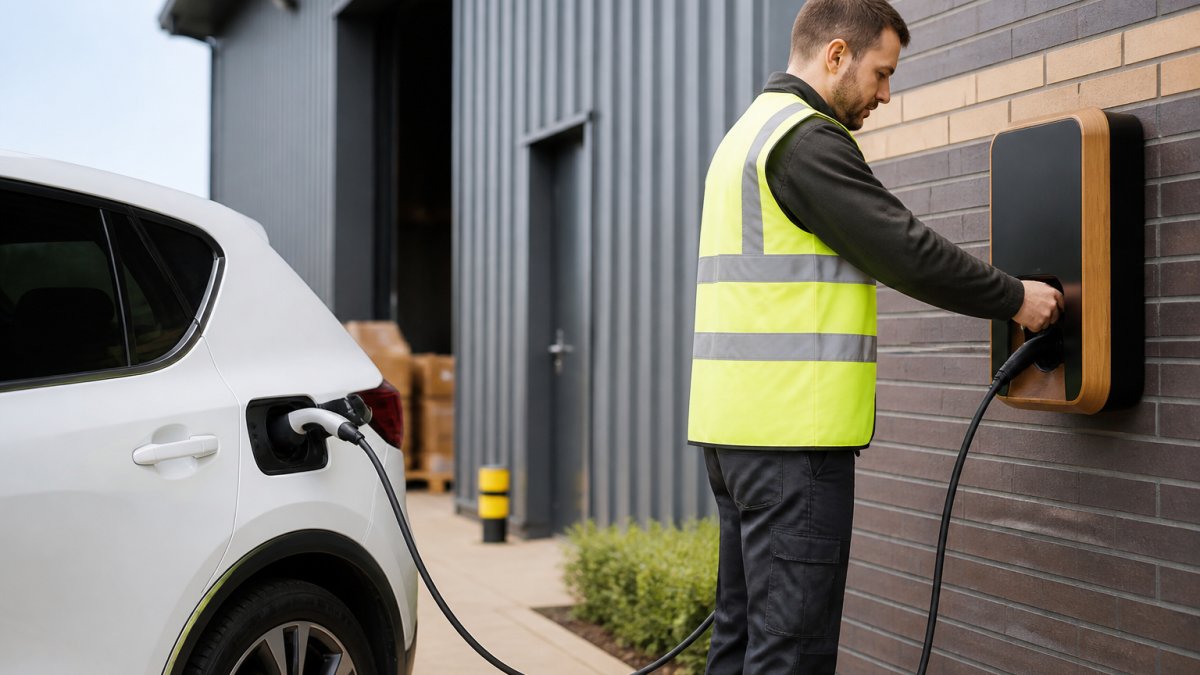
Workplace charging represents the most common commercial EV application in Scotland. Employees charge vehicles during working hours, typically 7-10 hours, making AC chargers ideal. Most workplace installations use 7 kW or 11 kW AC chargers, which require standard three-phase electrical connections and straightforward installation.
Connector standards affect vehicle compatibility and future-proofing. In the UK, the Type 2 connector (IEC 62196-2) is the standard for AC workplace charging and is fitted to nearly all modern electric cars and vans. Older vehicles (pre-2020) may use a three-pin domestic plug via a portable charger, but fixed installations must use Type 2 sockets to meet Building Standards and ensure safety.
Networked chargers (cloud-connected) allow businesses to manage charging remotely, set usage policies, track energy costs, and monitor uptime via a mobile app or web portal. Networked systems require a data connection (broadband or mobile) and enable load management, time-of-use scheduling, and integration with energy management systems. Non-networked chargers operate independently without cloud connectivity, but offer no remote control, usage data, or load management.
Total cost of ownership over 10 years includes equipment, installation, maintenance, energy, and software subscriptions. A networked system provides usage data, demand management, and the ability to charge employees or customers for electricity, offsetting costs in high-utilisation scenarios.
Site surveys determine electrical capacity and installation feasibility before purchase. Older properties or rural locations may have limited grid capacity, requiring upgrades that extend timelines and costs. A typical survey includes electrical load assessment, DNO capacity check, and recommendations for load management or grid reinforcement. Many installers offer free surveys; use this to compare options and identify hidden costs before committing.
Usage policies and access control vary by business type. Some employers offer free charging to all employees; others charge a small fee (typically £0.20-£0.50 per kWh) to recover electricity costs. Networked chargers allow you to restrict access by employee ID, time of day, or vehicle type, preventing non-employees or personal vehicles from using chargers.
Maintenance and reliability are critical for employee satisfaction. Modern chargers are highly reliable, but they require annual safety inspections (electrical testing) and occasional firmware updates. Networked systems alert you to faults immediately; non-networked chargers may fail silently. Ensure your installer provides a service-level agreement (SLA) guaranteeing response times for faults.
EV Charging for Electric Vans and HGVs
Electric vans and heavy goods vehicles present distinct charging challenges. Standard workplace AC chargers charge van batteries slowly, an electric van might require 8-12 hours on a 7 kW charger for a full charge. Fleet operators typically need faster options to maintain daily mileage targets.
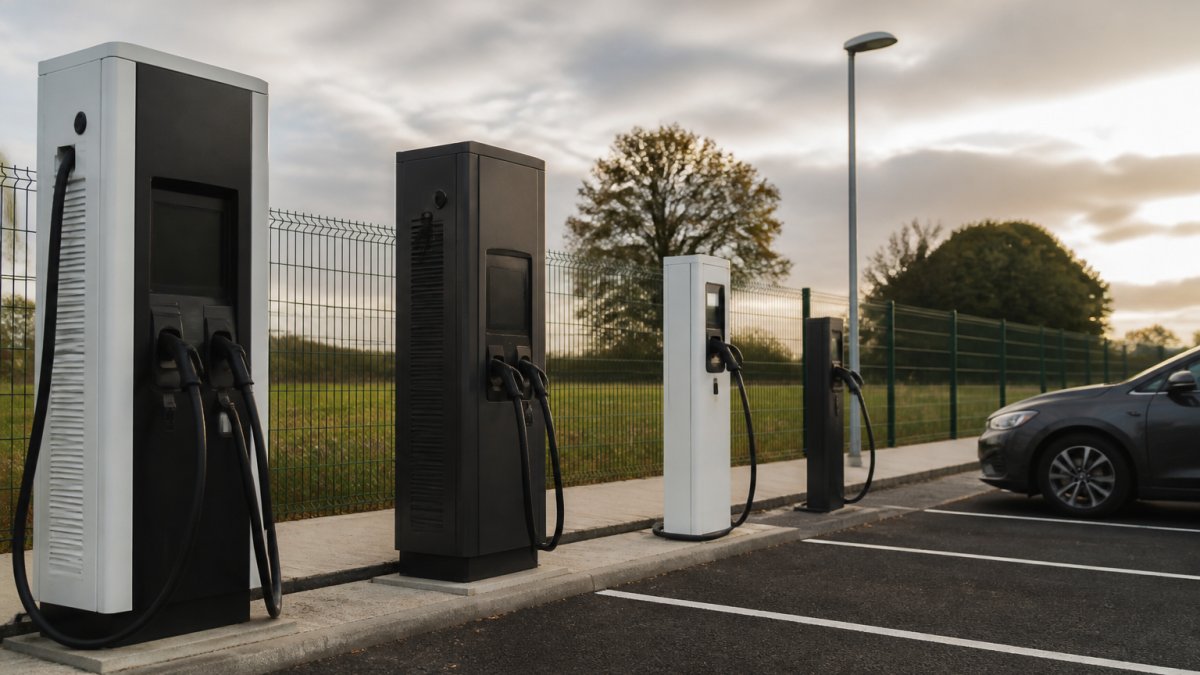
50 kW rapid DC chargers suit electric van fleets operating on predictable routes. A van can gain 150-200 miles of range in 30-40 minutes, supporting multiple daily trips. For larger HGV operations, 150 kW or higher ultra-rapid chargers become necessary, though HGV charging infrastructure remains limited across Scotland.
Fleet charging requires careful load management. Installing multiple high-power chargers simultaneously can exceed local grid capacity. Load management systems prioritize charging, stagger demand, and prevent grid overload. This infrastructure planning is essential before deploying commercial EV chargers for fleet operations.
Click HERE for your FREE SURVEY today →
Choosing the Right Commercial EV Charger for Your Business
Selecting the right charger depends on four factors: vehicle type, dwell time, site electrical capacity, and budget.

For retail outlets and hospitality venues where customers park 1-4 hours, 7-11 kW AC chargers provide adequate charging without requiring expensive DC infrastructure. A restaurant or hotel offering free charging attracts EV-driving customers without high operational costs.
Delivery and logistics businesses operating electric vans require 50+ kW DC chargers to maintain fleet productivity. The faster charging justifies higher installation costs through operational efficiency gains.
Company car parks supporting employee charging benefit from 11 kW AC chargers with networked management. This approach balances cost, charging speed, and remote monitoring capabilities.
Industrial sites with space and electrical capacity may justify on-site rapid DC charging for company vehicles and potential revenue generation through public charging networks. According to UK Government guidance on EV infrastructure, businesses offering public charging can access grants and support schemes.
| Scenario | Recommended Charger | Power Rating | Key Benefit |
|---|---|---|---|
| Retail/hospitality | AC networked | 7-11 kW | Customer attraction, low cost |
| Employee parking | AC networked | 11 kW | Productivity, remote management |
| Electric van fleet | DC rapid | 50+ kW | Fast turnaround, route viability |
| Public charging hub | DC ultra-rapid | 150+ kW | Revenue generation, rapid charging |
| Rural/limited capacity | AC non-networked | 7 kW | Simple installation, lower cost |
Installation, Grid Capacity, and Site Requirements
Before selecting a charger, assess your site's electrical infrastructure. Properties with single-phase supply cannot support high-power chargers; three-phase supply is necessary for 11 kW or higher AC chargers and essential for DC chargers.
Grid capacity determines how many chargers you can install simultaneously. A typical business might have 30-100 amp capacity available. A single 50 kW DC charger can draw 70+ amps during operation, and installing two or more without load management can exceed local distribution network capacity, triggering expensive reinforcement work from the Distribution Network Operator (DNO).
Installation timelines vary significantly. AC chargers typically install within 2-4 weeks on sites with adequate electrical infrastructure and no DNO work required. DC chargers and grid upgrades can require 8-16 weeks, particularly in rural areas where network operator involvement extends timelines. A DNO connection study (required for high-power installations) typically takes 4-8 weeks and may identify reinforcement needs that add months to project delivery.
Building Standards and planning permission requirements differ by installation type. Workplace and private charging installations typically do not require planning permission under permitted development rights, provided they do not materially change the building's external appearance. Public charging hubs or chargers visible from the road may require planning consent, particularly in conservation areas or on listed properties.
Electrical installation must comply with BS 7909:2020 (electrical safety in temporary installations) and BS 7671:2018 (Requirements for Electrical Installations, the IET Wiring Regulations). All charger installations must be certified by a qualified electrician registered with a competent person scheme such as NICEIC or ELECSA. This certification is essential for insurance, warranty, and future resale of the property.
Funding and grants significantly reduce capital costs. The Scottish Government's Switched On Scotland programme and the UK Government's Workplace Charging Scheme (WCS) offer grants covering charger and installation costs for eligible businesses (Workplace Charging Scheme). Eligibility requires the business to operate in Scotland, own or lease the property, and commit to making chargers available to employees or customers.
Energy supply and metering must be planned alongside charger selection. High-power DC chargers require dedicated circuits and may trigger higher electricity charges if your business does not have a suitable commercial tariff. Some energy suppliers offer time-of-use rates that incentivise charging during off-peak hours, reducing operating costs by 20-40%.
Conclusion
Selecting the right commercial EV charger requires matching power, speed, and infrastructure to your specific business operation. AC chargers suit workplace and retail applications with extended dwell times. DC rapid and ultra-rapid chargers support fleet operations and public charging networks where turnaround speed drives profitability.
Smarter Utility helps Scottish businesses navigate this decision through free, no-obligation site surveys. Our fully accredited team assesses your electrical capacity, recommends appropriate charger specifications, and manages installation to ensure your system delivers reliable, efficient charging. Get started with Smarter Utility and design a charging solution that powers your business sustainably.
Frequently Asked Questions
What is the difference between AC and DC commercial EV chargers?
AC chargers convert mains electricity directly to the vehicle's onboard charger, typically delivering 7-22 kW and charging times of 4-8 hours for a full battery. DC chargers bypass the vehicle's onboard system, delivering power directly to the battery at 50-350 kW, cutting charge time to 20 minutes to 2 hours. DC chargers suit high-turnover sites; AC chargers work better for overnight parking or workplaces where vehicles stay several hours.
How fast do commercial EV chargers charge an electric car?
Charging speed depends on charger type and vehicle capability. AC chargers deliver 7-22 kW, adding 20-30 miles of range per hour. Rapid DC chargers (50-150 kW) add 150-200 miles in 30 minutes. Ultra-rapid chargers (200-350 kW) deliver 200+ miles in 20 minutes. Fleet vehicles and commercial vans benefit most from rapid and ultra-rapid options, while workplace charging can use slower AC units during long dwell times.
What should a business consider when choosing a commercial EV charger?
Evaluate vehicle dwell time (how long vehicles park on site), fleet composition (vans, HGVs, cars), electrical capacity of your site, and expected daily charge cycles. A retail outlet with 2-3 hour visits needs rapid DC; a workplace with 8+ hour parking can use AC. Check grid connection limits and installation feasibility with a site survey. Consider networked chargers for payment systems and load management if you operate multiple units.
Can a normal electrician install a commercial EV charger?
Commercial EV charger installation requires specialist qualifications and must comply with Building Standards and electrical regulations. Only fully accredited installers, those approved for commercial charging infrastructure, should handle the work. Installation involves site surveys, electrical capacity assessment, and often grid upgrades. Always use a qualified installer to ensure safety, compliance, and warranty protection.