 blog
blog
Fast Chargers vs Slow Chargers for Business Use
Table of Contents
- Why the Fast vs Slow Decision Matters for Your Business
- Workplace EV Charging: Matching Charger Speed to Dwell Time
- EV Charging Times by Charger Type: What to Expect on Site
- Commercial EV Charger Installation: Infrastructure and Capacity
- Smart EV Chargers for Business: Control, Reporting and Revenue
- Total Cost of Ownership: Fast vs Slow Chargers for Business Use
- Reliability, Maintenance and Service-Level Planning
- Conclusion: Choosing the Right Mix for Your Site
- Frequently Asked Questions
Last Updated: October 4, 2026
Why the Fast vs Slow Decision Matters for Your Business
Choosing between fast chargers vs slow chargers for business use comes down to one question: how long does a vehicle sit on your site?
The gap between the two is not small. According to Energy Saving Trust guidance on EV charging, charger power determines how much range a vehicle gains per hour, and matching that output to how long vehicles actually park is the single biggest factor in whether an installation pays for itself.
Most guides compare charger speeds in isolation. That misses the point for a business.
Workplace EV Charging: Matching Charger Speed to Dwell Time
Workplace EV charging works best when charger power matches how long vehicles stay parked. Dwell time is the deciding variable, not budget or badge appeal.
Staff Parking All Day vs Short-Stay Visitors
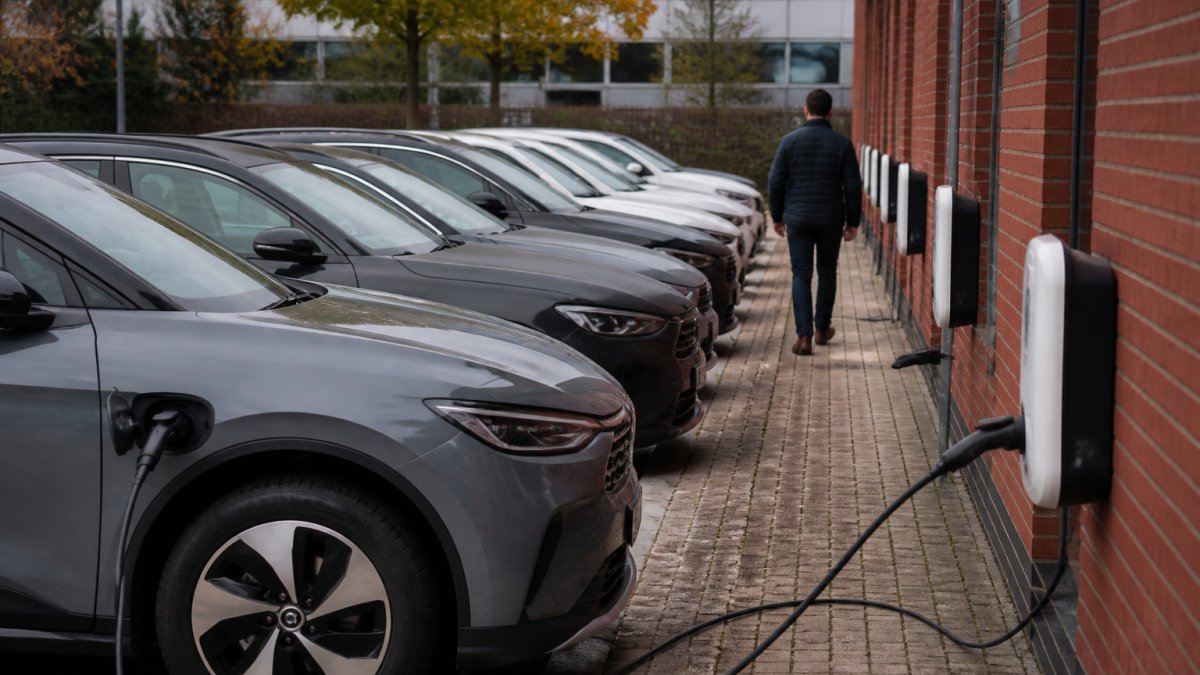
Staff who park for a full shift need very little power per hour. A low-power charger running for seven or eight hours delivers a full battery by home time, and it costs far less per point.
Short-stay visitors are the opposite. A driver stopping for 30 minutes needs high-speed charging or gets nothing useful.
The practical split:
- All-day staff parking: low-power charging, one point per bay, overnight-style top-ups
- Short-stay visitors and customers: high-speed charging, fewer points, rapid turnover
- Fleet vehicles returning to base: medium-power charging sized to the depot schedule
Get this wrong and you either strand drivers or overspend on hardware they never need.
EV Charging Times by Charger Type: What to Expect on Site
EV charging times by charger type range from roughly 8 to 12 hours on a standard 3-pin or low-power unit down to around 30 to 60 minutes on a high-power DC unit. The exact figure depends on battery capacity and the vehicle's onboard charger, not the charge point alone.
A common mistake is assuming a faster charger always charges faster. It does not. If a vehicle's onboard charger caps at 7kW, a 22kW point delivers no more than 7kW to that car. The charger is only as fast as the slowest link.
| Charger type | Typical power | Range added per hour | Best for |
|---|---|---|---|
| Slow (AC) | Up to 3kW | Low | Overnight, long-stay staff |
| Fast (AC) | 7-22kW | Moderate to high | All-day parking, fleet depots |
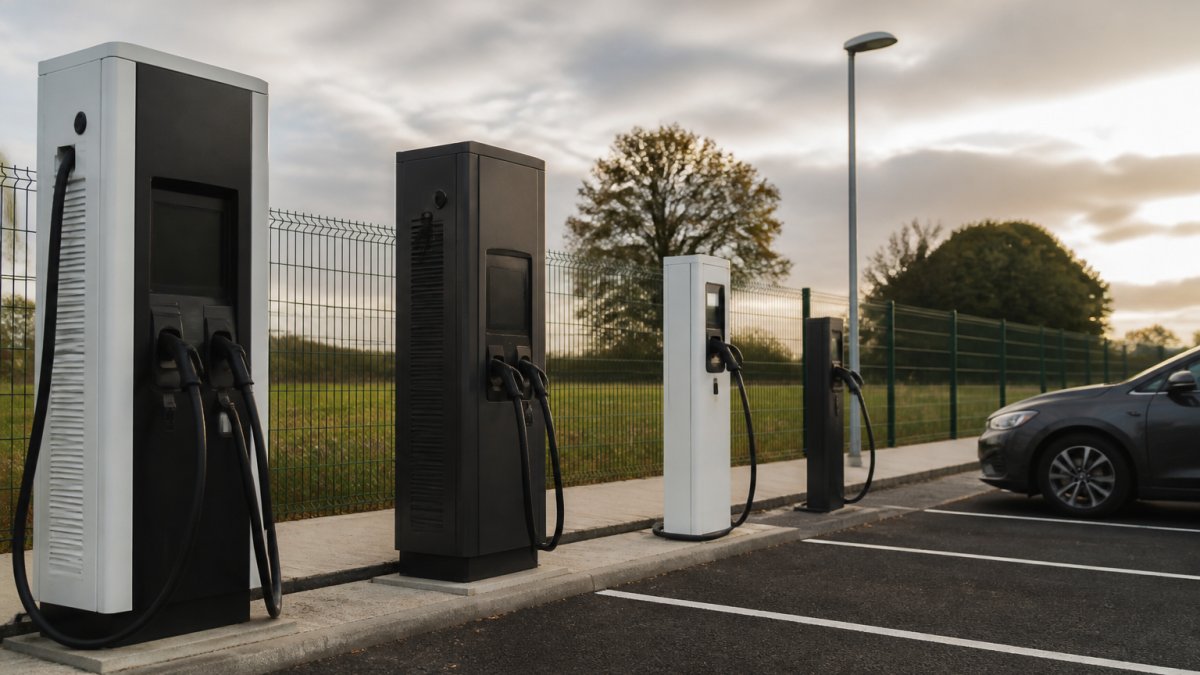
| Rapid (DC) | 50kW+ | Very high | Short-stay, en-route top-ups |
The kilowatt rating tells you the ceiling. The vehicle tells you the reality.
Commercial EV Charger Installation: Infrastructure and Capacity
Commercial EV charger installation is where most projects hit their first real obstacle: the site's electrical capacity. Adding charge points adds load, and every site has a limit before the supply needs upgrading. The number and type of chargers you can install is therefore an electrical question before it is a hardware question.
The cost drivers are rarely the chargers themselves:
- Available electrical capacity at the incoming supply
- Distance from the distribution board to the parking bays
- Groundworks, ducting and cable runs
- Whether the supply needs a new connection or upgrade
- Protection, isolation and metering arrangements for each charging zone
A site with spare capacity and short cable runs is a straightforward job. An older property with a stretched supply is a different project entirely. This is why we survey before we quote.
Load management and grid constraints
Load management lets a site run more charge points than its raw supply would allow, by sharing available power across them and prioritising the vehicles that need it most. Without it, a fleet of chargers can trip the supply at peak.
The mechanisms worth understanding:
- Static load balancing caps the total draw of the charging group at a fixed figure, so chargers share a set budget.
- Dynamic load balancing reads the building's live consumption and releases only the spare capacity to charging, which suits sites with heavy daytime demand.
- Scheduled or managed charging shifts charging into cheaper or quieter windows, which matters where a capacity or time-of-use tariff applies.
- Phase rotation and three-phase distribution spread load evenly and avoid overloading one phase.
Smart charging and load balancing are now standard tools for commercial sites. They keep the installation within existing capacity, which avoids the cost and delay of a supply upgrade. For constrained sites, this is often the difference between a viable project and one that never gets off the ground.
Site capacity arithmetic
A simple way to size a project is to work from the supply headroom rather than the car park. Take the spare capacity available after the building's peak demand, divide it by the power you intend to offer per vehicle, and you have a rough ceiling on simultaneous charging. If that ceiling is below the number of bays you want to serve, load management, phased installation or a supply upgrade are the levers available.
Connection and coordination realities
Where an upgrade is unavoidable, the process involves the distribution network operator and can take months, not weeks, so it should be started early. Groundworks, ducting and trenching are best planned once, even if chargers are installed in phases, because digging twice costs far more than oversizing a duct. For sites with on-site generation or battery storage, coordinating charging with those assets can reduce the load the grid connection must carry.
Click HERE for your FREE SURVEY today →
Smart EV Chargers for Business: Control, Reporting and Revenue
Smart EV chargers for business add the layer that turns a cost centre into a managed asset. They handle access control, usage reporting, billing and load management from one platform.
What a smart setup gives you:
- Access control: restrict charging to staff, fleets or paying customers
- Usage data: see which points earn their keep and which sit idle
- Billing: recover electricity costs from drivers or claim back business mileage
- Load balancing: keep demand within your supply limit
The reporting matters more than most buyers expect. Charger utilisation data shows whether you sized the installation correctly. A bank of rapid chargers running at low utilisation is a clear signal you overbought on speed.
Total Cost of Ownership: Fast vs Slow Chargers for Business Use
Total cost of ownership for fast chargers vs slow chargers for business use is not a purchase-price comparison. It is a comparison of five cost lines spread over the life of the installation, and the cheapest hardware often carries the most expensive second line.
The five lines to model:
- Equipment: low-power AC points cost the least per socket; rapid DC units cost several times more per connector and often need a cabinet, foundation and separate feeder.
- Electrical infrastructure: the connection upgrade, distribution board changes, protective devices, cabling and groundworks. On constrained sites this line alone can exceed the entire hardware spend.
- Energy and demand: unit rates plus, for larger supplies, capacity or peak-demand charges that penalise short bursts of high draw. Rapid charging concentrates load into short windows, which is exactly the profile that inflates a peak-based bill.
- Maintenance and service: DC units have more components (power modules, cooling, contactors) and higher failure rates than passive AC points, so spares, call-outs and downtime carry a real annual figure.
- Software and back office: per-port subscriptions for access control, billing, reporting and load management, usually charged monthly per charger.
The utilisation threshold that decides the case
The mechanism that separates the two is throughput per pound invested. A slow charger serving an all-day bay might deliver a full battery for one vehicle per working day. A rapid charger on a short-stay bay might serve several vehicles per hour. Divide the annualised cost of each option by the kilowatt-hours it actually delivers and the comparison becomes arithmetic rather than opinion.
A common pattern practitioners use: if a bay turns over fewer than a handful of vehicles per day, the premium for rapid hardware rarely pays back, because the throughput that justifies it never materialises. If a bay serves a steady stream of short-stay vehicles, the reverse is true and slow hardware becomes the false economy.
Where the hidden costs sit
Two lines catch businesses out. First, unused capacity: overspecified chargers still attract software subscriptions, maintenance cover and, on some tariffs, standing charges, whether or not they are used. Second, downtime: an out-of-service rapid unit on a revenue-earning forecourt is lost sales, not just a repair bill.
Set against all of this, faster chargers serve more vehicles per day, and on a busy forecourt or short-stay car park that throughput is the whole point. The honest answer is that neither wins outright: the cheapest installation is not the lowest total cost if it fails to serve your drivers, and the fastest hardware is not worth it if the bays sit empty.
Reliability, Maintenance and Service-Level Planning
Reliability decides whether an installation is worth having. A charge point that is out of action is worse than no charge point, because drivers arrive expecting power and leave without it.
Plan for maintenance from day one:
- Agree a service and response arrangement before installation
- Choose hardware with UK-based support and spare parts
- Monitor faults remotely so issues are fixed before drivers report them
- Budget for wear on cables, connectors and contactors
For fleets, an unavailable charger disrupts the whole schedule. Service-level planning is not an optional extra; it is part of the specification. The Office for Zero Emission Vehicles guidance on charge point reliability treats uptime as a core requirement for funded installations, and the same logic applies to any commercial site.
Conclusion: Choosing the Right Mix for Your Site
Most commercial sites need a mix, not a single charger type. Slow chargers for all-day staff parking, fast chargers for visitors and fleets, and rapid units only where genuine short-stay demand exists.
The decision rests on dwell time, electrical capacity and utilisation, and it starts with a proper survey of your site. At Smarter Utility, we are a fully accredited and approved MCS solar and battery storage installer, and we design EV charging that fits your actual energy profile rather than a generic template.
Click HERE for your FREE SURVEY today and get a charging design built around how your site really works.
Frequently Asked Questions
Are slow chargers better than fast chargers for a business?
Neither is universally better; it depends on dwell time. Slow chargers (7-22 kW) suit staff who park for four hours or more, keeping installation costs lower and reducing strain on your electrical capacity. Fast and rapid chargers (50 kW+) suit short-stay visitors, fleets needing quick turnarounds, or sites with limited parking. Many businesses run a mix: slow units for employee parking and a small number of fast units for top-up or visitor use.
How long does it take to charge an electric car with a workplace charger?
A 7 kW workplace charger adds roughly 20-30 miles of range per hour, so a full working day can deliver a meaningful top-up for most commuters. An 11 kW or 22 kW unit cuts that time further where the vehicle supports three-phase charging. Rapid 50 kW units can add 100 miles in around 30-40 minutes. Actual times vary with battery capacity, state of charge and vehicle compatibility, so plan around real-world figures rather than brochure claims.
Are fast EV chargers more expensive to install for a business?
Yes, typically. DC fast chargers need higher-capacity electrical supply, specialist groundwork, and in some cases a substation upgrade, all of which push upfront costs well above a standard AC installation. Slow and fast AC chargers are simpler to install and often avoid major supply upgrades. For most sites, the smarter investment is a well-designed AC setup with load management, reserving DC rapid charging for locations with high turnover or fleet duty cycles.
What is the 20/80 rule for charging?
The 20/80 rule means keeping a battery between 20% and 80% state of charge for most everyday use. Charging to 100% regularly can accelerate battery degradation, particularly on DC fast chargers. For business fleets, setting smart chargers to stop at 80% by default protects vehicle batteries, reduces charging time, and frees up charge points for more vehicles across the working day.