 blog
blog
10 Benefits of Workplace EV Chargers for Employees
Table of Contents
- Why Workplace EV Chargers Matter for Employees
- 10 Benefits of Workplace EV Chargers for Employees
- 1. Lower Commuting Costs with Cheaper On-Site Charging
- 2. Tax Savings Through Salary Sacrifice and Benefit in Kind
- 3. Reduced Range Anxiety and Reliable Charging Access
- 4. Health, Environmental and Employee Satisfaction Gains
- 5. Stronger Job Satisfaction and Day-to-Day Convenience
- 6. A Useful Recruitment Draw
- 7. Better Retention and Reduced Turnover Risk
- 8. Access for Drivers Without Off-Street Parking
- 9. A Simpler Route into Electric Driving
- 10. Fairer Access Through a Clear Charging Policy
- What This Means for Scottish Workplaces
- The Workplace Charging Scheme: What Employees Should Know
- EV Charging Grants for Businesses: Funding Support Explained
- Workplace EV Charging Costs: What Employers and Employees Should Expect
- How to Build an Employee EV Charging Policy That Works
- How to Implement Workplace EV Chargers: A Step-by-Step Approach
- Conclusion
- Frequently Asked Questions
Last Updated: October 7, 2026
Why Workplace EV Chargers Matter for Employees
Workplace EV chargers are on-site points that let staff plug in an electric vehicle while they work, turning dead commuting time into cheap top-up time.
Employers want a benefit staff actually value; employees want certainty they can charge without hunting for a public point on the way home.
That gap is where most workplace charging plans fail. They install hardware and stop there.
10 Benefits of Workplace EV Chargers for Employees
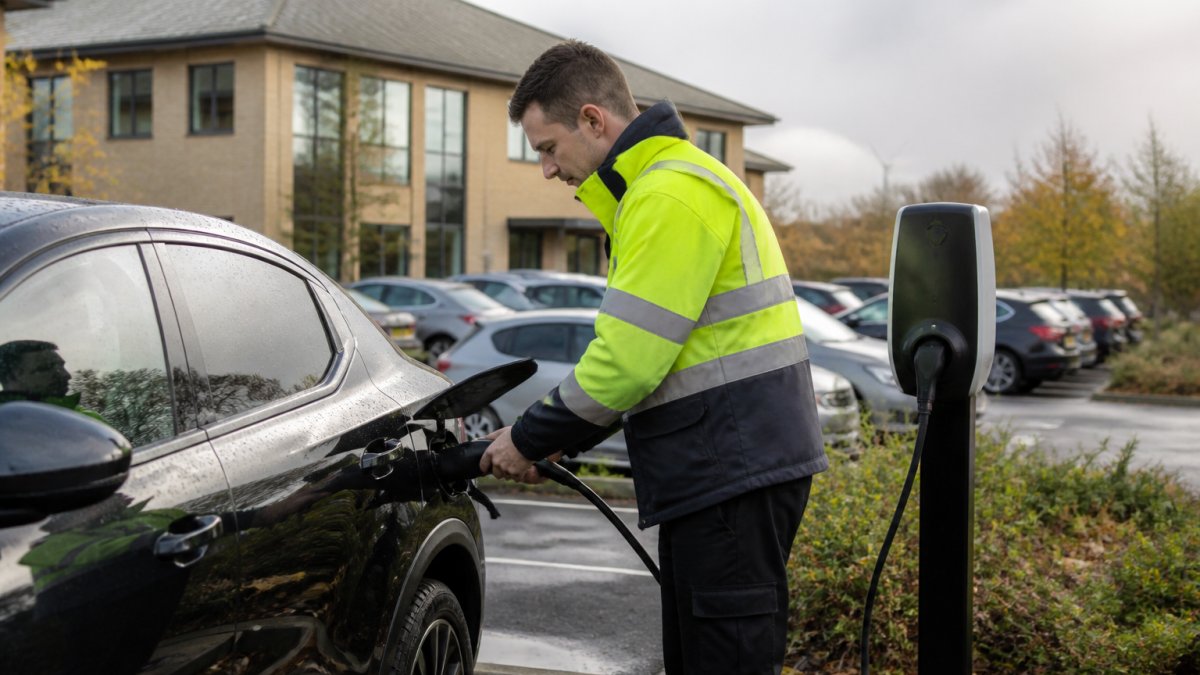
Here is how each one works in practice, with the mechanism and the caveat that matters.
1. Lower Commuting Costs with Cheaper On-Site Charging
Charging at work usually costs less per mile than petrol or diesel, and many employers offer it free or at a low rate. The saving repeats every week, so the annual figure is meaningful even if each charge looks small. The caveat: a peak-rate tariff with no off-peak scheduling shrinks the saving.
2. Tax Savings Through Salary Sacrifice and Benefit in Kind
Electric company cars attract far lower benefit in kind charges than petrol equivalents. Salary sacrifice schemes let staff pay for an electric car from gross pay, which reduces tax and National Insurance for both sides. Rules and rates change, so check the current position with HMRC guidance on company car and fuel benefits before you build a scheme.
3. Reduced Range Anxiety and Reliable Charging Access
Range anxiety is the fear of running out of charge before reaching a charger. A guaranteed point at work removes most of that worry, because drivers leave with a full battery. That matters most for staff in flats or terraced homes with no driveway, and for shift workers whose commute falls outside public charging hours.
4. Health, Environmental and Employee Satisfaction Gains
Electric driving cuts tailpipe emissions, improving local air quality around workplaces and commuter routes. A charging point signals that an employer takes climate action seriously, and the benefit is strongest when paired with a published carbon or travel plan, so staff see the link between the charger and the commitment.
5. Stronger Job Satisfaction and Day-to-Day Convenience
A charger that works is a daily, tangible benefit, removing the chore of hunting for a public point, queuing, or planning the week around charging. The caveat: a charger that is frequently broken or blocked does more damage than no charger at all, because it signals the employer did not think the benefit through.
6. A Useful Recruitment Draw
For roles where a car is part of the package, or where staff commute long distances, on-site charging is a differentiator, especially where public charging is sparse, and it can decide a candidate comparing two similar offers. Describe the benefit accurately in job adverts, including whether it is free, paid, or subject to a booking system.
7. Better Retention and Reduced Turnover Risk
Once staff rely on workplace charging, losing it is a real cost to them, creating a practical retention effect: the benefit is hard to replicate elsewhere unless that employer also has chargers. It is strongest for staff without home charging, who would otherwise rebuild their routine from scratch.
8. Access for Drivers Without Off-Street Parking
This is the equity benefit. Staff in flats, tenements, or terraced homes with no driveway often cannot charge at home at all. Workplace charging is sometimes the only realistic way for them to run an electric vehicle. Employers who want an inclusive benefit should prioritise these staff in the access policy, not just the earliest arrivals.
9. A Simpler Route into Electric Driving
For staff who are EV-curious but not yet committed, a workplace charger removes the biggest practical objection: they can try electric driving without depending on public infrastructure, and the employer gains a credible answer when staff ask whether an EV is realistic.
10. Fairer Access Through a Clear Charging Policy
A published policy, who can use the points, when, on what terms, and what happens when demand exceeds supply, turns a physical asset into a fair benefit. Common models include free for all staff with a booking system, cost-price pass-through, a set paid rate funding maintenance, and priority for long-distance commuters.
What This Means for Scottish Workplaces
Scottish workplaces have a specific advantage: the national grant sits alongside Scottish public body and enterprise agency programmes, and some local authority or enterprise support can be combined with it. Check all three sources, the national grant, any Scottish scheme the business qualifies for, and any local authority or enterprise agency support, because funding rounds close and timing matters as much as eligibility.
The Workplace Charging Scheme: What Employees Should Know
The Workplace Charging Scheme is a government grant that reduces the upfront cost of installing charge points at a business premises (Workplace Charging Scheme). It is claimed by the employer, not the employee, so staff benefit indirectly through a lower installation bill.
Who Can Claim and What It Covers
The grant is aimed at businesses, charities and public sector organisations installing charge points for staff or fleet use. It is not a consumer grant, and employees cannot claim it directly. The employer applies, the installer must be approved, and the points must meet technical requirements.
Eligibility Conditions That Catch Employers Out
Most failed applications fail on eligibility, not technology. Common conditions include:
- The applicant must be a registered business, charity or public sector organisation.
- The site must have dedicated off-street parking for staff or fleet vehicles.
- The charge points must be installed by an approved installer.
Because these conditions change, check the current rules before committing to a quote. A quote that assumes eligibility is the most common source of wasted time.
How the Grant Interacts with Scottish Support
Scotland has its own layer of support. Scottish public bodies and enterprise agencies run programmes alongside the national scheme, and some local authority or enterprise support can be combined with it. The practical move is to check all three sources, the national grant, any Scottish scheme the business qualifies for, and any local authority or enterprise agency support, because funding rounds close and timing matters as much as eligibility.
Click HERE for your FREE SURVEY today →
What Employees Should Ask Their Employer
Employees do not need to understand the grant mechanics, but they should ask four questions:
- Has the employer checked current eligibility for the national scheme?
- Has the employer checked Scottish and local authority support as well?
- Will the grant reduce the cost of the installation, and will that saving be passed on to staff through free or cheaper charging?
- Is the installer approved under the scheme, so the grant is not lost?
What the Grant Does Not Do
The grant lowers the upfront cost. It does not guarantee free charging, enough points for every driver, or a fair access policy, those are separate decisions. Treat the grant as a reason the employer can afford to act, not as a reason the benefit will automatically be good.
EV Charging Grants for Businesses: Funding Support Explained
Funding for workplace charging comes from a mix of national grant schemes and support tied to where the business operates.
The practical move is to check all three sources: the national grant, any Scottish scheme your business qualifies for, and any local authority or enterprise agency support.
Workplace EV Charging Costs: What Employers and Employees Should Expect
Costs split into two parts: the installation and the electricity.
Installation pricing depends on the number of points, the cable run, groundworks, and whether your supply needs an upgrade.
Electricity costs depend on your tariff and whether you pair charging with solar and battery storage.
For staff, the key question is whether charging is free or paid. Both are common.
How to Build an Employee EV Charging Policy That Works
A charging policy sets out who can use the points, when, and on what terms. Without one, the first two drivers to arrive claim the spaces and everyone else quietly resents it.
Equitable Access and Payment Models for Staff
Fair access is the hard part. Common models include:
- Free for all staff, funded as a benefit, with a booking system to manage demand.
- Cost price for staff, where the employer passes through electricity cost only.
- Paid at a set rate, which funds maintenance and future points.
Whichever you choose, publish it. A written policy prevents more arguments than any booking app.
Ongoing Operations and Managing Charging Demand
Demand grows. Start with a booking system or simple rota, then add load management so chargers share available power rather than tripping the supply. Schedule maintenance checks and log faults, downtime is the fastest way to lose staff trust in the whole scheme.
How to Implement Workplace EV Chargers: A Step-by-Step Approach
Implementation runs in six steps, from survey to launch, and most sites can be planned in weeks rather than months.
- Survey the site. Check the supply capacity, cable routes and parking layout.
- Confirm eligibility. Check the current grant rules and any Scottish funding.
- Size the system. Match the number of points to real staff demand, not guesswork.
- Get a written quote. Ask for a full breakdown with no hidden extras.
- Install and commission. Accredited installers handle the electrical work and testing.
- Launch the policy. Publish access rules, pricing and a contact for faults.
Conclusion
The hard part is not choosing a charger. It is sizing the system correctly and running it fairly once live. Get that wrong and you have an expensive parking space.
Smarter Utility designs and installs solar PV, battery storage and EV charging for businesses and homeowners across Scotland.
Click HERE for your FREE SURVEY today.
Frequently Asked Questions
Do employees have to pay to charge their electric car at work?
It depends on the employer's policy. Some businesses offer free charging as an employee benefit, while others use a payment model such as a flat monthly fee, pay-as-you-go, or a small per-kWh charge. If charging is provided free of charge, it is generally treated as a taxable benefit in kind unless an exemption applies. Employers should set out the payment model clearly in their employee EV charging policy so staff know what to expect before they plug in.
What is the workplace charging scheme and who can apply?
The Workplace Charging Scheme is a government grant that helps eligible businesses, charities, and public sector organisations reduce the upfront cost of installing electric vehicle charging points for staff and fleet use. The application is made by the employer, not the employee, and the business must meet eligibility criteria such as having dedicated off-street parking. Once approved, the voucher is redeemed against the cost of installation by an authorised installer. Employers should check current eligibility rules before applying, as the scheme is periodically updated.
Can employers claim a grant for installing workplace EV chargers?
Yes, many employers can claim a grant through the Workplace Charging Scheme to offset part of the installation cost. The grant covers a portion of the purchase and installation of each eligible charging socket, up to a capped number of sockets per business. To qualify, the business must have suitable off-street parking and use an authorised installer. The application process is straightforward but requires proof of eligibility. Employers should confirm the current grant terms and caps before committing to a supplier.
How many workplace EV chargers does a business need?
There is no fixed rule, but a common starting point is one charging socket for every two to three plug-in vehicles regularly parked on site. Employers should consider current EV ownership among staff, planned fleet electrification, and future uptake. A site survey can help determine the right number and the electrical capacity available. It is often more cost-effective to install extra ducting and capacity during the initial build so more chargers can be added later without major groundwork.