 blog
blog
Commercial Solar vs Wind Energy for Scottish Warehouses: 2026
Table of Contents
- Commercial Solar vs Wind Energy: A Quick Comparison for Scottish Warehouses
- Commercial Solar Panels for Warehouses: How They Perform in Scotland
- Commercial Wind Turbines for Businesses: Feasibility on Industrial Sites
- Solar vs Wind Energy Efficiency: Which Suits a Warehouse's Load Profile?
- Commercial Solar Battery Storage: Making Rooftop Generation Work Harder
- Planning, Grid, and Payback: The Commercial Case in Scotland
- Conclusion: Matching the Right Technology to Your Warehouse
- Frequently Asked Questions
Last Updated: October 6, 2026
Commercial Solar vs Wind Energy: A Quick Comparison for Scottish Warehouses
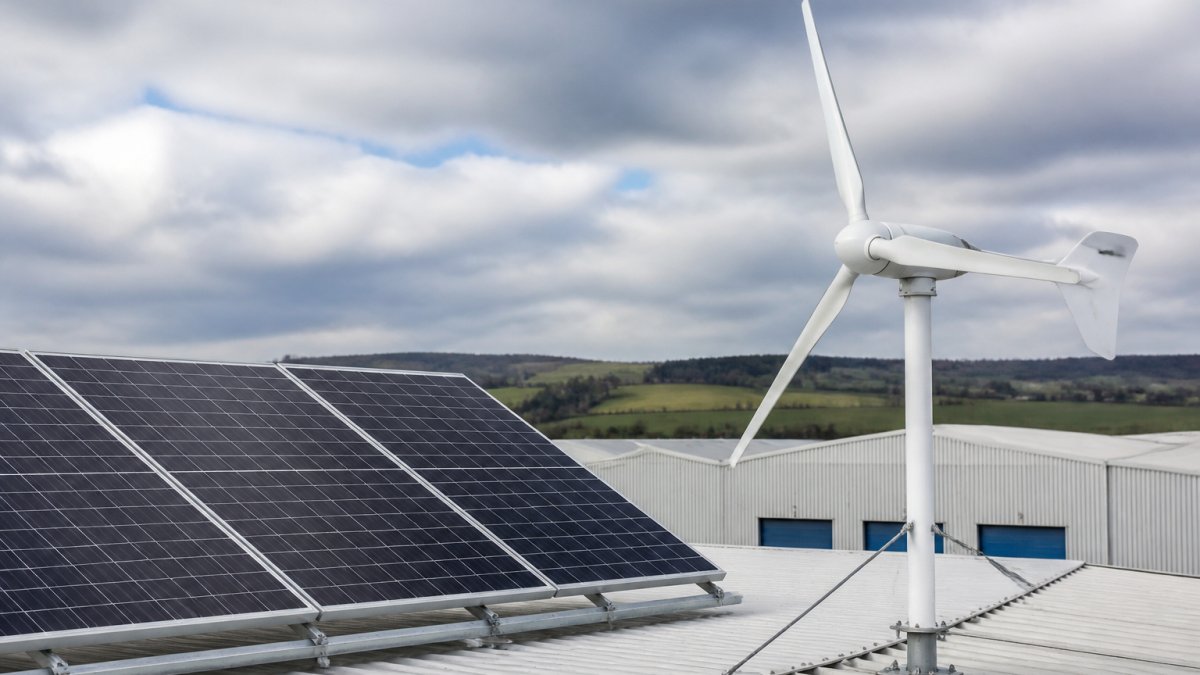
For most Scottish warehouses, commercial solar beats on-site wind. Panels have no moving parts, need far less maintenance, and fit roof space you already own.
This guide from Smarter Utility sets out how commercial solar vs wind energy plays out for Scottish warehouses: roof suitability, wind feasibility, load matching, battery storage, and the commercial case.
Solar wins on cost, simplicity, and speed to generate. Wind can still make sense on a large, exposed brownfield site with poor roof structure, but that is the exception.
| Factor | Rooftop Solar | On-site Wind |
|---|---|---|
| Roof or land needed | Existing roof space | Open land and a tall mast |
| Moving parts | None | Gearbox, blades, bearings |
| Maintenance burden | Low | Higher, with service intervals |
| Planning complexity | Usually simpler | Often more involved |
| Best fit | Most warehouses | Exposed brownfield sites |
| Output profile | Daytime, matches working hours | Variable, often overnight-heavy |
Commercial Solar Panels for Warehouses: How They Perform in Scotland
Solar works well on Scottish warehouse roofs despite the cloud cover. Panels generate from daylight, not direct sun, so a bright overcast day still produces useful output, and long summer days partly offset darker winters.
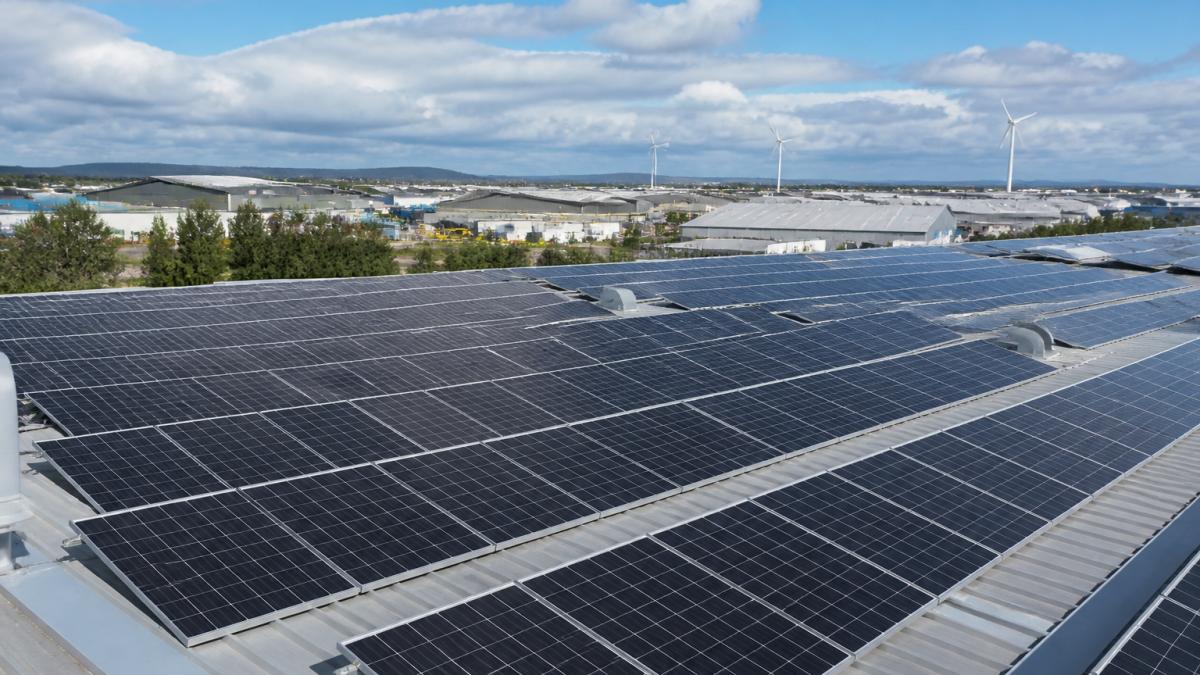
The practical constraint is roof condition and orientation. A large, south-facing roof in good order is close to ideal; east-west roofs still work but spread output across the day.
Three things decide how much a roof can deliver:
- Usable area: plant, skylights, and vents all remove space.
- Structural capacity: older roofs may need strengthening first.
- Shading: nearby buildings and trees cut output where they fall.
Panel choice matters less than layout: a well-planned array on standard panels usually beats a cramped premium one.
Commercial Wind Turbines for Businesses: Feasibility on Industrial Sites
On-site wind is feasible for a minority of warehouses.
You also need somewhere to put it.
UK planning practice guidance on renewable energy sets out how local authorities weigh turbine applications, including noise and visual impact.
Where wind does work, it is usually a single mid-sized turbine on an exposed brownfield site with clear surroundings. Even then, output is variable.
Solar vs Wind Energy Efficiency: Which Suits a Warehouse's Load Profile?
Solar vs wind energy efficiency comes down to timing, not just total output. Warehouses run their heaviest loads during working hours, lighting, forklift charging, refrigeration, machinery, and solar peaks at exactly that time.
The useful comparison is how each technology's output profile lines up with a real warehouse's consumption profile across a full year, and that is where the two diverge sharply.
What a warehouse load profile actually looks like
Most single-shift warehouses follow a predictable shape:
- 06:00-08:00 morning ramp: lights, doors, HVAC and systems come on; demand climbs quickly.
- 08:00-16:00 daytime plateau: machinery, conveyor systems, forklift charging and refrigeration run at full draw. This is usually 60-75% of daily consumption.
- 16:00-18:00 evening drop: most activity stops, but security, cold storage and standby loads continue.
A two-shift or 24-hour operation flattens this curve and raises the overnight base load considerably. Cold-storage warehouses are the extreme case: refrigeration runs continuously, so the load profile is almost flat.
How solar output maps onto that profile
A south-facing rooftop array generates a bell curve peaking around midday and producing nothing after dark. In summer a Scottish array can produce useful output from roughly 05:00 to 21:00 in June; in winter generation concentrates between about 09:00 and 15:00, with daily yield perhaps a fifth of June's.
The consequence: solar covers a large share of the daytime plateau in spring and summer, and much less in winter.
How wind output maps onto that profile
Wind behaves differently in three ways that matter to a warehouse:
- It is not diurnal. Wind blows at night as readily as in the day, so there is no built-in alignment with working hours.
- It is more seasonal in the opposite direction. Scottish wind resource is strongest in winter and weakest in summer, the reverse of solar. On a good site, a turbine can produce two to three times more in January than in July.
- It is more variable hour to hour. A turbine can swing from rated output to near zero within hours as a front passes, which is harder to match to a steady warehouse load without storage or a flexible export arrangement.
For a single-shift warehouse, a meaningful share of wind generation arrives overnight or at weekends when the site draws only base load. Without a battery, that surplus is exported, often at a lower price than the electricity you would otherwise have imported.
The seasonal complementarity angle
The point most comparisons miss: solar and wind are seasonally complementary in Scotland. Solar is strongest in summer, when cooling and refrigeration loads are highest; wind is strongest in winter, when solar output is weakest and lighting and heating loads rise.
That does not mean every warehouse should install both. The honest answer to 'which is more efficient for my load?' depends on when your consumption peaks:
- Summer-peaking loads (refrigerated distribution, significant cooling) favour solar.
- Winter-peaking loads (ambient warehouses with heavy lighting and heating) narrow the gap, and on an excellent wind site wind can compete.
- Flat 24-hour loads (cold storage, some food processing) suit solar well because there is always demand to absorb daytime output, and suit wind less well because overnight generation still exceeds the base load.
What to measure before you decide
Before choosing a technology, pull half-hourly consumption data from your meter (or ask your supplier) and compare it against a modelled generation profile for each option. Three numbers decide the outcome:
- Self-consumption rate: the share of generation used on site rather than exported.
- Load-match factor: how closely generation tracks demand across the year.
- Export value: what you are paid for surplus, and whether that beats the import price you avoid.
A high self-consumption rate is worth more than a high total yield, because offsetting a unit of imported electricity beats exporting the same unit. That principle explains why rooftop solar usually wins on a warehouse, even where a turbine would generate more kilowatt-hours overall.
Click HERE for your FREE SURVEY today →
Commercial Solar Battery Storage: Making Rooftop Generation Work Harder
Commercial solar battery storage fixes the timing problem, capturing surplus daytime generation and releasing it in the evening or during peak tariff periods, so more of what you generate is used on site rather than exported cheaply.
Sizing is where most projects go wrong: too small wastes surplus, too large pays for capacity you never cycle. A properly sized battery is built around your actual consumption pattern, not a rule of thumb.
Storage also future-proofs the site. If you add EV charging for a fleet or a heat pump later, the battery and inverter can often be specified now to handle that extra load.
Planning, Grid, and Payback: The Commercial Case in Scotland
The commercial case rests on three things: planning, grid connection, and payback. Solar usually clears all three faster, and understanding the differences before you commit separates a project that pays back in six years from one that never does.
Planning: permitted development versus full application
Roof-mounted solar on a commercial building often falls within permitted development rights, so no full planning application is needed. Conditions apply: panels must not protrude significantly above the roof plane, the building must not be in a sensitive designation, and the local authority must sometimes be notified.
Ground-mounted solar and most wind turbines are a different matter. A mast tall enough to reach steady wind, typically 15 metres or more for a mid-sized commercial turbine, normally requires a full planning application, bringing:
- Noise assessment: turbines have a defined noise limit at nearby dwellings, usually assessed as part of the application.
- Visual impact and landscape assessment: relevant even on brownfield sites, and more so near sensitive receptors.
- Aviation and radar consultation: required within a certain distance of an airport, airfield or radar installation, a common cause of delay and occasionally refusal.
UK planning practice guidance on renewable energy sets out how local authorities weigh turbine applications, including noise and visual impact.
Grid connection: where the real bottleneck sits
For a modest rooftop solar system, say 50-250 kWp, connection is usually a straightforward notification to your distribution network operator, and the existing supply can often accommodate it without reinforcement.
Wind is harder. A larger generator, or one exporting significant volumes, can trigger a formal connection application and sometimes network reinforcement.
Ofgem guidance on connecting to the electricity network explains how connection applications and costs are handled.
The implication: to generate and consume on site quickly, solar's grid path is shorter and cheaper.
Payback: the numbers that actually drive it
Here is the honest framework, with indicative ranges rather than false precision.
Capital cost. Capital costs for rooftop solar and battery storage depend on factors such as roof complexity, access, structural work, and the specific system components chosen.
Revenue and savings. Value comes from three places:
- Avoided import: every kWh generated and used on site offsets electricity you would otherwise buy at your import price, for a commercial warehouse on a typical business tariff, the largest single source of value.
- Export: surplus generation can be sold, but export prices are usually well below import prices, which is why self-consumption matters more than total yield.
- Battery arbitrage: a battery lets you shift cheap generation into expensive peak periods, or charge on a cheap overnight tariff and discharge at peak. This can improve returns meaningfully, depending on your tariff structure.
Indicative payback. For a well-sited rooftop solar array on a warehouse with good daytime demand, payback periods can be attractive, with a system life of 25 years or more.
Sensitivity: what moves the numbers most
Three variables dominate the economics:
- Import electricity price. The higher your import price, the more valuable self-consumption becomes and the faster solar pays back, the single biggest lever.
- Self-consumption rate. A site using 80% of its generation on site outperforms one using 40%, even if the second generates more.
- Capital cost per kWp. Roof condition, access and structural work can swing solar costs significantly; on wind, ground conditions and grid connection can swing them even more.
We would not quote a firm payback figure without a survey, every roof, tariff and load is different. But the framework above is what a proper assessment should be built on, and any proposal that does not show these numbers with your own meter data behind them is not a serious one.
Conclusion: Matching the Right Technology to Your Warehouse
For most Scottish warehouses, the decision is not close. Rooftop solar, paired with a correctly sized battery, delivers lower risk, lower maintenance, and generation that matches when you actually use power.
If you are weighing commercial solar vs wind energy for your own premises, the right first step is a proper assessment of your roof, your load, and your tariffs.
Frequently Asked Questions
Is solar or wind better for a warehouse?
For most Scottish warehouses, solar PV is the more practical choice. Roof-mounted panels use existing space, have no moving parts, and generate electricity directly for on-site use. Wind turbines need a mast, open land, and a grid connection, which is rare on a brownfield or industrial site. Solar also has a shorter payback period and simpler planning route for most commercial buildings.
Can warehouse roof solar panels meet a business's electricity needs?
They can cover a significant portion of daytime demand. A large roof can host hundreds of panels, and generation often aligns with warehouse operating hours. However, output drops in winter and on cloudy days, so solar is best combined with battery storage and a grid connection. Many sites aim to offset 40% to 70% of annual electricity use, depending on roof size and load profile.
What permissions may be needed for a commercial wind turbine?
A commercial wind turbine usually requires planning permission from the local authority, and possibly an environmental impact assessment. You will also need a grid connection agreement from the distribution network operator. In Scotland, the Scottish Government's planning policies and local development plans govern turbine siting, height, and noise limits. Roof-mounted solar panels often fall under permitted development rights, making them a faster route to installation.
How should a warehouse compare the costs of solar and wind energy?
Start by getting a structural survey and an energy audit. Solar costs depend on roof condition, panel count, and inverter choice; wind costs depend on turbine size, foundation, and grid connection. For a like-for-like comparison, calculate the payback period using current electricity prices and your site's annual consumption. Smarter Utility offers a free, no-obligation survey to help you size a system accurately and avoid hidden fees.