 how-to
Calculate Solar Panel Savings: A Scotland Guide
Table of Contents
- What You'll Need to Calculate Solar Panel Savings
- Step 1: Find Your Current Electricity Bills and Usage
- Step 2: Determine Your System Size and Annual Generation
- How to Calculate Solar Energy Savings
- Using a Solar Panel Savings Calculator
- Understanding Your Solar Panel Payback Period Calculator
- How Battery Storage Affects Your Solar Savings
- Common Mistakes to Avoid When Calculating Savings
- Frequently Asked Questions
Last Updated: October 10, 2026
What You'll Need to Calculate Solar Panel Savings
To understand how to calculate solar panel savings in Scotland accurately, gather honest numbers about your current energy use and costs.
Collect your last 12 months of electricity bills (showing kWh consumption and rates), plus your property details: roof orientation, pitch, and postcode, which determine solar radiation levels.
Understand your energy tariff type (standard or time-of-use). Daytime consumption increases savings; evening-heavy use makes battery storage more valuable.
Clarify your goals: bill reduction, carbon reduction, or both, and whether you'll export surplus power to the grid.
Step 1: Find Your Current Electricity Bills and Usage
Your electricity bills show how much energy you use and what you pay for it, the foundation of any savings calculation.

Gather 12 months of statements showing monthly kWh consumption. Monthly data matters because winter usage is higher (heating, longer nights) while summer shows lower consumption but higher solar generation.
Write down:
- Monthly kWh consumption for each of the past 12 months
- Your current electricity rate per kWh (usually shown on the bill)
- Any standing charges (fixed daily costs)
- Your total annual bill
If you lack old bills, contact your supplier for a 12-month history.
If your supplier offers half-hourly consumption data online, use it to determine optimal system size and battery need.
Step 2: Determine Your System Size and Annual Generation
System size (kW) and location determine annual generation, which drives your savings calculation.
System size (typically 3-6 kW) depends on roof space, budget, and goals. Larger systems generate more but cost more; smaller systems fit tighter budgets.
How location and postcode affect generation
Generation varies by region due to daylight, cloud cover, and solar irradiance. Northern locations generate less, especially in winter.
A 4 kW system generates 3,200-3,600 kWh/year in the central belt, 2,800-3,200 kWh/year in the Highlands and Islands, and 3,600-4,000 kWh/year in the south.
This 20% difference in generation translates to a 2-year swing in payback period.
Use online solar irradiance maps or request installer quotes for your postcode to get generation estimates based on your specific roof.
Roof orientation, pitch, and shading
Beyond postcode, three physical factors shape your generation:
Orientation: South-facing roofs are ideal and generate 100% of theoretical maximum. East or west-facing roofs generate 80-90% of south-facing output. North-facing roofs generate only 40-60% and are rarely worth installing on unless you have no alternative.
Pitch: Roofs pitched at 30-40 degrees are most efficient. Steeper (50+°) or shallower (under 20°) pitches lose 5-10%. Flat roofs need tilted frames, adding cost.
Shading: Trees, buildings, and structures reduce generation. Shading for more than 2-3 hours during peak times (10am-3pm) significantly cuts output. Professional surveys measure this impact.
Estimating your specific annual generation
Use a solar calculator or request a professional quote. These ask for:
- Your postcode (determines solar radiation and weather patterns)
- Roof orientation (degrees from south)
- Roof pitch (degrees from horizontal)
- Shading profile (whether trees or buildings block sunlight)
- System size you're considering (in kW)
The calculator models your generation based on historical weather and roof characteristics, far more reliable than national averages.
Don't guess. A 15% error in generation cascades into a 15% error in savings and payback. Professional quotes are free.
How to Calculate Solar Energy Savings
When learning how to calculate solar panel savings in Scotland, the core calculation is straightforward: annual generation × electricity rate = gross savings. But real savings account for self-consumption, export tariffs, and standing charges. Here's a step-by-step approach you can adapt.
The calculation framework
Solar savings come from two sources: (1) Direct self-consumption, power you use immediately, avoiding grid purchases at full rate; (2) Export income, surplus power exported under the Smart Export Guarantee (SEG). Total first-year saving is the sum of both, then compounded by energy price inflation over 25-30 years.
Step-by-step worked example
Let's work through a realistic example with clearly stated assumptions. You can then substitute your own numbers.
Assumptions: 4 kW system; 3,600 kWh annual generation; 28p/kWh import rate; 40% self-consumption; 20p/kWh SEG export rate; 50p/day standing charge.
Step 1: Calculate the power you use directly from your panels
Annual generation × self-consumption percentage = direct use
3,600 kWh × 40% = 1,440 kWh per year
Step 2: Calculate the power you export to the grid
Annual generation − direct use = exported power
3,600 kWh − 1,440 kWh = 2,160 kWh per year
Step 3: Calculate savings from direct self-consumption
Direct use × your electricity import rate = direct savings
1,440 kWh × £0.28 = £403.20 per year
Step 4: Calculate income from exported power
Exported power × SEG export rate = export income
2,160 kWh × £0.20 = £432 per year
Step 5: Add direct savings and export income
Direct savings + export income = total first-year saving
£403.20 + £432 = £835.20 per year
Click HERE for your FREE SURVEY today →
Adjusting for your own circumstances
Your actual numbers will differ. Here's how to adapt the calculation:
Your electricity import rate: Check your bill for pence per kWh. For time-of-use tariffs, use a weighted average or calculate separately by period.
Your self-consumption percentage: Home workers and daytime appliance users achieve 50-70%; away-workers achieve 20-30%. Assume 40% if unsure.
Your SEG export rate: Check your supplier's current rate (typically 15-25p/kWh in 2026). Use a conservative estimate if unsure.
Standing charges: Fixed daily costs unaffected by solar. Don't include in savings calculations, but they affect your total bill.
Accounting for energy price inflation
Electricity prices typically rise 3-5% annually. A £835 year-1 saving grows to approximately £1,760 by year 25 at 3.5% inflation, totalling roughly £27,500 over 25 years. This is why solar remains attractive even with a 10-year payback, the system generates free electricity for the remaining 15-20 years.
Common adjustments and complications
Time-of-use tariffs: Calculate self-consumption and export separately for peak and off-peak periods, as off-peak generation may be worth less.
Seasonal variation: 60% of annual generation occurs April-September. Winter heating costs reduce winter savings; summer cooling improves them.
Battery storage: Batteries increase self-consumption to 60-75% by storing daytime power for evening use. Recalculate with higher self-consumption and lower export.
Changing tariffs: Recalculate savings using actual rates paid in each period if you switch suppliers.
Why this calculation matters
This approach lets you stress-test assumptions. Run calculations at different self-consumption rates (30% vs. 50%) and SEG rates (15p vs. 25p) to see the range and identify which assumptions matter most.
Using a Solar Panel Savings Calculator
A solar savings calculator automates these steps and reduces errors.
The best calculators ask for postcode, roof orientation and pitch, annual bill or kWh consumption, electricity rate, system size, and battery size. They estimate annual generation, self-consumption, export income, savings, payback period, and 25-year projections.
Many installers offer free online calculators for ballpark estimates, but professional surveys account for roof shading, micro-climate, and actual consumption patterns.
Test multiple scenarios (3, 4, 5 kW systems and battery options) to see trade-offs between cost and savings.
Calculators estimate based on average weather and consumption. Actual results vary with sunny/cloudy years and daytime usage patterns.
Understanding Your Solar Panel Payback Period Calculator
The payback period shows how many years before your system pays for itself: system cost ÷ annual savings. A £8,000 system saving £800/year has a 10-year payback.
Most payback calculators assume flat energy prices, which is unrealistic. A 10-year payback at today's prices may hit payback in 8 years if rates climb 3% annually.
Check for local grants or schemes in 2026, as no national subsidy exists for residential solar in the UK.
A payback period under 10 years is generally considered excellent. 10-15 years is still attractive for a 25-30 year system lifespan. Beyond 15 years, the investment becomes less compelling unless you have other reasons (carbon reduction, energy independence, future-proofing against price rises).
Don't obsess over payback alone. A system with a 12-year payback still generates free electricity for 13-18 years after it's paid for itself. That's significant long-term value.
How Battery Storage Affects Your Solar Savings
Battery storage changes the savings equation dramatically. It shifts power from the grid to later in the day when you're actually using electricity.
Without a battery, you self-consume maybe 30-50% of your generation. The rest exports at SEG rates (15-25p per kWh).
Example: Your system generates 3,800 kWh per year. Without a battery, you self-consume 40% (1,520 kWh) and export 60% (2,280 kWh) at 20p per kWh.
- Direct savings: 1,520 kWh × 28p = £425.60
- Export income: 2,280 kWh × 20p = £456
- Total: £881.60
With a 5 kWh battery, you capture more of that export power. You might now self-consume 60% (2,280 kWh) and export only 40% (1,520 kWh).
- Direct savings: 2,280 kWh × 28p = £638.40
- Export income: 1,520 kWh × 20p = £304
- Total: £942.40
Battery storage adds roughly £60 extra per year in this scenario. But batteries cost £4,000-£8,000 upfront, so payback extends significantly.
Battery costs are falling. In 2026, they're roughly 30% cheaper than five years ago. If you're not ready to buy now, installing solar first and adding a battery later is a sensible approach.
Common Mistakes to Avoid When Calculating Savings
People often overestimate savings by ignoring real-world factors. Here are the pitfalls to watch for.
Assuming 100% self-consumption. Your panels don't generate at night. If you work away from home during the day, most generation happens when nobody's using power.
Ignoring system losses. Panels degrade slightly each year (typically 0.5% annually). Inverters aren't 100% efficient. Wiring loses a small amount of power.
Using outdated electricity rates. Energy prices change.
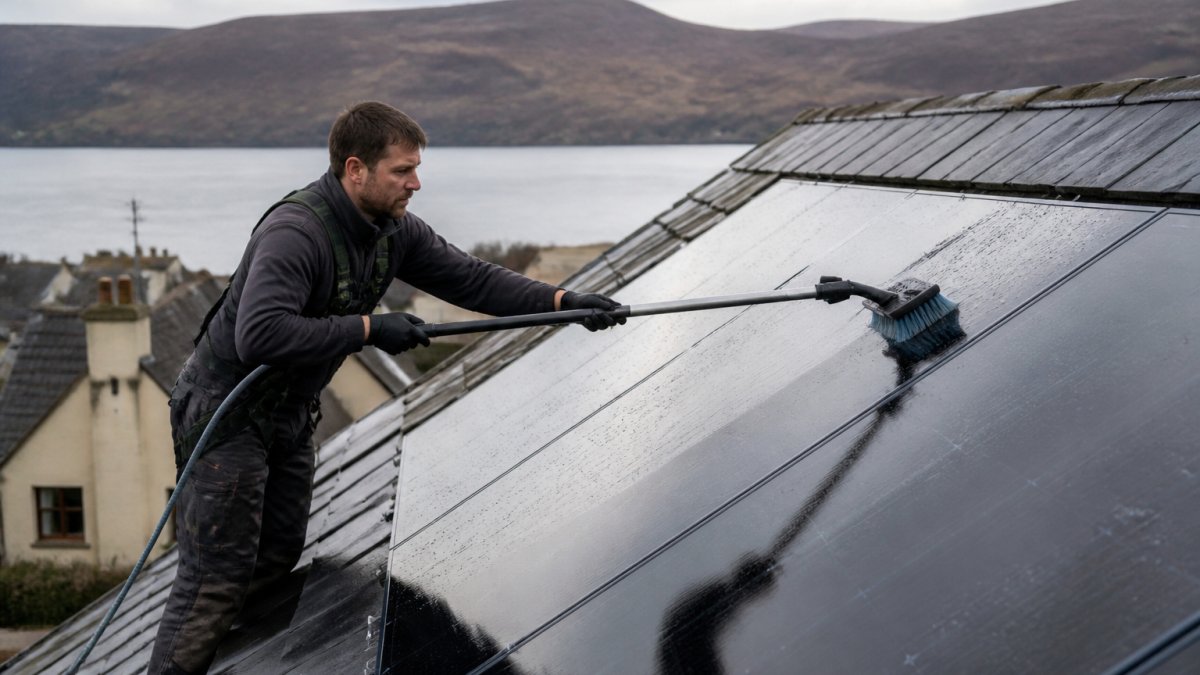
Forgetting maintenance costs. Solar panels need minimal upkeep, but occasional cleaning and inverter servicing cost money. Budget £100-£200 per year.
Overestimating export income. SEG rates vary by supplier and change monthly. Don't lock in today's rate as permanent.
Neglecting roof condition. If your roof needs replacement in five years, factor that cost in.
Underestimating consumption growth. If you're planning to add an electric vehicle or heat pump, your electricity use will rise.
At Smarter Utility, we help homeowners and businesses work through these calculations accurately.
Calculating solar panel savings requires honest data about your current bills, your roof characteristics, and your actual consumption patterns. Whether you're looking to cut your electricity bills, reduce your carbon footprint, or both, understanding how much you'll actually save is the first step. The UK government's energy efficiency guidance provides additional context on home energy management.
Frequently Asked Questions
What information do I need to calculate solar panel savings?
You need three key pieces: your annual electricity consumption (kWh per year from your bills), your current electricity tariff (pence per kWh), and details about your roof (orientation, pitch, and available space). Your postcode helps estimate solar generation for your location based on daylight hours and weather conditions. If you're considering battery storage, note your daily usage pattern to size it correctly. A free survey can verify these details and provide a professional generation estimate tailored to your property.
How do you calculate solar energy savings?
Multiply your estimated annual generation (kWh) by your electricity import rate to find your savings from self-consumption. Add any export payments from surplus electricity sold back to the grid. Subtract the annual installation cost (spread across the system's lifespan, typically 25 years) to get your net annual saving. For example: if your system generates 4,000 kWh annually, you use 3,000 kWh (saving £450 at 15p/kWh), and export 1,000 kWh (earning £150 at export rates), your gross saving is £600 before installation costs are factored in.
How does battery storage affect solar panel savings?
Battery storage increases savings by allowing you to use more of your generated electricity instead of exporting it at lower rates. If export tariffs pay 15p/kWh but your import rate is 25p/kWh, storing and using that electricity saves an extra 10p per kWh. A battery typically costs £3,000-£8,000 depending on capacity. Calculate whether the additional savings over the battery's lifespan (usually 10-15 years) exceed its cost. Battery storage also provides resilience during grid outages and can be sized to cover your evening and night consumption, maximising self-consumption.
What is the payback period for solar panels?
Payback period is the number of years it takes for your annual savings to equal your installation cost. Divide your total system cost by your annual net savings (after all costs and export payments). For example, if your system costs £8,000 and saves £800 per year, the payback period is 10 years. Factors affecting payback include roof orientation, system size, current tariffs, and whether you add battery storage. Most systems in Scotland achieve payback in 8-12 years, after which savings are nearly pure profit for the remaining 13-17 years of the panel warranty.