 listicle
MCS Accredited Solar Installers Scotland: 2026 Guide
Table of Contents
- What MCS Accreditation Means for Solar Installations
- How to Verify MCS Certification Before You Hire
- Top MCS Accredited Solar Installers in Scotland
- Solar Panel Installation Costs: What to Expect
- Solar Panel Grant Eligibility and Scottish Funding
- The Installation Process and Post-Installation Maintenance
- How to Choose the Right Installer for Your Property
- Conclusion
Last Updated: August 15, 2026
What MCS Accreditation Means for Solar Installations
MCS accreditation is the quality mark that separates trustworthy solar installers from the rest. The Microgeneration Certification Scheme is an independently managed certification programme that sets technical standards for small-scale renewable energy installations across the UK. Any installer carrying MCS certification has been assessed against rigorous criteria covering system design, installation practice, and customer service, and continues to be audited to maintain that status.
For homeowners and businesses considering solar installations, this matters enormously. Without MCS certification, you cannot access the Smart Export Guarantee, the primary mechanism by which solar owners earn money for surplus electricity exported to the grid. You also lose access to certain grant schemes and have no independent recourse if something goes wrong.
According to MCS Certification's official installer standards documentation, only installers who meet the scheme's full technical and consumer protection requirements are permitted to issue MCS certificates for completed installations.
Why the Microgeneration Certification Scheme Exists
The scheme was created to give consumers confidence in a sector that once attracted poor-quality operators. Before MCS, there was no consistent national standard for what constituted a properly designed and installed solar PV system. MCS changed that by establishing a certification framework that holds installers accountable through periodic audits and independent complaint resolution.
Consumer Protections That Come With MCS Certification
Choosing an MCS certified installer gives you several concrete protections:
- A formal MCS certificate for your installation, required for Smart Export Guarantee registration
- Access to independent dispute resolution if problems arise
- Assurance that your system has been designed and installed to recognised technical standards
- Eligibility for applicable government grant schemes
- Warranty documentation that holds legal weight
The certificate is tied to your property, supporting your Energy Performance Certificate and strengthening future property sales.
How to Verify MCS Certification Before You Hire
Verifying MCS certification takes under two minutes and should be non-negotiable before signing any contract. The MCS certified installer database allows anyone to search by postcode, company name, or technology type.
Before committing:
- Search the installer's company name on the MCS database and confirm the result matches
- Check that the certification covers solar PV specifically
- Confirm the certification is current, not lapsed or suspended
- Ask the installer for their MCS certificate number and cross-reference it yourself
- Verify whether the installer also holds HIES or RECC consumer code membership for additional financial protection
Top MCS Accredited Solar Installers in Scotland
Choosing from the full list of MCS accredited solar installers operating across Scotland requires more than a quick Google search. The following nine companies have been selected based on their accreditations, track record, service range, and suitability for different property types and project scales.
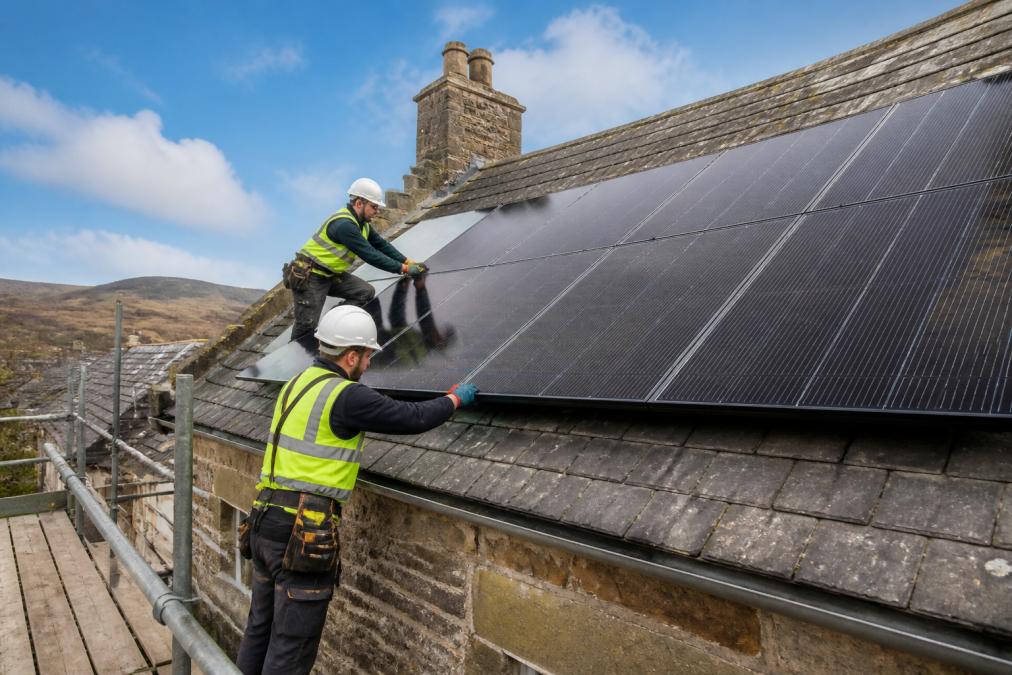
1. Smarter Utility
Smarter Utility is Scotland's leading installer of solar PV, battery storage, and electric vehicle charging solutions. As a fully accredited MCS solar and battery storage installer, every system qualifies for the Smart Export Guarantee and meets technical standards required for grant eligibility.
What sets Smarter Utility apart is the combination of breadth and depth. The team handles solar PV, battery storage, and EV charging infrastructure under one roof, allowing for phased approaches to home energy. The free, no-obligation home survey is a genuine differentiator, with proper site assessment ensuring system design is tailored to your specific roof orientation, shading profile, and energy consumption pattern before any contract is signed.
2. The Edinburgh Boiler Company
The Edinburgh Boiler Company has built a strong reputation for domestic and commercial solar PV and battery storage installations, backed by MCS certification and EPVS accreditation. EPVS certification means that savings figures quoted at the survey stage are independently validated, removing a common source of post-installation disappointment. With over 1,000 installations completed and a 4.9-star rating from more than 3,000 verified customers, their track record is strong.
3. Central Renewables
Based near Stirling, Central Renewables holds both MCS certification and HIES accreditation. HIES membership provides financial protection for customer deposits and independent dispute resolution, adding a meaningful consumer protection layer on top of MCS. Their Octopus Energy Trusted Partner status is a practical advantage for homeowners who want to integrate their solar system with smart energy tariffs.
4. AES Solar
AES Solar, based in Forres in Moray, is one of Scotland's longest-established solar companies with over four decades of experience. They cover solar PV, solar thermal, and energy storage, with particular strength in rural properties and larger commercial projects where site complexity is higher.
5. Greener Energy Group
Greener Energy Group, based in Paisley, offers solar panels, battery storage, and heat pumps across Scotland. Their 4.6-star Trustpilot rating from over 1,700 reviews reflects consistent customer satisfaction. The breadth of their renewable energy offering is useful for homeowners thinking beyond solar.
6. Solar Services Scotland Ltd
Solar Services Scotland brings over a decade of experience and more than 4,000 installations to the table. Their focus on custom system design and ongoing maintenance sets them apart from installers who treat post-installation support as an afterthought.
7. Boxergy
Boxergy is MCS certified for both solar PV and air source heat pumps, with a focus on making renewable energy accessible at a lower entry price point. Their 10-panel solar PV package, which includes a premium inverter and full MCS certification, is priced at £3,999 (as of April 2025), well below the Scottish average for a complete system.
8. RB Grant Electrical Contractors
RB Grant, based in Fife, has completed thousands of solar PV installations across Scotland and provides transparent pricing: installations from £4,000 for a 4kW system to £7,000 for a 10kW system, fully installed and MCS certified. They also offer free guidance for new build properties on meeting SAP requirements.
9. Eco Energy Ltd
Eco Energy Ltd covers solar panels, air source heat pumps, and battery storage across Scotland and the north of England. Their point of difference is post-installation optimisation: they offer inverter upgrades, maintenance contracts, bird-proofing, and grid trading solutions that help maximise financial returns from existing systems.
Solar Panel Installation Costs: What to Expect
Solar panel installation costs vary considerably depending on system size, panel type, roof complexity, and whether battery storage is included. Pricing examples from RB Grant (£4,000 to £7,000 for 4kW to 10kW systems) and Boxergy (£3,999 for a 10-panel package) give a useful reference range for standard domestic installations. Most installers operate on a quote-based model because variables are too significant for fixed pricing to be meaningful across all properties.
Factors That Affect Your Final Quote
The following elements will influence your final solar panel installation cost:
Click HERE for your FREE SURVEY today →
| Factor | Impact on Cost | What to Ask |
|---|---|---|
| System size (kW) | Higher kW = higher cost | What size suits my consumption? |
| Panel type (mono vs poly) | Monocrystalline typically costs more | Which performs better for my roof? |
| Battery storage addition | Adds £2,000-£5,000+ typically | What capacity do I need? |
| Roof complexity | Steep pitch or multiple aspects add labour | Is scaffolding included? |
| Existing electrical panel | Upgrades may be needed | Do I need a consumer unit upgrade? |
| Grid connection work | DNO applications may apply | Is DNO notification included? |
Always request an itemised quote that separates equipment costs, labour, scaffolding, and any grid connection or DNO notification fees.
Solar Panel Types for the Scottish Climate
The Scottish climate presents specific challenges that should influence panel selection. Monocrystalline panels are the most appropriate choice for most Scottish properties. They perform better in low-light and diffuse light conditions, common across Scotland for much of the year. Their higher efficiency per square metre also makes them better suited to smaller roof areas.
Polycrystalline panels are less efficient in diffuse light and are now largely superseded by monocrystalline technology for domestic installations. For north-facing or north-west-facing roofs, a site survey is essential before drawing conclusions.
Solar Panel Grant Eligibility and Scottish Funding
Grant eligibility for solar installations is determined by the technology installed, the installer's accreditation, and the applicant's household circumstances. MCS certification from your installer is a baseline requirement for most funding routes. Without it, you cannot access the Smart Export Guarantee and are unlikely to qualify for grant support.
According to Energy Saving Trust's guidance on solar panels, the financial case for solar in Scotland is strengthened by the combination of available grant funding and export income, particularly for properties with higher-than-average daytime electricity consumption.
Smart Export Guarantee and Post-Installation Income
The Smart Export Guarantee requires energy suppliers with more than 150,000 customers to offer export tariffs to eligible small-scale generators. To qualify, your system must be MCS certified and under 5MW in capacity, which covers all domestic and most commercial installations. Export rates vary between suppliers, so comparing tariffs from multiple providers after installation is worthwhile.
Home Energy Scotland and Regional Grant Navigation
Home Energy Scotland, funded by the Scottish Government and managed by Energy Saving Trust, is the primary route for Scottish homeowners seeking grant support and interest-free loans for renewable energy installations. The scheme covers solar PV and battery storage, with eligibility criteria including property type, income thresholds, and MCS-certified installation requirements.
The Home Energy Scotland grant and loan scheme details provides current eligibility criteria and application guidance. Rural and island properties may also qualify for additional support through the Rural Homes Renewable Heat Incentive and other regional programmes.
The Installation Process and Post-Installation Maintenance
A standard domestic solar PV installation follows a predictable sequence, though timelines vary by installer, grid connection requirements, and scaffolding availability.
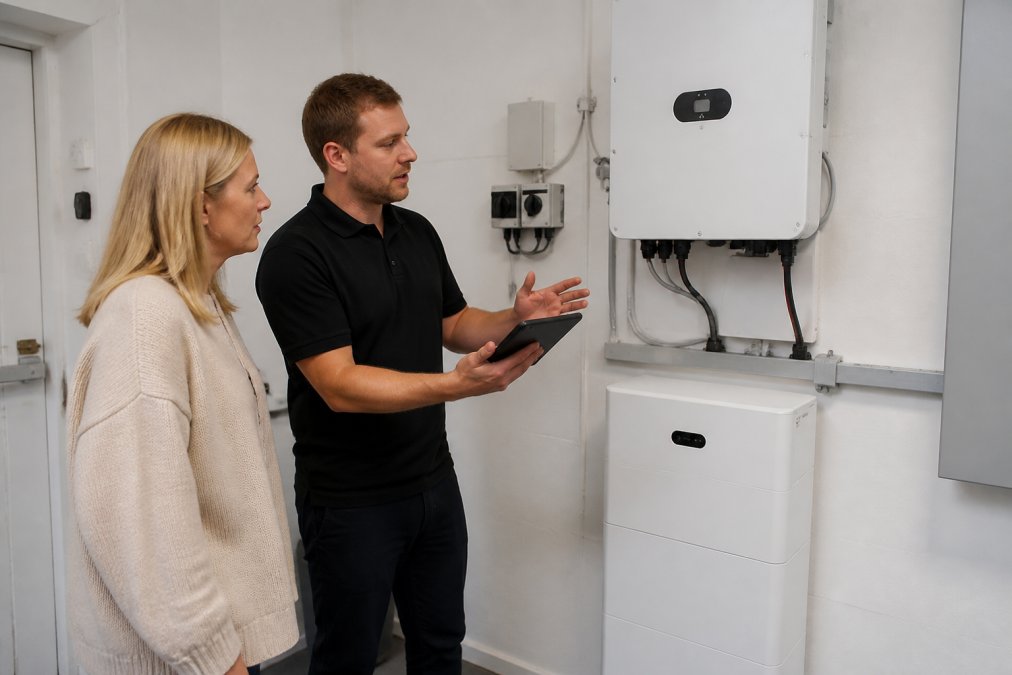
The typical sequence runs as follows:
- Site survey - An engineer assesses roof structure, orientation, shading, and existing electrical installation
- System design - Installer produces a tailored design specifying panel count, inverter type, and battery capacity if applicable
- Quote and contract - Itemised quote is provided; contract signed; installation date agreed
- DNO notification - Installer notifies the Distribution Network Operator; for systems over 3.68kW, formal approval may be required before installation
- Scaffolding erected - Usually 1-2 days before installation
- Installation day - Panels, mounting system, inverter, and cabling installed; typically 1-2 days for a domestic system
- Electrical sign-off - A qualified electrician completes the electrical installation certificate
- MCS certificate issued - Installer issues the MCS Microgeneration Installation Certificate
- SEG registration - Homeowner registers with a licensed energy supplier for export payments
Grid Connection and Performance Monitoring
Grid connection for solar PV involves notifying your Distribution Network Operator before the system is commissioned. For systems up to 3.68kW, this is typically a straightforward notification process. Larger systems require a formal application and may involve a waiting period for DNO approval. Your installer should handle this process as part of the installation contract.
Performance monitoring is an area where many homeowners underinvest. Most modern inverters include monitoring software that provides real-time and historical generation data. Reviewing this data periodically allows you to identify underperformance early. Post-installation maintenance requirements are modest: annual cleaning maintains panel efficiency, and inverters typically carry 5-10 year warranties.
How to Choose the Right Installer for Your Property
The right MCS accredited solar installer for your property is not necessarily the cheapest, the largest, or the one with the most Google reviews. Start with accreditation: MCS certification is the floor, not the ceiling. Installers who also hold HIES or RECC consumer code membership offer additional financial protection.
Next, assess experience with your specific property type. Evaluate the quality of the site survey, an installer who quotes without visiting the property is cutting corners. Finally, consider the long-term relationship. Solar systems last 25 years or more. An installer who offers maintenance contracts, monitoring support, and a clear process for warranty claims is worth more over that timeframe than one who is difficult to contact after installation day.
Customer reviews that specifically mention post-installation experience are the most reliable signal available before you commit.
Choosing the right solar installer is one of the most consequential energy decisions a homeowner or business can make, and the MCS accreditation framework exists precisely to give you a reliable starting point. Smarter Utility stands out as Scotland's leading MCS accredited solar and battery storage installer, offering free no-obligation home surveys, expert system design tailored to your property, and a fully accredited team covering solar PV, battery storage, and EV charging. Click HERE for your FREE SURVEY today and get a system designed around your actual energy needs, not a generic template.
Frequently Asked Questions
Can I check an installer's MCS certificate online?
Yes. The MCS website hosts a publicly searchable directory at mcscertified.com. Enter the installer's company name or postcode to confirm their current accreditation status, the technologies they are certified to install, and whether their certification is active. Always check this before signing a contract, as MCS accreditation must be renewed annually and can lapse if an installer fails to meet ongoing quality standards.
Why is MCS accreditation important for solar panel installations?
MCS accreditation is the recognised quality mark for microgeneration installations in the UK. Only systems installed by an MCS accredited installer qualify for the Smart Export Guarantee, which pays you for surplus electricity exported to the grid. MCS certification also underpins eligibility for most government grants and funding schemes, and it gives you access to independent dispute resolution if something goes wrong with your installation.
Does an MCS certificate affect my eligibility for government grants?
Directly, yes. Home Energy Scotland loans and cashback offers, as well as the Smart Export Guarantee, all require your system to be installed by an MCS accredited solar installer. Without MCS certification, energy suppliers are not obliged to accept your SEG application, and grant bodies will not process your claim. Always confirm your installer holds a valid MCS certificate before any work begins to protect your solar panel grant eligibility.
How much does solar panel installation cost in Scotland?
Solar panel installation costs vary depending on system size, panel type, roof complexity, and whether battery storage is included. Publicly available pricing from installers in this list ranges from around £3,999 for a basic 10-panel package to £7,000 or more for larger systems. The best way to get an accurate figure for your property is to request a free, no-obligation site survey, which allows the installer to assess your roof, shading, and energy usage before quoting.
Do I need to be MCS accredited to install solar panels myself?
You do not legally need MCS accreditation to fit solar panels on your own home, but a self-installed system will not qualify for the Smart Export Guarantee or most grant schemes. Building regulations under the Scottish Building Standards still apply, and grid connection must be notified to your Distribution Network Operator. For most homeowners, using an MCS accredited installer is the only practical route to accessing financial incentives and warranty-backed installations.
This article was written using GrandRanker