 listicle
What Are the Main Benefits of Large Scale Solar Business?
Table of Contents
- Why Large Scale Solar Business Makes Financial Sense in 2026
- Commercial Solar Panel Benefits That Cut Operating Costs
- How Business Solar Energy Savings Add Up Over Time
- Commercial Solar Payback Period: What Affects Your Return
- Commercial Solar Panels and Battery Storage: More Than Generation
- Environmental and Reputational Gains From Large Scale Solar
- Risks, Limitations and Suitability: What to Check Before You Commit
- Conclusion: Turning Solar Potential Into Business Reality
- Frequently Asked Questions
Last Updated: October 8, 2026
Why Large Scale Solar Business Makes Financial Sense in 2026
Large scale solar is now one of the most predictable capital investments a business can make.
The case has strengthened because the economics have changed. According to the International Energy Agency's renewables analysis, solar PV is now among the cheapest sources of new electricity generation in most markets.
But most guides sell the environmental story and skip the engineering. A commercial solar system only performs as promised if it is sized correctly, sited well, and matched to how your site uses power.
Commercial Solar Panel Benefits That Cut Operating Costs
Commercial solar panel benefits show up fastest on the bills you already pay. A well-designed system generates during daytime operating hours, reducing the volume you buy from the grid.
Reduced Electricity Bills and Utility Costs
The most immediate gain is a lower import bill. Solar generation offsets units you would otherwise purchase, and for many commercial sites the daytime load profile lines up with peak generation.
- Daytime load matching: offices, retail, and cold storage run hardest when the sun is up
- Lower unit costs: self-generated power avoids supply and network charges on those units
- Reduced exposure to peak pricing: generation during expensive periods cuts the costliest part of the bill
The saving depends on how much generation you use on site. Exporting surplus earns far less than avoiding a purchase, so consumption patterns matter as much as system size.
Protection From Energy Price Volatility
Energy price volatility is the risk most businesses underrate. Wholesale and contract prices can move sharply, and those movements land directly on your operating costs. Generating your own power fixes a portion of your energy cost for the life of the system, valuable for budgeting, particularly for energy-intensive operations.
How Business Solar Energy Savings Add Up Over Time
Business solar energy savings compound because the asset keeps producing long after it is paid for. A commercial solar system typically works for decades, while the investment is recovered over a much shorter period.
Long-Term Savings and Operational Cost Reduction
Once the system is paid off, the electricity it generates is effectively free at the point of use, aside from modest maintenance. That is where the long-term savings sit: years of reduced operational cost after payback ends.
Two factors drive the scale of those savings:
- System lifespan: panels degrade slowly, so output remains strong for decades
- Rising grid prices: the value of each self-generated unit tends to grow over time
- Low running costs: maintenance is minimal compared with the value of the power produced
For a business with high daytime demand, the cumulative saving over the system's life can dwarf the original capital investment.
Energy Independence and Reduced Grid Reliance
Energy independence is about control as much as cost. Reducing grid reliance means your operations depend less on external supply, price setting, and network constraints.
For rural and agricultural premises this matters more than for urban sites. A farm or remote facility with a weak grid connection gains real resilience from generating its own power, and paired with battery storage can keep critical loads running when supply is interrupted.
Commercial Solar Payback Period: What Affects Your Return
The commercial solar payback period is the time it takes for energy savings to recover the capital invested. Most well-designed commercial projects fall within a range of several years, but the exact figure depends on site-specific factors.

Large-Scale Project Economics and Payback Modelling
Payback modelling for large-scale projects separates good projects from optimistic ones. The model must reflect your actual consumption, not an average.
| Factor | What It Does to Payback | Why It Matters |
|---|---|---|
| Self-consumption rate | Higher use shortens payback | Export earns far less than avoided purchase |
| System size vs load | Oversizing lengthens payback | Surplus power is low value |
| Roof or land suitability | Poor orientation lengthens payback | Shading and pitch cut output |
| Financing structure | Lower cost of capital shortens payback | Interest changes total cost |
| Energy price outlook | Higher future prices shorten payback | Raises value of each unit |
The single biggest driver is how much generation you consume on site. A business with heavy daytime loads will almost always see a stronger return than one that is empty during peak generation hours. Take a distribution warehouse with a 250 kWp roof array, a daytime base load absorbing roughly 70% of generation on site, and the remainder exported. The model has four moving parts:
- Generation: annual yield depends on orientation, pitch, shading and location, a clean south-facing roof in southern England will out-produce a shaded north-facing one by a wide margin.
- Self-consumption: the share of generation used on site, valued at the full import tariff you avoid (unit rate plus standing and network charges on those units).
- Export: the surplus, valued at whatever your supplier pays, typically a small fraction of the import rate under a Smart Export Guarantee arrangement.
Change any input and the payback moves. Raise self-consumption from 70% to 90% by shifting load or adding storage and the return improves materially; halve the export rate and the same system looks weaker.
Financing Options and Incentives That Improve ROI
Financing options change the return as much as the engineering does. A project bought outright delivers the full saving to the owner, while financed or no upfront cost arrangements spread the cost but share the benefit.
- Outright purchase: highest total return, highest upfront capital; the owner captures the full avoided cost.
- Asset finance or loan: spreads cost, keeps ownership, interest reduces net return; match the term to the asset life, not the shortest available deal.
- Power purchase agreements: no upfront cost, but you buy the power rather than own the asset; the discount to grid price is the benefit, and the installer or funder keeps the asset.
According to Ofgem's guidance on business energy, understanding your supply contract and consumption profile is essential before committing to any generation project.
What a Realistic Payback Model Should Include
A defensible model for a large-scale project should show, line by line:
- Half-hourly or hourly consumption data for at least twelve months, not an annual total.
- Modelled generation from a recognised tool, with shading and soiling losses stated.
- Tariff breakdown, unit rate, standing charge, capacity or peak charges, and the export rate offered.
If a proposal skips the sensitivity cases, it is not a model, it is a sales pitch.
Commercial Solar Panels and Battery Storage: More Than Generation
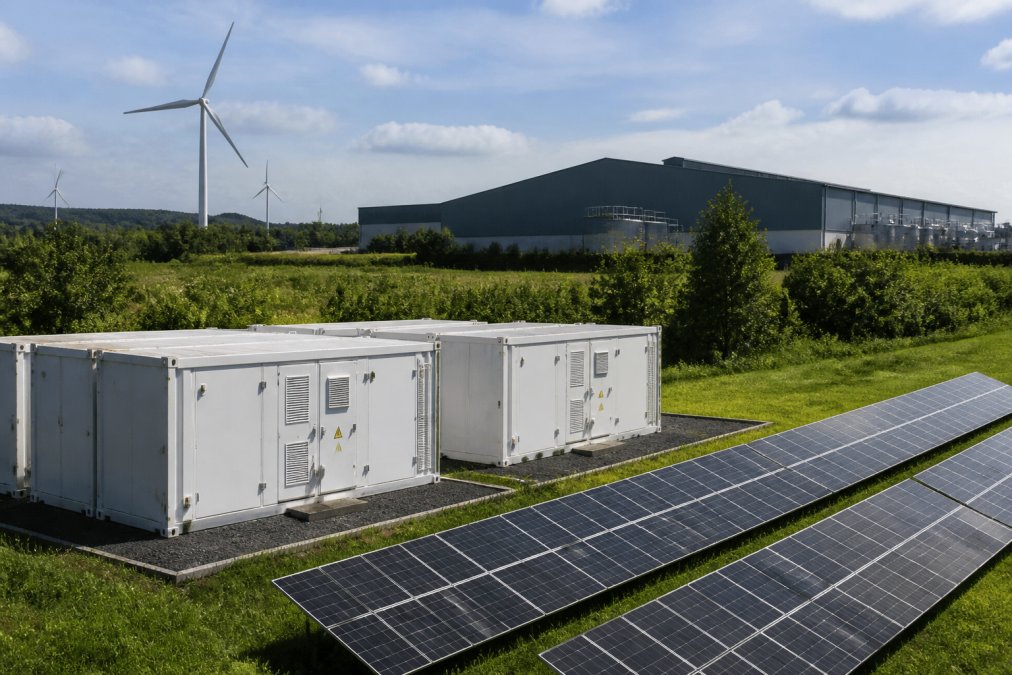
Commercial solar panels and battery storage together do more than a solar array alone. Generation is only half the equation; storage decides when you use it.
Click HERE for your FREE SURVEY today →
Demand Management and Energy Use Optimisation
Battery storage lets you shift generation to when it is worth most. Instead of exporting surplus cheaply at midday, you store it and use it during expensive evening periods or peak demand charges.
- Peak shaving: discharge the battery when site demand is highest
- Load shifting: move cheap generation to expensive periods
- Export timing: sell when prices are favourable rather than when generation peaks
For sites on tariffs with high peak rates or capacity charges, demand management can improve the return more than adding extra panels would.
Business Resilience and Operational Continuity
Business resilience rarely appears in payback models but often matters most. A solar and storage system with backup capability keeps critical systems running through grid interruptions.
For cold storage, manufacturing, or any operation where a power cut means lost stock or halted production, that continuity is hard to put in a spreadsheet but easy to justify in a boardroom.
Environmental and Reputational Gains From Large Scale Solar
Environmental gains are the benefit most businesses already understand, but the reputational side is underused, and both are only credible when measured. Generating your own renewable energy cuts emissions and shrinks your carbon footprint in a way that is quantifiable and reportable, provided you track it properly.
Turning Generation Into a Reported Emissions Figure
The mechanism is what separates a real sustainability claim from a slogan. Every unit your system generates and consumes on site displaces a unit you would otherwise have imported from the grid, and that displaced unit carries an emissions factor, the average carbon intensity of grid electricity, published and updated annually by the government.
That distinction matters because it feeds directly into the frameworks your larger customers and your own reporting obligations rely on:
- Streamlined Energy and Carbon Reporting (SECR): large unquoted companies and LLPs must report energy use and associated emissions in their annual reports. On-site generation changes both the energy use and the emissions figures.
- Energy Savings Opportunity Scheme (ESOS): qualifying organisations must assess their energy use; a large solar asset is part of that picture.
- Scope 2 reporting under the GHG Protocol: purchased electricity sits in Scope 2, and self-generation reduces it. The market-based versus location-based method changes how the reduction is presented, so the basis must be stated.
According to the government's guidance on business energy and net zero, organisations of all sizes are being encouraged to measure and reduce their emissions, which is pushing sustainability credentials up the agenda in procurement.
Where the Reputational Benefit Actually Converts
The competitive advantage is real but specific. It helps most where your customers are large organisations with their own environmental targets, and least where price is the only buying criterion. Where it converts, the mechanism is procurement: public sector tenders increasingly carry scored social value and environmental criteria, and large private buyers push similar requirements down their supply chains.
Three practical points strengthen the claim:
- Use metered data, not modelled estimates. Inverter and monitoring platform output is auditable; a spreadsheet assumption is not.
- State the boundary and the method. Say whether the figure is self-consumed generation, total generation, or net of export, and which emissions factor and reporting year you used.
- Keep it current. Emissions factors are revised annually, so a figure quoted from three years ago will not survive scrutiny.
The Limits of the Reputational Case
It is worth being straight about where this benefit does not help. If your market is purely price-driven, or your customers never ask about supply chain emissions, the reputational gain will not move revenue. The emissions reduction is still real and reportable, but do not let it inflate the business case. Weight it as a secondary benefit behind cost and resilience, and treat any reputational upside as a bonus rather than a justification for the investment.
Risks, Limitations and Suitability: What to Check Before You Commit
Suitability decides everything. Solar is not right for every site, and a good installer will tell you so before you spend anything.
The main limitations to weigh:
- Roof condition and structure: an ageing roof may need work before or alongside installation
- Orientation and shading: north-facing or heavily shaded roofs generate less
- Consumption profile: sites that are empty during daylight use less of what they generate
A proper survey should model your actual consumption, inspect the roof or land, and confirm connection arrangements before any figure is quoted. If a quote arrives without that groundwork, treat it with caution.
Conclusion: Turning Solar Potential Into Business Reality
The benefits of large scale solar are real, but not automatic.
At Smarter Utility, we are Scotland's leading installer of solar PV, battery storage, and EV charging, and a fully accredited MCS solar and battery storage installer.
Click HERE for your FREE SURVEY today and find out what your site could actually generate, save, and return.
Frequently Asked Questions
How long do commercial solar panels last?
Most commercial solar panels come with performance warranties of 25 to 30 years, and many continue generating useful electricity beyond that. Inverters typically need replacement after 10 to 15 years. Battery storage systems have shorter warranties, often 10 years. When planning a large scale solar business case, factor in mid-life component replacements so your payback period and long-term savings estimates stay realistic.
What are the main benefits of solar energy for businesses?
The main benefits are lower electricity bills, protection from energy price volatility, and a shorter commercial solar payback period. Businesses also gain energy independence, reduced carbon footprint, and a stronger sustainability story for customers and stakeholders. Adding commercial solar panels and battery storage improves resilience and lets you shift demand away from expensive peak periods, which increases business solar energy savings over the system's life.
Can large-scale solar reduce a business's electricity bills?
Yes. Large scale solar generates electricity on site, so you buy less from the grid during daylight hours. The exact reduction depends on your electricity consumption profile, system size, and how much generation you use directly. Adding battery storage lets you use more of your own solar power in the evening, cutting bills further. A free survey is the best way to model the figures for your specific site.
What happens to solar panels after 25 years?
After 25 years, most panels still produce at around 80% of their original capacity, according to manufacturer warranties. They do not stop working overnight. At that point you can keep using them, add more capacity, or replace them. For a large scale solar business, planning for repowering or expansion at year 25 helps you protect the long-term return on investment and keep operational cost reduction going.