 how-to
How Energy Audits Cut Business Overheads in Scotland
Quick Summary
Energy audits business overheads by showing where energy is wasted and ranking the fixes by cost, saving and payback period. The audit diagnoses the leaks, and the savings come only from acting on its recommendations. One case study found potential to cut consumption by up to 50%, though results vary by building.
- A business energy audit reviews electricity, gas, water and heating use and produces a ranked report.
- Audits are diagnostic: they identify waste but only save money if you act on the recommendations.
- Simple payback is the installed cost divided by the annual saving, and it is a quick way to rank measures.
- Grant funding and energy price changes can shift payback, so test measures against both before committing.
- Ask assessors to map recommendations to ESOS, SECR and Climate Change Agreements to add compliance value.
Table of Contents
- What a Business Energy Audit Actually Covers
- How Energy Audits Reduce Business Overheads
- Business Energy Audit Checklist: What Your Assessor Should Examine
- Business Energy Audit Cost and How to Judge Value
- Calculating Return on Investment From Audit Recommendations
- Energy Audit Savings Examples From Real Premises
- Business Energy Efficiency Measures Worth Prioritising
- Booking Your Free Survey and Next Steps for Your Premises
- Frequently Asked Questions
What a Business Energy Audit Actually Covers
A business energy audit is a structured review of how a premises uses energy, from electricity and gas to water and heating, and it is one of the most practical ways to start controlling energy audits business overheads. The assessor measures where energy goes, checks equipment condition, and lists the changes that would cut waste. Think of it as a health check for your utility spending.
Most audits look at lighting, heating, ventilation, compressed air, refrigeration and any process equipment. They also review your utility bills, tariffs and meter readings. The result is a written report that ranks each recommendation by cost, saving and payback period.
Audits are diagnostic. They tell you where the money leaks. They do not fix the leaks on their own, so the value depends on what you act on afterwards.
How Energy Audits Reduce Business Overheads
Energy is a fixed cost for most premises, so cutting waste goes straight to the bottom line. An audit finds the waste, and the recommended changes then lower the monthly bill.
Research on energy efficiency suggests the potential reduction can be large. One case study found that an audit identified potential to cut energy consumption by up to 50% Energy audit case study on potential consumption reduction. Results vary by building and how much action follows, so treat this as an upper potential rather than a guaranteed outcome.
Audits typically help overheads in three ways:
- Lower running costs from equipment that is switched off, upgraded or set correctly
- Fewer surprise bills because usage patterns become visible
- Better planning when you know which upgrades pay back first
Benchmarking is one of the main tools here. Comparing your usage against similar premises shows where you are overspending, which is a common way to protect your margin Rimkus guidance on energy benchmarking for businesses.
Business Energy Audit Checklist: What Your Assessor Should Examine
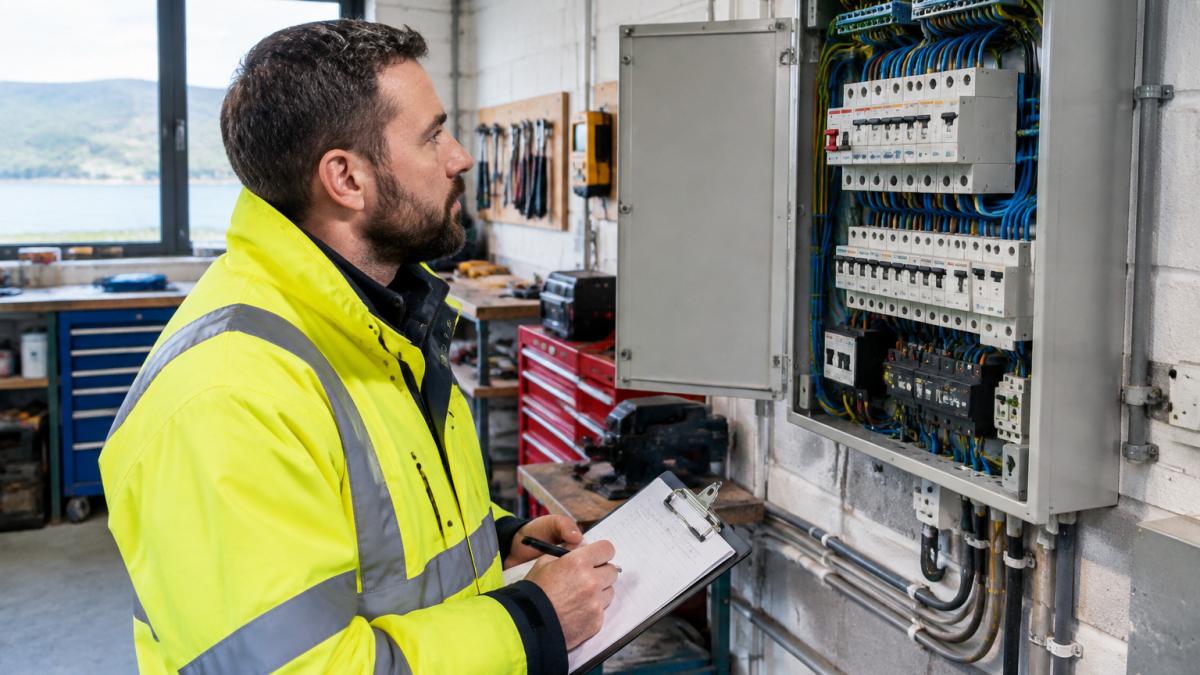
A thorough audit should cover the following areas. Use this list to check the scope of any quote you receive.
- Electricity and gas bills for at least 12 months
- Meter readings and half-hourly data where available
- Lighting type, controls and hours of use
- Heating, ventilation and air conditioning settings and servicing records
- Insulation in roofs, walls and pipework
- Refrigeration and any process equipment
- Compressed air leaks, where relevant
- Hot water systems and their controls
- Building fabric, including draughts and glazing
- Any on-site generation or battery storage
Ask the assessor to explain each recommendation in plain terms. A good report states the cost, the expected saving and the payback period for every item.
Business Energy Audit Cost and How to Judge Value
Audit pricing depends on the size and complexity of the premises, the number of sites and the depth of analysis required. Please request a quote from our team for current figures.
When you compare quotes, look at scope rather than price alone. Check whether the report includes:
- A clear list of recommendations, each with a cost and saving
- Payback periods for upgrades
- Any grant or support schemes you might qualify for
- A plan for measuring results after changes are made
A cheap audit that only lists problems can cost more over time than a fuller one that prioritises actions.
UK schemes that change the value calculation
An audit is worth more when it connects to funding and compliance drivers. Ask your assessor to map recommendations against the following:
- Energy Savings Opportunity Scheme (ESOS). Qualifying large undertakings must assess energy use and identify cost-effective savings. An audit that produces ESOS-compliant evidence avoids paying twice for the same work.
- Streamlined Energy and Carbon Reporting (SECR). Quoted companies and large unquoted companies must report energy use and carbon emissions. Audit data feeds directly into the disclosure.
- Climate Change Agreements (CCAs). Energy-intensive sectors can secure a reduced rate of Climate Change Levy in return for meeting efficiency targets. Audit findings help demonstrate progress.
- Enhanced Capital Allowances and the Annual Investment Allowance. Some energy-saving plant and machinery qualifies for accelerated tax relief. Confirm eligibility with your accountant before you commit capital.
- Boiler Upgrade Scheme and similar grant programmes. Where a recommendation involves heat pumps or other qualifying low-carbon heating, grant funding can materially shorten payback.
Judging value beyond the report
The best value comes from an audit that leaves you with a prioritised action plan, a baseline you can measure against, and evidence you can reuse for compliance reporting. Ask prospective assessors how they will help you track savings after implementation, and whether they will revisit the site to verify results. An audit that is never revisited rarely delivers the savings it promised.
Calculating Return on Investment From Audit Recommendations
An audit becomes useful when you turn its recommendations into numbers. Most practitioners find that a simple, repeatable framework beats a detailed spreadsheet nobody updates. The aim is to rank measures so you can defend a budget request and sequence work sensibly.
A four-step ROI framework
- List each recommended measure with its installed cost. Use quotes, not list prices, and include enabling works such as wiring, controls or access equipment.
- Estimate the annual saving from your current energy bills. Use your own meter data and tariff, not a generic benchmark. If a measure changes both electricity and gas use, calculate each separately.
- Divide the cost by the annual saving to get the simple payback period. This is the quickest screen and is understood by finance teams.
- Rank measures by payback, shortest first. Then overlay disruption, compliance deadlines and any grant funding before you commit.
For example, if a measure costs £5,000 and saves £1,000 a year, the simple payback is five years. A controls upgrade costing £1,200 and saving £600 a year pays back in two years and would normally go first.
Beyond simple payback
Simple payback ignores the life of the asset and the time value of money. For larger projects, add two refinements:
Click HERE for your FREE SURVEY today →
- Whole-life cost. Compare the installed cost plus maintenance over the asset life against the cumulative saving. A boiler replacement with a 15-year life can look weaker on simple payback but stronger on whole-life cost.
- Discounting. Apply your organisation's cost of capital to future savings. A project with a five-year payback may still fail a hurdle rate if savings arrive slowly.
Watch out: savings estimates that assume perfect operation rarely survive contact with a busy site, so apply a realistic utilisation factor to any measure that depends on staff behaviour.
Accounting for grants and energy price risk
Grant funding changes the payback calculation. Subtract any confirmed grant from the installed cost before dividing, and keep the grant claim separate in your records. Energy price movements also matter: a measure that looks marginal at today's tariff may look strong if prices rise, so test the payback at a higher and lower tariff to see how sensitive it is.
A worked example
A small warehouse reviews three audit recommendations:
- Lighting controls: cost £1,800, saving £900 a year, payback two years.
- Roof insulation: cost £9,000, saving £1,500 a year, payback six years.
- Compressed air leak repair: cost £600, saving £1,200 a year, payback six months.
The leak repair and controls go first because they release cash quickly. Insulation waits for a capital budget or a grant, even though its whole-life case may be strong.
For a detailed method applied to a specific technology, see our guide on calculating commercial solar ROI for Scottish businesses calculating commercial solar ROI for Scottish businesses. Current installation cost figures are also useful when you plug numbers into your own estimate commercial solar installation costs.
The article sets out a simple ROI framework, with a worked example showing how each measure ranks by payback period.
| Measure | Cost | Annual saving |
|---|---|---|
| Lighting controls | £1,800 | £900 |
| Roof insulation | £9,000 | £1,500 |
| Compressed air leak repair | £600 | £1,200 |
Energy Audit Savings Examples From Real Premises
Real examples show what audits can uncover. One Scottish-relevant case involved Argyle Energy, which audited its electricity, gas and water use. The audit identified potential to reduce utility usage by 30%, with total cost savings exceeding £50,000 Argyle Energy case study on utility audit savings.
Results will differ for every site, so use examples to understand the kinds of savings to look for, not as a promise for your own premises.
Business Energy Efficiency Measures Worth Prioritising
Audit reports usually group recommendations into quick wins and larger projects. Quick wins include controls, timers and maintenance. Larger projects include insulation, lighting upgrades and renewable generation.
Renewables are often a strong option. Audits are increasingly used to reduce demand first, so that any solar or battery investment is sized correctly EECA guidance on energy audits and demand reduction. For premises with large roof space, you can explore our commercial solar panel installation service as one of the options your audit may highlight.
Prioritise measures by payback and by how much disruption they cause. A simple controls upgrade may beat a major rebuild on both counts.
Booking Your Free Survey and Next Steps for Your Premises
The most useful next step is to book an assessment and get a clear list of options for your site. Smarter Utility offers a free, no-obligation survey so you can see what applies to your premises before committing to anything.
Contact Smarter Utility to arrange a free site survey.
Bring your last 12 months of utility bills to the survey. That gives the assessor what they need to show you where overheads can come down.
Frequently Asked Questions
How can an energy audit reduce business overheads?
An energy audit measures where electricity, gas and water are used and identifies waste such as lighting left on out of hours, heating systems running inefficiently, and equipment drawing power when idle. Each recommendation has an estimated saving attached, so a business can prioritise measures that cut its utility bills fastest.
How much can a business save after an energy audit?
Savings vary widely with building size, equipment age and how the premises are used. Audits are diagnostic, so savings only materialise when the recommended projects are carried out, which may be limited by available budget.
Is a business energy audit worth the cost?
It is worth it when the recommendations are likely to pay back within a reasonable period. Compare the audit fee against your annual energy spend and the likely saving from the top three recommendations. Ask the assessor for estimated payback periods on each measure, and check that the audit covers electricity, gas and water rather than only one utility.
Can an energy audit identify whether solar panels or battery storage could reduce energy costs?
Yes. A well-scoped audit establishes your daytime and out-of-hours consumption profile, which is the information needed to judge whether solar generation and battery storage would suit your premises. Audits are often used to reduce demand first, so the solar system is sized to what the building actually needs. Smarter Utility offers a free, no-obligation survey to assess this for your site.