 Ultimate guide
Future of Renewable Energy Storage for Farms: Options and Outlook
Last Updated: November 18, 2026
Quick Summary
Renewable energy storage for Scottish farms means capturing surplus solar or wind power and using it later, such as during evening milking or cold-store operation. Battery storage is becoming practical, with about 0.5 GW of battery capacity operating in Scotland by September 2025. Sizing should start from half-hourly consumption data, not annual totals.
- Battery energy storage capacity in Scotland was about 0.5 GW at the end of September 2025.
- Solar output peaks midday, while many farm loads run early and late, creating a gap storage can fill.
- Collect at least 12 months of half-hourly consumption data before sizing any battery system.
- Set the battery's power rating from peak demand and its capacity from the energy you want to shift.
- Ask any quote to show the half-hourly peak it was designed around and its payback assumptions.
Table of Contents
- Why Scottish Farms Are Turning to Renewable Energy Storage
- Solar Panels for Farms: Generation That Needs Storage
- Battery Storage for Farms: Matching Systems to Farm Loads
- Pumped and Other Storage Technologies Worth Watching
- Farm Battery Storage Costs and Payback Scenarios
- Government Strategy, Grants and the Policy Outlook
- Planning Your Farm's Energy Storage Next Step
- Frequently Asked Questions
Why Scottish Farms Are Turning to Renewable Energy Storage
Battery energy storage is moving from a niche idea to a practical option for Scottish agriculture, and renewable energy storage now features in more farm energy plans. At the end of September 2025, approximately 0.5 GW of battery energy storage system (BESS) capacity was operating in Scotland, according to the Scottish Government's Battery Energy Storage Systems report. Farms ready for the next step can review our commercial solar panel installation service, designed for agricultural and business sites.
Energy storage is the practice of capturing electricity when it is produced, holding it, and releasing it later. For a farm, that means storing surplus solar or wind output and drawing on it during evening milking, cold-store operation, or periods when generation falls. The ClimateXChange literature review on electrical energy storage examines how storage supports Scotland's electricity system as more time-variable renewable generation comes online.
The pressure is not only environmental. Farms carry energy costs that move with the wider market, and many rural premises are at the end of long grid connections where supply can be less stable. Storage is one way to reduce exposure to both problems.
Solar Panels for Farms: Generation That Needs Storage
Solar panels are usually the starting point for on-farm generation. The difficulty is timing: solar output peaks in the middle of the day, while many farm loads, such as milking equipment and ventilation, run early and late.
Without storage, a large share of midday generation is either exported at a lower rate or used only when the farm happens to be drawing power. Battery storage can help close that gap.
Battery Storage for Farms: Matching Systems to Farm Loads
The right battery depends on what the farm actually consumes, and the only reliable way to match the two is to work from half-hourly data rather than annual totals. A battery sized for a small domestic load will be undersized for a dairy unit, and an oversized unit on an arable holding may sit idle for most of the year.
Matching the system to the load also means considering where the battery sits. A unit serving a single building behaves differently from one connected to the main farm supply, and the difference matters most during an outage or a period of high tariff pricing.
A Practical Sizing Method
A repeatable method works better than a rule of thumb. A repeatable approach is:
- Collect half-hourly consumption for at least 12 months. Identify the maximum import in each half-hour period and the time of day it occurs.
- Overlay the generation profile. Use the solar or wind output for the same periods, ideally from a monitoring platform rather than an estimate.
- Calculate the self-consumption gap. For each half-hour, subtract generation from consumption; the positive remainder is what storage could shift or shave.
- Set the power rating from peak demand. The battery's kilowatt rating must cover the load you want it to support at any one time, not the total energy used over a day.
- Set the capacity from the energy you want to shift. Multiply the average shifted load by the number of hours you need to cover, then add a margin for degradation and depth-of-discharge limits.
- Check the backup requirement separately. If the farm needs critical loads protected during an outage, size an islanding-capable circuit around those loads rather than the whole site.
A common pattern is that the power rating is set by a short, sharp peak such as a milking parlour or a grain dryer start-up, while the capacity is set by the evening load the farm wants to cover. Getting one right and the other wrong is the most frequent sizing error we see.
Sizing by Farm Type
Dairy farms usually have a strong, predictable daily load from milking and cooling, which makes them good candidates for storage that shifts consumption into the evening.
Arable operations tend to have seasonal peaks linked to drying and irrigation, so storage may be most valuable for a limited number of months.
Watch out: a battery sized from annual kilowatt-hour totals alone will usually be wrong on power rating, so insist that any quote shows the half-hourly peak it was designed around.
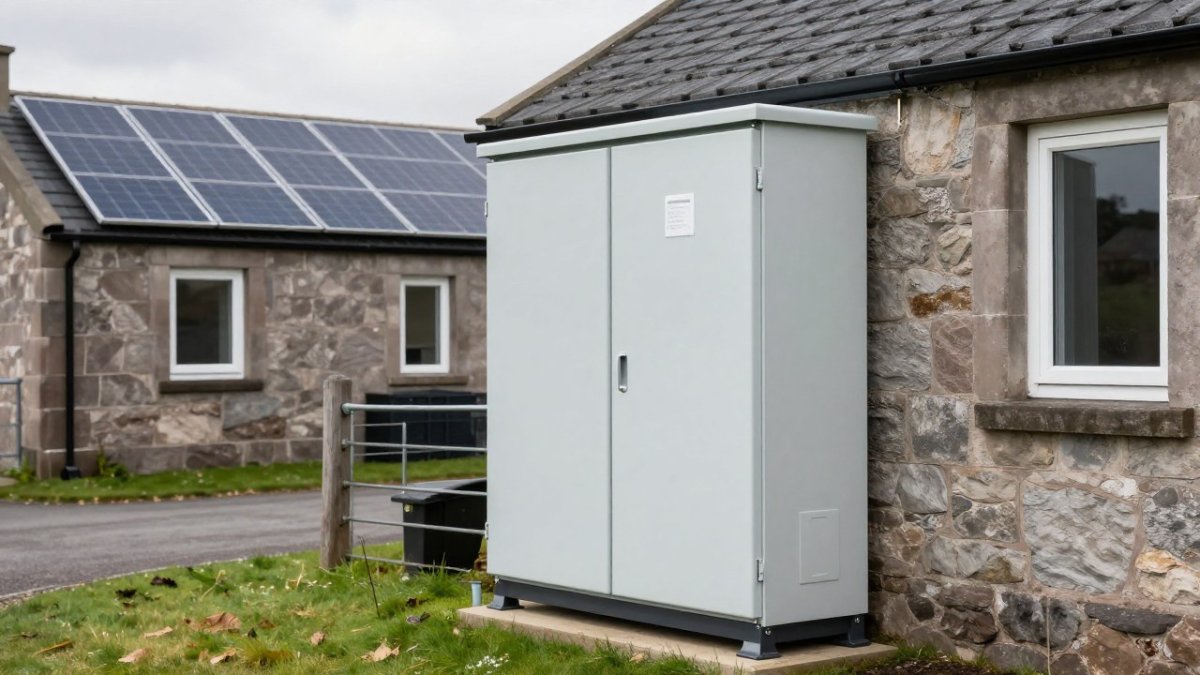
!A Scottish farm yard with a battery storage cabinet mounted beside a farm building, with solar panels on a nearby shed roof under overcast sky
The sizing method below turns farm load data into a battery specification, and the table summarises its steps.
| Step | What to do | Basis |
|---|---|---|
| Collect consumption data | Gather half-hourly consumption for at least 12 months | Peak import and its timing |
| Overlay generation | Add solar or wind output for the same periods | Monitored output, not estimate |
| Calculate gap | Subtract generation from consumption each half-hour | Shiftable remainder |
| Set power rating | Cover the peak load to support at any one time | Kilowatt rating |
| Set capacity | Multiply shifted load by hours to cover, add margin | Kilowatt-hours |
| Check backup | Size islanding circuit around critical loads only | Outage protection |
Pumped and Other Storage Technologies Worth Watching
Batteries are the storage technology most farms will consider, but they are not the only one. The Scottish Enterprise techno-economic analysis of the energy storage market estimates 13.4 GW of storage systems in the Scottish market, mainly battery energy storage systems, with some flow batteries and liquid-air energy storage. The study's date and scope should be checked before relying on that figure.
Pumped storage, which moves water between reservoirs at different heights, operates at utility scale and is not a realistic option for an individual farm. For agricultural premises, the practical choices today are lithium-based batteries and, over time, emerging chemistries that may suit longer-duration storage. We recommend watching these developments while choosing proven technology now.
Farm Battery Storage Costs and Payback Scenarios
Costs depend on system size, equipment, site conditions and installation complexity, and no responsible installer publishes a single fixed price because a figure without a survey behind it would mislead you. What we can do is set out the structure of the calculation, so you can see what drives the number and test any quote against it.
What Drives the Capital Cost
The main cost components typically include the battery modules and inverter, the balance-of-system works (cabling, switchgear, containment and any civil works), the grid connection or upgrade if one is needed, and the installation and commissioning labour. Planning, building warrant and electrical certification costs may apply in some cases and not others, so ask for these to be shown separately.
The Payback Calculation
A useful way to frame a quote is to compare the total installed cost against annual savings over the system's life, and to show the assumptions behind every line. The calculation has four inputs:
- Self-consumption savings. The kilowatt-hours shifted from import to stored generation, multiplied by the import tariff they avoid.
- Export income. The value of generation that would otherwise be exported, compared with the value of using it on site.
- Tariff structure. Time-of-use import prices, standing charges and any export tariff all change the answer, and a battery that shifts load into a cheap overnight window can pay back differently from one that only stores solar.
- Degradation and life. Battery capacity falls over time, so savings in year ten are lower than in year one; a payback that ignores this overstates the return.
A simple table of year-by-year cash flow, with a sensitivity check on the tariff and on the number of cycles the battery actually completes, is a sensible way to present this. If a quote shows only a single payback figure, ask which assumptions it rests on.
Operating Costs and Whole-Life Economics
Capital cost is only part of the picture. Operating costs include monitoring subscriptions, occasional firmware and warranty administration, insurance, and the cost of replacing the inverter at some point in the system's life.
Bringing these together gives a whole-life view rather than a headline payback. A system with a slightly higher capital cost but a longer warranty and lower degradation can be the better investment, and the only way to see that is to compare the full cash flow rather than the sticker price.
Watch out: a battery sized too large for the farm's loads adds cost without adding savings, so ask how the sizing was justified before agreeing to a system, and check whether the payback assumes a tariff that is no longer available.
Government Strategy, Grants and the Policy Outlook
Scotland has set a target of generating at least 30% of its energy needs from renewable sources, and its stated net-zero target is 2045, five years ahead of the rest of the UK, as Lichfields' analysis of solar and storage development in Scotland describes. That policy direction shapes the planning and funding environment for farm-scale storage.
Grants and loans change over time and depend on eligibility, so check the current position with the funding body before you rely on any scheme. Check that any planning guidance you rely on is current, as policy documents are revised over time. Planning is a real consideration as well: a Solar Power Portal report on Scottish BESS planning guidance notes that applicants must address site selection and planning before development proceeds.
Planning Your Farm's Energy Storage Next Step
The sensible next step is an assessment of your own consumption and roof or land space, followed by a clear comparison of options. Our MCS-accredited installation standards approach means we design around your figures, not a template. Farms in remote locations may also benefit from reviewing how how to power a remote farm building off-grid with solar could work alongside storage.
If you are ready to take the next step, book a solar battery storage installation consultation to see how a system would perform on your farm. For a quick local option, find a renewable installer near you to discuss your site, or see our solar PV and battery storage services for an overview of what we install. Our free, no-obligation survey gives you a tailored design before you commit to anything.
Frequently Asked Questions
How can energy storage help farms use renewable electricity?
Energy storage lets a farm keep electricity generated by solar panels or wind turbines and use it later, when generation is low or demand peaks. For a farm, this means milking equipment, grain drying, cold stores and workshop loads can run on power the farm has already produced rather than drawing from the grid at higher rates. Storage also reduces the amount of surplus generation that is exported at low prices. The practical benefit depends on how closely the storage size matches the farm's daily load pattern, which is why a site survey and load assessment should come before any purchase decision.
Can farms store surplus solar or wind power for later use?
Yes. A battery energy storage system charges when generation exceeds on-site demand and discharges when demand exceeds generation, such as during evening milking or overnight cold storage. Battery storage is the most common option for farm-scale installations in Scotland, and Scottish Government reporting shows operating battery capacity already in place across the country, with a larger pipeline of projects. Whether storing surplus is worthwhile depends on the size of the surplus, the cost of the battery and how the electricity tariff is structured.
What should farmers consider before installing battery storage?
Start with a load profile covering a typical day and a busy season, not just annual consumption. Check the existing electrical supply and whether the site needs planning permission, since battery storage is an increasingly common consideration in Scotland. Consider how the system will connect to existing solar or generation, expected lifespan, maintenance, and what happens during a grid outage. Ask any installer for a sizing calculation tied to your own loads, and check that the installer is MCS accredited for battery storage.