 Ultimate guide
Are EV Charging Demand Response Programmes Worth It?
Last Updated: November 16, 2026
Quick Summary
EV charging demand response programmes are worth it when charging is controllable and can move away from peak periods without leaving vehicles short of charge. Payments depend on the programme, tariff and site, so the value varies. Smart charging and load balancing make this possible.
- Academic work says charging can be moved away from peak periods if it is controllable.
- Public charging could reach 600 GW by 2030, adding stress to local networks.
- Check whether your charger and connection meet the programme's approved requirements before enrolling.
- Confirm a guaranteed minimum state of charge by departure time in the programme terms.
- Ask for a sample report showing how event reductions are measured against a baseline.
Table of Contents
- What Demand Response Means for EV Charging
- How EV Charging Demand Response Works in Practice
- EV Smart Charging and Load Shifting Explained
- How EV Charging Load Balancing Protects Site Capacity
- Choosing EV Charging Management Software for Demand Response
- Enrolling, Economics and Participant Protections
- Next Steps for Your Charging Site in Scotland
- Frequently Asked Questions
What Demand Response Means for EV Charging
Demand response is a set of arrangements in which electricity users reduce or shift their consumption when the grid is under strain, usually in return for payment or a lower tariff. For electric vehicle owners and fleet operators, the question is whether charging can be moved away from peak periods without disrupting the vehicles' needs. Academic work on the subject is clear that it can, provided the charging is controllable.
The concept is increasingly relevant because public charging networks are growing quickly. A 2026 paper by Y. Cho et al. on data-driven demand response aggregation for public EV charging projects that global public charging infrastructure could reach 600 GW by 2030. At that scale, uncoordinated charging could add meaningful stress to local networks, which is why aggregation and demand-side flexibility are attracting research attention.
We think the practical starting point is simple: a charger that can be scheduled or throttled is a grid asset, not only a load. Whether that asset earns money depends on the programme, the tariff and the site, which the rest of this guide examines.
How EV Charging Demand Response Works in Practice
In practice, a demand response programme sends a signal, such as a price change, a request from a utility or an aggregator, or a schedule instruction. The charging system then adjusts power delivery to the vehicles connected to it. The vehicle's required state of charge and departure time set the limits on how far that adjustment can go.
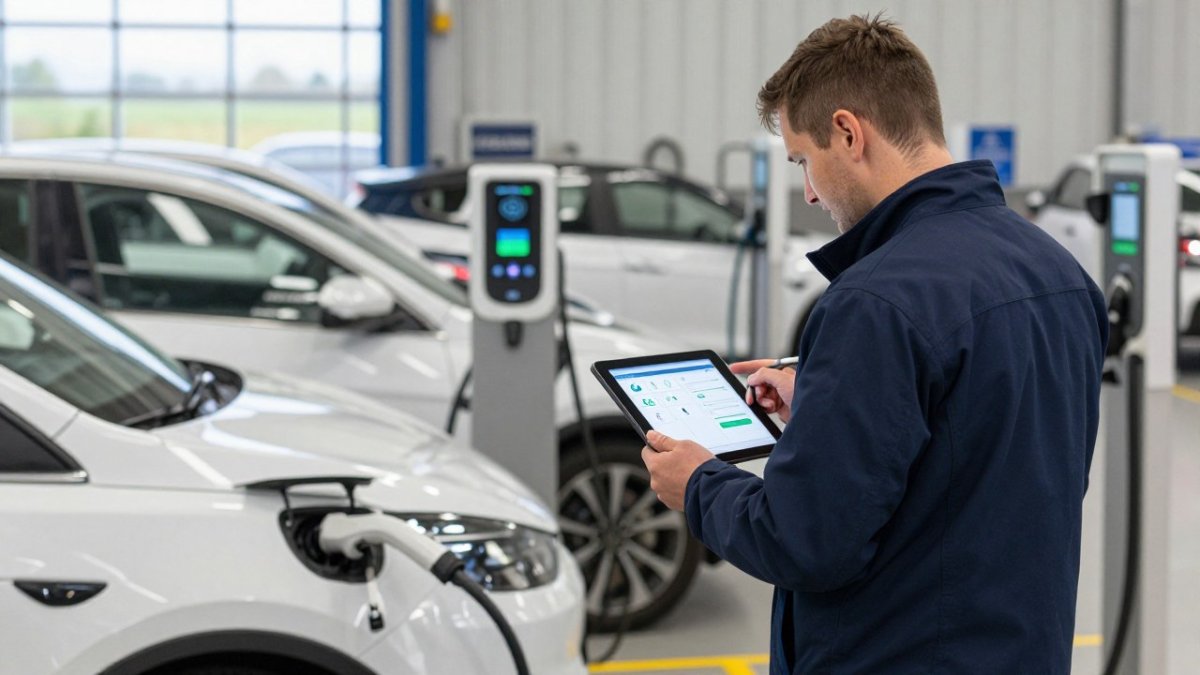
Research on demand response for electric vehicles treats this as an optimisation problem. A systematic survey on demand response management by R. Kakkar et al. (2024) discusses how energy consumption can be optimised for secure and efficient demand response, and the same logic applies to individual charging sites.
!Fleet manager reviewing a charging dashboard on a tablet beside electric vehicles plugged in at a depot
Operators usually face three practical decisions: which events they will respond to, how much flexibility they can commit to without missing a vehicle's departure, and how they will measure the reduction they delivered.
EV Smart Charging and Load Shifting Explained
Smart charging refers to controlling when and how fast vehicles charge, rather than starting every session at full power. Load shifting moves that charging to periods when electricity is cheaper or the grid has spare capacity, typically overnight or when local renewable generation is high.
A 2024 study by G. G. Zanvettor et al. on a stochastic approach for EV charging stations in demand response describes demand response as a way of helping balance electricity supply and demand in renewable energy communities. This is the core benefit of load shifting: it lets more renewable output be used locally rather than curtailed.
Load shifting works best where vehicles stay parked for long periods, as they do at homes, workplaces and depots. Where a driver needs a fast top-up before a journey, the flexibility available is far smaller, and the scheduler has to respect that.
How EV Charging Load Balancing Protects Site Capacity
Load balancing distributes available power between several chargers so that the total draw stays within the site's connection limit. It is the mechanism that lets a site install more charging points than its supply could feed at full power simultaneously.
For demand response, load balancing matters because it provides a safe way to reduce site demand without switching chargers off. A charging hub can drop its aggregate draw during an event while every vehicle still receives some energy. Watch out: a load-balancing setup that is not sized to the site's real capacity can trip protective equipment, so the connection and the charger configuration should be checked together.
Choosing EV Charging Management Software for Demand Response
Management software is the layer that receives signals, applies schedules and logs what happened. It is also the layer that decides whether a site can join a programme at all, because most programmes specify the communications they require. When comparing options, work through the criteria below rather than starting from a feature list. Because communications and scheduling determine whether a site can respond to programme signals, Yorks Ev highlights why dynamic load balancing belongs in the same assessment.
Signal and protocol support. Confirm which demand response signals the software can receive and act on. Common patterns include OpenADR (Open Automated Demand Response), which is widely used for commercial and industrial demand response, and OCPP (Open Charge Point Protocol) for communication between the charger and the management system. OCPP 1.6J and OCPP 2.0.1 are the versions most often specified; OCPP 2.0.1 adds smart-charging profiles and improved device management, but not every charger supports it.
Load balancing and per-vehicle scheduling. The software should support static and dynamic load balancing across the site, and should let you set a minimum state of charge and a departure time per vehicle. Without per-vehicle targets, a site-wide cap can leave one vehicle short while another is over-charged.
Reporting and verification. Programme payments usually depend on measured performance, so the software must log event start and end times, the power delivered during each event, and the baseline it is being compared against. Ask to see a sample report before you commit.
Charger compatibility. Check the make and model of your existing chargers against the software's supported list. Older units may need a firmware update or a communications gateway. Where a site has mixed hardware, confirm that the software can manage all of it under one schedule.
Cybersecurity and data handling. The software will control live electrical equipment and hold data about vehicle use. Confirm how access is controlled, how firmware updates are handled, and where data is stored. For commercial sites, check that the supplier's arrangements are consistent with your obligations under UK data protection law.
Watch out: a software platform that supports the right protocols on paper but has not been tested against your specific charger model and programme can fail at the first event, so ask for a reference site with comparable hardware.
Pricing depends on the charger count, the connection and the programme requirements, so we recommend requesting a quote rather than relying on general figures.
The article lists the criteria to check when comparing management software for demand response.
| Criterion | What to check | Why it matters |
|---|---|---|
| Signal and protocol support | OpenADR, OCPP 1.6J or 2.0.1, tested API | Determines whether the site can join a programme |
| Load balancing and scheduling | Static and dynamic balancing, per-vehicle targets | Keeps each vehicle's charge and departure time met |
| Reporting and verification | Event start and end, power delivered, baseline | Programme payments depend on measured performance |
| Charger compatibility | Make and model on supported list | Older units may need a firmware update or gateway |
| Cybersecurity and data handling | Access control, firmware updates, data storage | The software controls live electrical equipment |
Enrolling, Economics and Participant Protections
Most guides stop at describing demand response and never explain how a site actually joins a programme, what it is paid, or what protects the driver. This section covers those three practical questions, which is where most of the risk and most of the value sit.
Enrolment and eligibility. The steps are broadly similar across programmes, though the detail varies. A typical sequence is: confirm that your charger model and communications are on the programme's approved list; confirm that your electricity connection and metering meet the programme's requirements; agree the event terms, including how much notice you will receive and how many events you will accept; set the minimum state of charge and departure times the programme must respect; and complete a test event before live participation. Eligibility often depends on the type of connection, the charger's ability to receive remote signals, and whether the site is domestic, commercial or a fleet depot.
How the economics work. Compensation usually takes one of four forms. Availability payments reward a site for being ready to respond, whether or not an event is called. Event payments reward the actual reduction delivered during a called event. Time-of-use tariffs reward shifting charging to cheaper periods through the unit price rather than a separate payment. Capacity or connection agreements can reward a site for keeping its peak draw below an agreed level, which may reduce the cost of a new or upgraded connection. Many programmes combine two or more of these. Ask how the reduction is measured, what baseline is used, and whether there are penalties for missed events or for opting out early.
Participant protections. These matter as much as payments. Look for a guaranteed minimum state of charge by departure time, a clear statement of what the programme may do to your charger and when, a straightforward override that lets a driver charge immediately when needed, and a simple opt-out process. On data, confirm what information about vehicle use and charging is shared, with whom, and for how long. Under UK data protection law, you should be able to see what is held about you and ask for it to be corrected or erased where the law allows.
Watch out: a programme that pays well for availability but offers no departure guarantee can leave a driver without the charge they need, so read the protection terms before the payment terms.
Next Steps for Your Charging Site in Scotland
If you are considering demand response for a home, depot or business site in Scotland, the first step is a site assessment. You can request a free survey from our solar and EV installers in East Kilbride, who can review your connection, charger options and whether home panels or battery storage would strengthen the case. For commercial sites, our renewable energy services in Hamilton cover design, installation, commissioning and maintenance.
Before choosing software, it is worth reading our overview of how smart charging can move loads away from peak periods and our guide to how vehicle-to-grid charging extends these benefits. For fleets comparing options, our page on commercial smart charging software for fleet load management sets out what to look for.
Frequently Asked Questions
What is demand response in EV charging?
Demand response is an arrangement where EV charging is adjusted in response to signals from the grid, such as a request to reduce or delay power draw during periods of high demand. Charging sites that take part can be paid for the flexibility they provide, while drivers still expect their vehicle to be ready by a set time. The programme terms define how much notice is given, how long events can last and what minimum charge level must be guaranteed to the driver. Smart charging software is typically needed to act on these signals automatically.
Does demand response affect when an electric vehicle is ready to drive?
It can, but well-designed programmes protect the driver's departure time. Most schemes let the operator set a target state of charge and a departure time, and the charging system then spreads energy delivery across the available window. Load shifting only delays charging within that window rather than stopping it. Drivers should check the guarantees in any programme they join, including the minimum charge they will receive before a set time, and whether they can override a curtailment event.
How does EV charging load balancing differ from demand response?
Load balancing is a local control that shares a fixed site capacity between several chargers so the total draw stays within the connection limit. Demand response is an external arrangement in which the site responds to grid or market signals to reduce or shift demand. A site can use load balancing without joining any programme, and many demand response setups rely on load balancing to carry out the reduction safely.
Can businesses earn revenue from EV charging demand response?
Businesses with managed charging can be paid for flexibility, typically through a payment for making capacity available and additional payments when they are called on to reduce demand. The amount depends on the programme, the flexible capacity offered, how often events are called and the notice period. Figures vary widely, so operators should request written terms and a detailed estimate based on their own charging data before committing.