 how-to
How to Power a Remote Farm Building Off-Grid With Solar
Quick Summary
An off-grid solar system generates and stores its own electricity without a grid connection, which suits remote farm buildings a kilometre or more from the nearest pole. Start by auditing the building's real daily energy use, then size the panels for winter output and the battery for two to three days of essential load. Plan the installation around shading, dust and UK inspection rules.
- Measure real use first by listing each item's watts and daily run hours.
- Size the solar array on December sun hours, not summer sunshine, for year-round loads.
- Add a 20 to 30 percent margin to the panel array for dull days and losses.
- Size the inverter for the largest simultaneous surge, at least 1.5 to 2 times the biggest motor.
- Size the battery for two to three days of essential load in the worst winter month.
Table of Contents
- Why Remote Farm Buildings Need Their Own Power Supply
- Step 1: Carry Out a Farm Load Audit
- Step 2: Work Out Your Farm Solar System Sizing
- Step 3: Choose Solar Panels and Battery Storage for Farms
- Step 4: Plan Off-Grid Battery Storage for Agricultural Buildings
- Step 5: Install and Power Farm Sheds Safely
- Booking Your Free Survey for a Remote Farm Off-Grid System
- Frequently Asked Questions
Why Remote Farm Buildings Need Their Own Power Supply
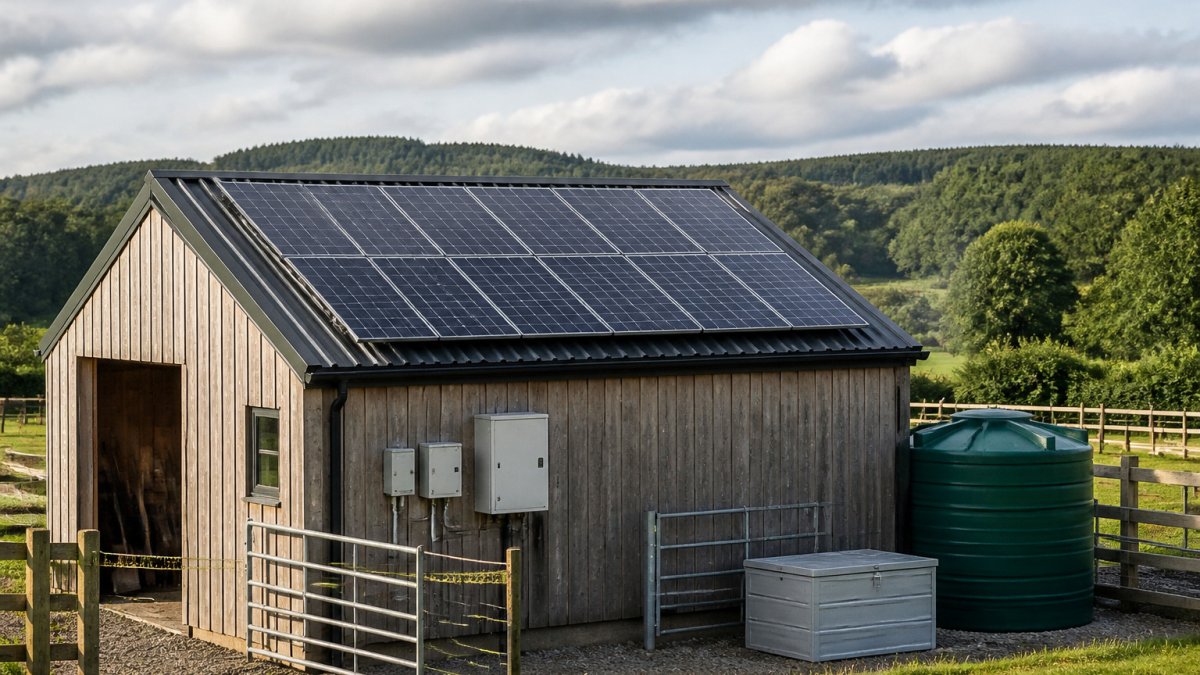
Many remote farm buildings sit far beyond the grid. A grain store, machinery shed or livestock shelter may be a kilometre or more from the nearest pole, so an off-grid solar system is one option to consider.
The case is practical. Remote buildings still need light, power for water pumps, electric fencing and tools, and somewhere safe to charge batteries. A diesel generator can fill the gap, but fuel must be carried, stored and paid for, and it runs loud and dirty. Solar with battery storage gives a quieter, steadier supply once sized correctly.
Off-grid solar is the term for a system that generates and stores its own electricity without a connection to the public network. For a farm, it means the shed runs on its own power, day and night, with no monthly standing charge.
Getting it right depends on the details. The sections below walk through the process, from measuring your real electricity use to planning storage for the darker months.
Step 1: Carry Out a Farm Load Audit
Before buying a single panel, you need to know how much electricity the building actually uses.
Start by listing every electrical item the building will run. Include the following:
- Lighting, including security lights
- Water pumps and trough fillers
- Electric fencing energisers
- Power tools, such as drills, grinders, and battery chargers
- Refrigeration or freezers for stored produce or feed
- Ventilation fans for livestock or grain
- Phone and tablet charging points
For each item, note its power rating in watts (usually on the label or in the manual), then estimate daily run hours. A pump might run 30 minutes twice a day; a freezer runs more or less all day.
Remember occasional loads too, such as a welder or a larger pump that runs once a week.
Multiply each item's watts by its daily hours to get watt-hours per day. Add the totals together. This daily figure is your starting point for system sizing in the next step.
The table below summarises the load audit so each item and its sizing role can be scanned at a glance.
| Item | Typical use | Sizing note |
|---|---|---|
| Lighting and security lights | Daily | Include in daily watt-hours |
| Water pumps and trough fillers | Around 30 minutes, twice a day | Check starting surge |
| Electric fencing energiser | Runs continuously | Include in daily watt-hours |
| Power tools and battery chargers | Occasional | Note for surge sizing |
| Refrigeration or freezers | Most of the day | Long daily run time |
| Ventilation fans | Daily | Include in daily watt-hours |
| Phone and tablet charging | Daily | Small but constant load |
Step 2: Work Out Your Farm Solar System Sizing
Once you have a daily energy figure, you can work out system size. Two numbers matter: solar array size and battery capacity.
Size the array from winter yield, not summer sunshine
To size the array, divide daily energy use by average useful sun hours. In the UK, plan on fewer than you might expect, especially October to March: a site seeing four to five peak sun hours in June may see only one to one-and-a-half in December. Use the December figure for year-round loads, and the summer figure only for seasonal loads such as irrigation pumps.
Worked example: a livestock shed with 1.2 kWh per day of essential load (LED lighting, a trough pump, and an electric fencing energiser) sized on 1.2 peak sun hours needs roughly 1 kWp of panels before any margin. Add a margin of 20 to 30 percent for dull days, dust on the panels, and cable losses, and you are looking at around 1.3 kWp. That is typically three to four standard 400 W modules.
Account for surge loads and inverter headroom
Daily energy is only half the story. Motors and pumps draw starting current several times their running current, and a welder or large grinder can briefly pull more than the whole daily load. Size the inverter for the largest simultaneous surge, not the average, typically at least 1.5 to 2 times the largest motor's running wattage, and use soft-start or variable-speed pumps where possible.
List your surge loads separately in the load audit: borehole and transfer pumps, refrigeration compressors, workshop tools, and any three-phase equipment.
Calculate battery autonomy in days, then check it against winter
For the battery, decide how many days of backup you want without sun and multiply daily use by that number. Many farms plan for at least one or two days of autonomy, keeping essential loads running through a dull spell.
But check that against winter. If December yield is one-third of June yield, a battery sized for two summer days may cover less than one winter day once lower generation and higher lighting loads are accounted for. Size the battery for two to three days of essential load in the worst month, and treat non-essential loads as shedable.
Step 3: Choose Solar Panels and Battery Storage for Farms
With sizing worked out, you can choose equipment. Older farm roofs may face the wrong direction or have limited space.
Click HERE for your FREE SURVEY today →
The battery stores energy for use when the sun is down.
Pricing for solar panels and battery storage depends on the system size, the type of equipment, and the installation work involved, including any roof or ground structures. Our solar panels for agricultural buildings guide explains the panel options available for farm roofs in more detail. For a current quote tailored to your building, visit the Smarter Utility website or request a survey.
Sizing Battery Capacity for Winter Autonomy
Winter is the hard test for any off-grid system in Scotland: shorter days and lower sun angles cut panel output, while heating and longer lighting hours push demand up. Our guide to battery storage benefits for Scottish farms covers how these pressures play out in practice.
To size for winter, use the lowest-output month rather than the yearly average. Work out how many kilowatt-hours your essential loads need over a typical winter day. Then size the battery to cover at least one or two of those days without sun. This is called winter autonomy.
Step 4: Plan Off-Grid Battery Storage for Agricultural Buildings
Battery storage planning for a farm can take account of the building and its surroundings.
Many farms also need a clear plan for how the system behaves when the battery runs low. A good controller will shed non-essential loads first, such as a workshop heater, and keep the fencing and lighting running. Set these priorities in advance rather than leaving them to chance.
Step 5: Install and Power Farm Sheds Safely
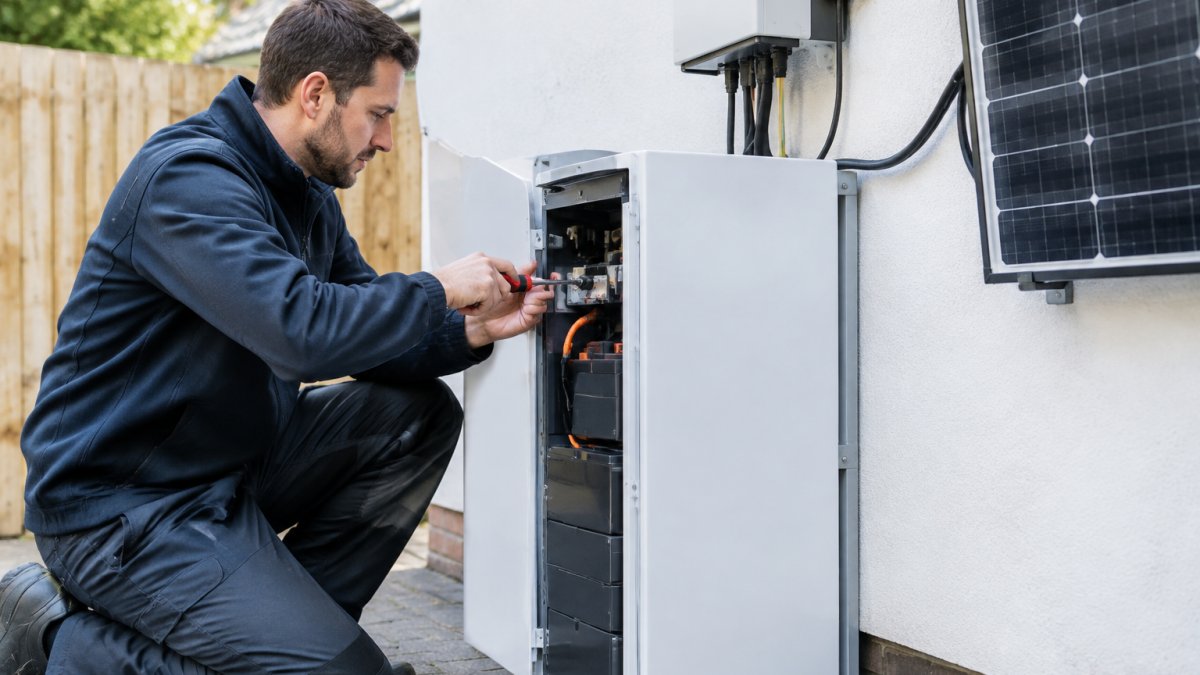
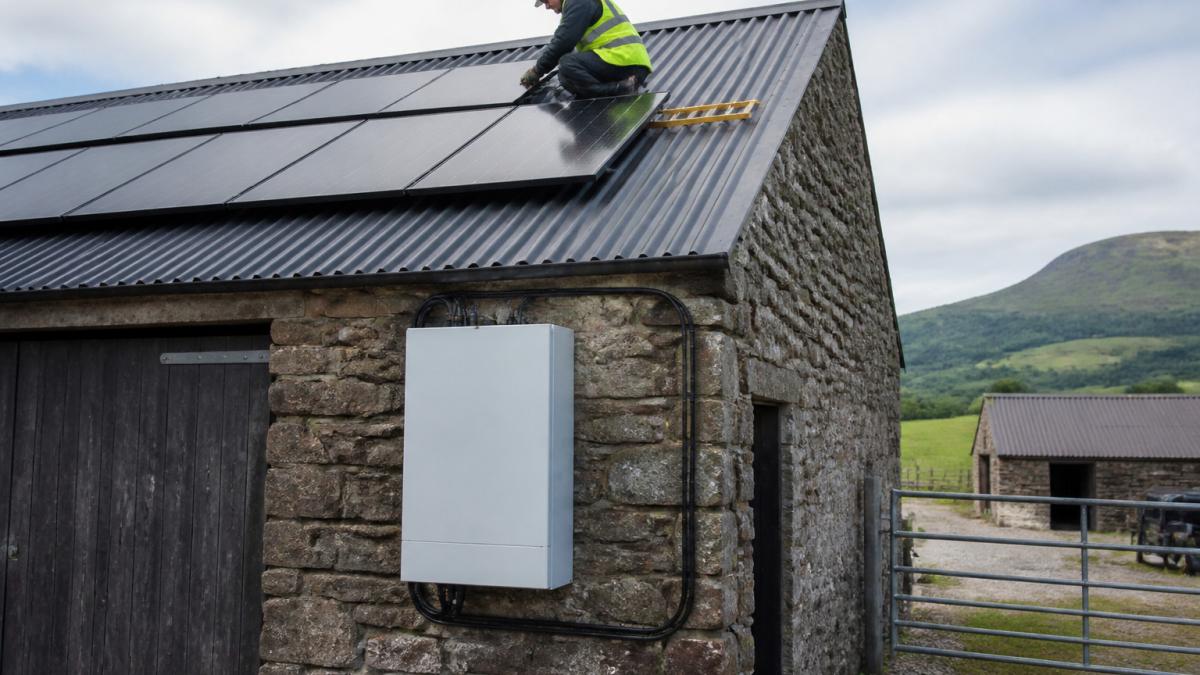
Installation is where a good design either works or fails. Solar and battery work involves electrical equipment and stored energy. On a farm, the building adds considerations beyond those of a domestic job.
Check the building before you check the equipment
Orientation and shading matter as much as condition. A roof facing east or west will produce less than a south-facing one, and a nearby tree, silage clamp, or taller building can shade the array for part of the day. Shading on one module can disproportionately reduce string output, so plan the layout around obstructions rather than assuming the roof is clear.
Design for dust, moisture, and livestock
Cable runs are a design decision, not an afterthought. Plan the route early, keep DC runs as short as practical, and size cables for current and voltage drop.
Meet UK installation and inspection requirements
Ask your installer for the test certificates and a schematic of the system at handover. These are what a future electrician or insurer will ask for.
Set load priorities and a maintenance routine
Many farms also need a clear plan for how the system behaves when the battery runs low. A good controller will shed non-essential loads first, such as a workshop heater, and keep the fencing and lighting running. Set these priorities in advance rather than leaving them to chance.
Booking Your Free Survey for a Remote Farm Off-Grid System
Every remote farm is different. The load audit, sizing and building layout depend on local details hard to judge from a distance.
Smarter Utility offers a free, no-obligation home survey. Our team is fully accredited and approved as an MCS solar and battery storage installer.
If you are ready to discuss your energy needs, contact Smarter Utility. You can also read our guide on planning battery storage for agricultural buildings.
Frequently Asked Questions
How do you power a remote farm building without a grid connection?
A remote farm building can be powered off-grid by combining a solar PV array, a battery bank and, where needed, a backup generator. The panels generate electricity during daylight, the battery stores the surplus for evening and overnight use, and an inverter converts the stored power to usable AC.
How many solar panels are needed to power a farm building?
The number of panels depends on your daily energy consumption in kilowatt-hours, the peak sun hours at your site and how many panels you can physically fit. Because Scottish daylight is short in winter, panels must be sized for the lowest-output months rather than the summer average.
What size battery do I need for an off-grid farm solar system?
Battery size is set by how many hours of autonomy you need, meaning how long the building must run from storage without sun. Most designs size the battery for the critical overnight and cloudy-period loads rather than the full daily total.
Do remote farm buildings need a backup generator with solar and batteries?
Many off-grid farm systems keep a backup generator for extended dull periods, large motor starts or unusually high winter demand. A hybrid design, with solar and storage as the primary supply and a generator as a fallback, is often the most resilient choice. Your installer should confirm the generator's role during the design stage so that the battery and inverter are configured to work with it.