 ultimate-guide
7 Benefits of Off-Grid Solar Battery Systems
Last Updated: November 4, 2026
Quick Summary
Off-grid solar battery systems deliver energy independence and security by removing exposure to standing charges, tariff changes and grid outages, while cutting electricity bills through self-consumption of stored power. They also lower carbon footprint, though winter performance requires sizing on the worst month and often a backup generator.
- Sales of off-grid solar systems rose 17% in the first half of 2024, according to PVcase's market analysis.
- A grid-tied system with battery backup delivers roughly 90% of the energy independence at 30-50% of the cost of going fully off-grid.
- A household using 10 kWh a day with a battery usable to 90% depth of discharge needs at least 11 kWh of nominal capacity for one day of autonomy.
- Lithium iron phosphate cells lose usable capacity in the cold and should not be charged below freezing without heating or charge inhibition.
- A system that is 30% oversized for summer is often correctly sized for January.
Table of Contents
- Why Off-Grid Solar Battery Systems Are Gaining Ground
- Energy Independence and Security: The Core Benefit
- How Off-Grid Solar Battery Systems Cut Electricity Bills
- Off-Grid Solar System Cost UK: What Drives the Figure
- Solar Battery Storage Capacity Requirements Explained
- Reliability, Carbon Footprint and Winter Performance
- Maintaining Off-Grid Solar Systems for the Long Term
- Book Your Free Survey and Size Your System Right
- Frequently Asked Questions
Why Off-Grid Solar Battery Systems Are Gaining Ground
Off-grid solar battery systems are self-contained power setups that generate electricity from photovoltaic panels, store it in a battery bank, and supply a property without any connection to the mains grid. Sales of off-grid solar systems rose 17% in the first half of 2024, according to PVcase's market analysis, which shows how quickly households and rural businesses are moving toward energy autonomy.
At Smarter Utility, we design and install solar PV, battery storage and EV charging for homeowners and businesses across Scotland, and the questions we hear have shifted. Five years ago, most people asked whether solar could cut a bill. Now they ask whether it can carry them through a winter outage entirely.
The benefits are real, but they come with trade-offs that most guides skip. Below, we break down the seven advantages, the cost drivers behind an off-grid solar system, and the sizing maths that decides whether a system works or fails in February. For a closer look at the core advantages, our guide to solar battery storage benefits in Scotland covers the fundamentals.
Energy Independence and Security: The Core Benefit
The headline benefit is energy autonomy: an off-grid system removes your exposure to standing charges, tariff changes and grid outages in one move. A 2022 case study on living off-grid with renewable energy, hosted by California Polytechnic State University's research repository, describes batteries as storing excess energy from sources such as solar for later use, which is the mechanism behind that independence.
What most guides miss is that independence is a spectrum, not a switch. A grid-tied system with battery backup delivers roughly 90% of the energy independence at 30-50% of the cost of going fully off-grid, according to Nuwatt Energy's analysis of off-grid solar. For most homes, that is the sensible trade. Full islanding suits rural premises where a connection is expensive or unreliable.
How Off-Grid Solar Battery Systems Cut Electricity Bills
Savings come from self-consumption: every kilowatt-hour your panels generate and your battery discharges is a unit you do not buy. An off-grid property removes most grid-supplied electricity, though it also forfeits export payments and grid backup.
The arithmetic is straightforward. A system sized around your daily consumption, charged by daylight and discharged overnight, displaces the bulk of imported units. Load management sharpens the effect: run the washing machine, dishwasher and EV charging during peak generation, and the battery bank carries the evening load instead of the grid.
Watch out: sizing a battery bank on summer generation is a common mistake. A system that cycles comfortably in June can hit its discharge depth limit by 4pm in December.
Off-Grid Solar System Cost UK: What Drives the Figure
There is no single off-grid solar system cost UK figure, because the price is set by your daily kWh demand, the battery capacity needed to cover winter, and whether you keep a grid connection as backup. Off-grid setups generally carry a higher upfront cost than grid-connected systems, largely because of the additional battery storage required.
Four factors move the number most:
- Battery bank size, measured in kWh capacity, which scales roughly with winter demand rather than annual demand
- Inverter and charge controller ratings, matched to peak load rather than average load
- Backup generation, such as a generator, for prolonged low-sun spells
- Installation complexity, including cable runs, mounting and any groundworks
To make the figure concrete, work in cost per kWh of usable battery capacity rather than a headline total. Lithium iron phosphate (LiFePO4) units typically cost more per kWh of nominal capacity than lead-acid, but because they tolerate deeper discharge and more cycles, the cost per usable kWh over their service life is often lower.
The cost-benefit case rests on what you avoid. An off-grid property reduces unit charges and standing charges, but it also forfeits export payments under the Smart Export Guarantee and loses the grid as a backup. The honest comparison is therefore between an off-grid system and a grid connection with battery backup. For many homes, the grid-connected route delivers much of the resilience at a lower capital outlay.
We do not publish fixed prices, because a quote built on guesswork is worse than no quote. For context on how quickly a system repays its cost, see our breakdown of the solar panel payback period in Scotland.
Solar Battery Storage Capacity Requirements Explained
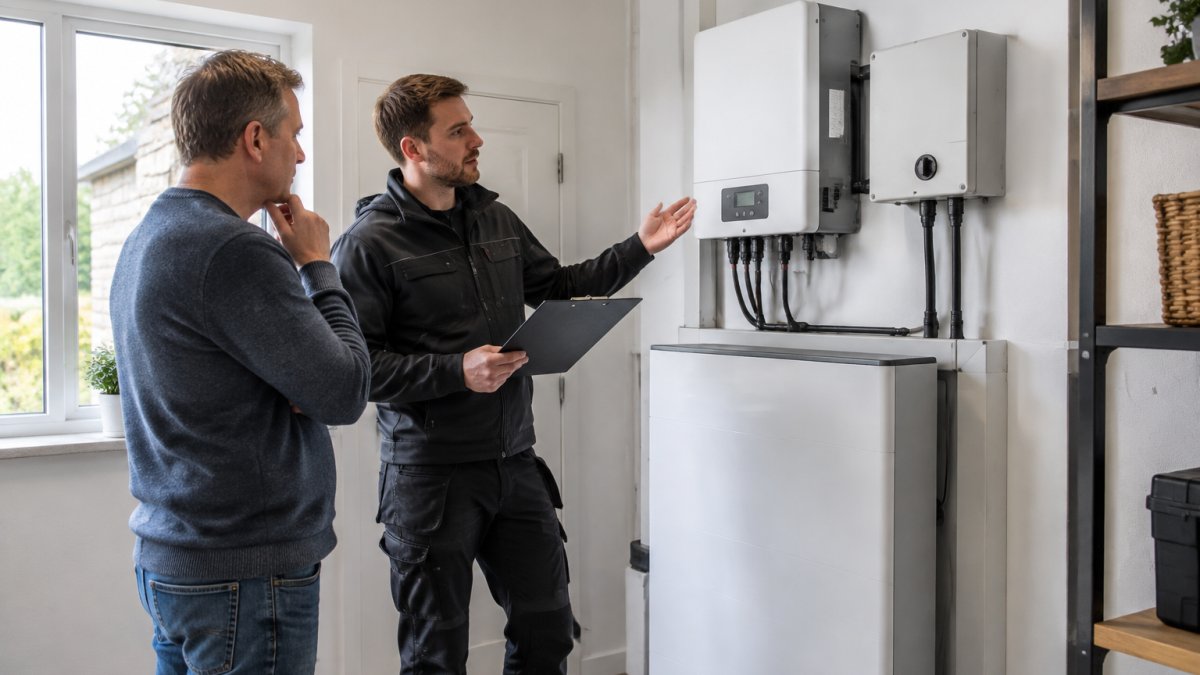
Solar battery storage capacity requirements are calculated from your winter daily consumption divided by the usable discharge depth of the battery, then increased to cover consecutive low-generation days. A household using 10 kWh a day with a battery usable to 90% depth of discharge needs at least 11 kWh of nominal capacity for one day of autonomy, and 22-33 kWh for two to three days. Expanding this storage capacity often requires significant structural planning, making the process of combining solar with renovations an ideal opportunity to integrate battery housing directly into the home foundation.
Click HERE for your FREE SURVEY today →
Battery chemistry matters here. Lithium iron phosphate units typically tolerate deeper discharge and more cycles than lead-acid alternatives, which means less nominal capacity for the same usable energy. Our guide to solar battery maintenance and lifespan expectations explains how chemistry affects long-term performance.
The sizing maths comes down to a few figures you can check before committing to a battery bank.
| Item | Value | Note |
|---|---|---|
| Example daily household use | 10 kWh a day | Used to work through the sizing example |
| Usable depth of discharge | 90% | Assumed for the example battery |
| Capacity for one day of autonomy | At least 11 kWh nominal | Daily use divided by usable discharge depth |
| Capacity for two to three days | 22-33 kWh | Covers consecutive low-generation days |
| Lithium iron phosphate | Deeper discharge and more cycles | Means less nominal capacity for same usable energy |
| Lead-acid | Tolerates less discharge | Needs more nominal capacity for same usable energy |
Reliability, Carbon Footprint and Winter Performance
Reliability is where off-grid systems earn their keep: with no grid dependency, a blackout has no effect on a property that generates and stores its own power. The carbon footprint falls too, since every stored unit replaces grid electricity, and renewable integration at this scale displaces fossil generation directly. If you want to understand how solar behaves when the grid goes down, our article on whether solar panels work during a power cut answers it directly.
Winter is the real test, and it is the part most guides gloss over. In low-light months, generation falls sharply while demand rises, so an off-grid system must be sized on the worst month, not the average. Three mechanisms decide whether it copes.
First, panel tilt and orientation. A steeper tilt sheds snow more readily and catches the low winter sun at a better angle than a summer-optimised pitch. Second, snow and frost. A covered array produces nothing, so either the tilt allows self-shedding or you need safe access to clear it. Third, battery temperature. Lithium iron phosphate cells lose usable capacity in the cold and should not be charged below freezing without heating or charge inhibition, so an unheated outbuilding is a poor home for a battery bank. Voltage regulation and the battery management system handle this, but they cannot create energy that the panels did not generate.
The practical consequence is oversizing. A system that is 30% oversized for summer is often correctly sized for January, and a backup generator or a modest grid connection is the standard hedge against a run of consecutive low-generation days. A common pattern among off-grid households is to accept a short generator run in the depths of winter rather than pay for a battery bank large enough to cover the worst-case week. That trade-off is a design decision, not a failure, and it should be made explicitly at the survey stage rather than discovered in February.
Maintaining Off-Grid Solar Systems for the Long Term
Maintaining off-grid solar systems is mostly routine: check battery health and maintenance cycles annually, clean panels, inspect connections, and monitor system efficiency through the energy management system. Because an off-grid property has no grid fallback, a neglected battery bank is a single point of failure.
A practical annual checklist:
- Review battery capacity and discharge depth logs
- Inspect and clean panel surfaces and mounting
- Test inverter and charge controller firmware and settings
- Check cable terminations and voltage regulation
- Confirm backup generation starts and runs under load
Book Your Free Survey and Size Your System Right
The difference between a system that works and one that disappoints comes down to design: correct sizing, matched components and an honest view of what off-grid can and cannot deliver. A free, no-obligation survey from Smarter Utility gives you that foundation, with an assessment of your roof, consumption and battery requirements before you commit to anything.
We design every system around your actual figures, whether that means full islanding or a grid-tied setup with battery backup. To see the installation service and arrange your survey, book a solar battery storage installation with our team.
Frequently Asked Questions
What are the main benefits of an off-grid solar battery system?
The headline benefits are energy independence, protection from power cuts, and lower long-term electricity costs. Batteries store excess energy from sources such as solar for later use, so you draw on your own supply rather than the grid. Interest in off-grid solar has grown quickly. You also cut your carbon footprint and avoid standing charges on a fully off-grid supply.
How much does an off-grid solar system cost in the UK?
Off-grid solar system cost UK figures vary with battery capacity, inverter size and whether you need ground-mount or roof-mounted panels. Off-grid setups generally cost more upfront than grid-tied systems because of the extra battery storage and equipment required. A grid-tied system with battery backup can deliver much of the same independence at a lower cost. Pricing depends on your consumption and installation details, so request a quote based on your own circumstances via the Smarter Utility website.
How do I work out solar battery storage capacity requirements?
Start with your daily kWh consumption, then add a margin for winter when solar generation drops. Battery capacity is measured in kWh, and usable capacity is lower than the headline figure because of discharge depth limits. A household's storage needs depend on its daily consumption and how many low-generation days it must cover. Sizing too small wastes money on a system that cannot carry you through, so base the calculation on a full year of usage data, not a summer snapshot.
How long do off-grid solar batteries last and what maintenance do they need?
Battery longevity depends on chemistry, and lithium iron phosphate generally tolerates deeper discharge than lead-acid. Maintaining off-grid solar systems means checking connections, cleaning panels, and monitoring state of charge through the energy management system. Lead-acid banks need periodic water top-ups. Most lithium batteries are sealed and largely maintenance-free, but annual checks on the inverter, charge controller and voltage regulation keep system efficiency up and catch faults before they cost you a replacement.
If you are weighing up off-grid independence against a grid-connected system with battery backup, the right answer depends on your property, your winter demand and your tolerance for backup generation. Smarter Utility provides free home surveys, expert system design and fully accredited installation, so you can make an educated decision before spending anything. Get started with Smarter Utility and size your system correctly the first time.