 Ultimate guide
Future-Proofing Home EV Charging in Scotland for 2026
Last Updated: November 19, 2026
Quick Summary
Future proofing home EV charging in Scotland means planning for more electrical demand than you have today, because the number of electric vehicles is rising and your home's supply has to cope with them. Choose a charger with smart charging and software updates, check your supply capacity before installing, and plan solar and battery storage alongside it.
- Consumer Scotland recorded 54,047 electric vehicles in Scotland as of June 2025, excluding company-owned vehicles.
- Get a quote for three scenarios: straightforward, standard and complex installs, each with the costs itemised.
- Load management can avoid a supply upgrade, but a heat pump or second EV may justify upgrading once.
- Choose a charger that supports software updates, smart charging and suits Scottish weather with a strong warranty.
- Plan solar panels and battery storage with the charger as one system rather than as separate projects.
Table of Contents
- Why Future-Proofing Your Home EV Charger Matters in Scotland
- EV Charger Installation Cost Scotland 2026: What to Budget For
- Choosing a Smart Home EV Charger: Features That Last
- Pairing Your Charger With Solar Panels and Battery Storage
- Electrical Capacity, Three-Phase Supply and Load Management
- EV Charging Requirements for New Buildings Scotland: What Applies to You
- A 2026-to-2030 Future-Proofing Checklist for Your Home Charger
- Frequently Asked Questions
Why Future-Proofing Your Home EV Charger Matters in Scotland
Installing a home charger once and forgetting about it is no longer a safe bet, which is why future proofing home EV charging in Scotland now deserves a deliberate plan. Public charging networks are expected to grow over the coming years, and the electrical demands of the homes around them are changing at the same pace.
Consumer Scotland recorded 54,047 electric vehicles in Scotland as of June 2025, a figure that excludes company-owned vehicles. Consumer Scotland electric vehicle statistics, 2025 Every additional vehicle adds pressure on local networks and on the single electrical connection into your property, so future proofing home EV charging in Scotland means planning for that extra demand now.
Charging infrastructure is also being planned with deliberate intent. Transport Scotland has said that support will focus on public, workplace and home charging, with targeted help for rural and island communities, lower-income households and households without off-street parking.
Where you put a charger also matters beyond your own driveway. Research published in Energy in 2025 found that existing charging-station distribution favours affluent areas, which may reinforce existing inequalities. Geodemographic-aware EV charging location planning study, Energy 2025 For a homeowner, the practical lesson is simple: plan for more demand on your circuit than you have today.
EV Charger Installation Cost Scotland 2026: What to Budget For
Installation costs depend on the property, the distance from the consumer unit to the parking space, and the capacity the work requires. You can also check how to claim available charger grants to offset the cost. To see how the installation itself unfolds, read through the steps before committing money. Pricing depends on the survey and the quantity and specification of the equipment. For current prices or a quote that reflects your home, visit the Smarter Utility website or book a free survey.
What matters most when budgeting is the work that sits outside the charger itself. Cable runs, trenching, consumer unit upgrades and any required load management can each add to the total. A quote that looks low may simply leave these out, so ask the installer to itemise them.
Scenario-Based Budgets and Hidden Fees
Build your budget around three scenarios rather than a single number. In a straightforward install, the charger sits close to a sound consumer unit and the cable run is short; the labour and materials are modest and the main variable is the unit itself. In a standard install, the cable must be routed through a garden, along an external wall or under a path, which adds trenching, conduit and reinstatement. In a complex install, the incoming supply needs an upgrade or the consumer unit must be replaced before the charger can be connected, and that electrical work can cost more than the charger and its installation combined.
Ask for a quote against each scenario so you can see how the total moves. A written quote should separate the charger, the cable route, protective devices, any consumer unit work, load management hardware, commissioning and certification. If a line item is missing, ask why.
Watch out: a quote that excludes trenching, ducting or driveway reinstatement can look competitive and then grow once the ground is opened.
Ongoing and Future Costs to Plan For
Installation is the first cost, not the last. Ongoing charging costs depend on your tariff and your mileage. Budget separately for a future supply upgrade if your five-year plan includes a heat pump, a second EV or a battery, because doing that work alongside the charger is usually cheaper than returning to it later. A transparent budget therefore has three lines: the install, the annual charging cost, and a contingency for electrical upgrades within the life of the charger. Keeping those three budget lines distinct makes it easier to spot what EV charger installation pricing may leave outside the initial quote, before a later upgrade turns a contingency into an unexpected cost.
Choosing a Smart Home EV Charger: Features That Last
A charger installed today should still be useful when you change car. Prioritise units that support smart charging, can be updated through software, and can be integrated with a load-management system if your home's supply is limited. Charging speed should match your typical overnight charging window and the capacity of your supply, not simply the maximum the unit can deliver.
Weather resistance, a secure mounting position and a strong warranty are equally important in Scotland's damp and variable climate. Ask the installer to confirm the unit's ingress rating and how firmware updates are handled over the product's life.
Pairing Your Charger With Solar Panels and Battery Storage
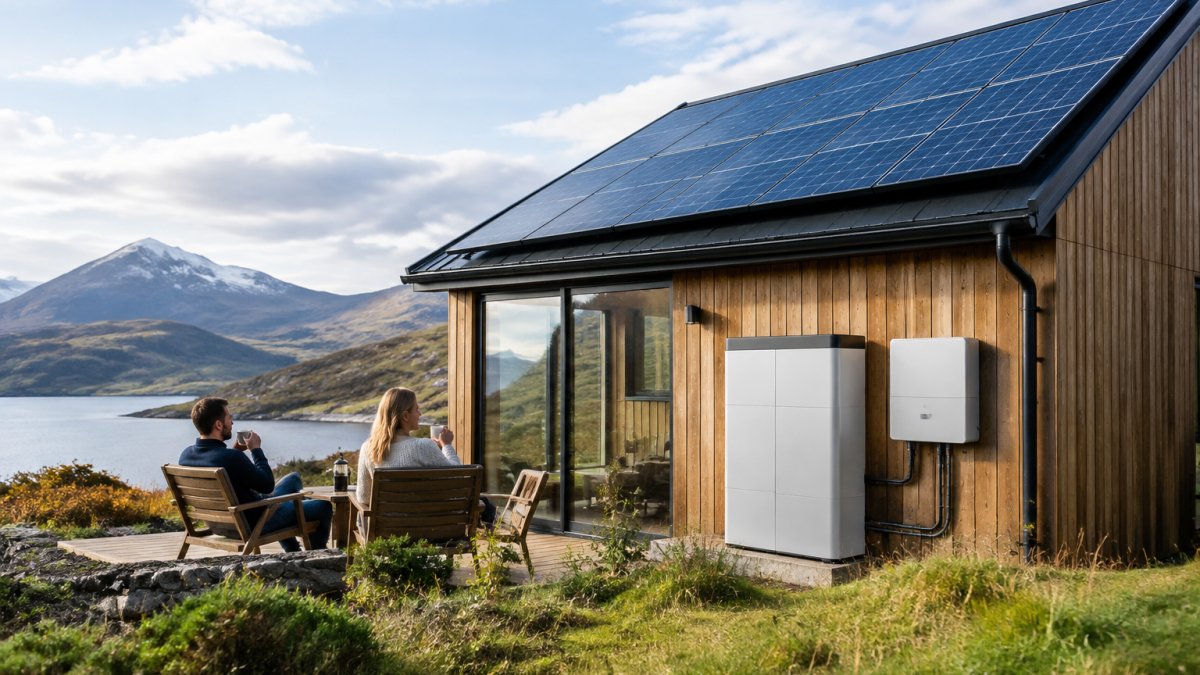
If you are already considering solar panels, plan your charger and battery together rather than as separate projects. A charger that can direct surplus solar generation into your vehicle can significantly change the economics of both systems. Battery storage can also smooth out the difference between generation and charging demand.
Solar with battery storage is not right for every property, and a survey should confirm whether your roof and household usage make it worthwhile. Our guide to judging fit for solar and battery explains what to check before booking an assessment. Our solar and battery installation service can plan a charger alongside solar and storage as one system.
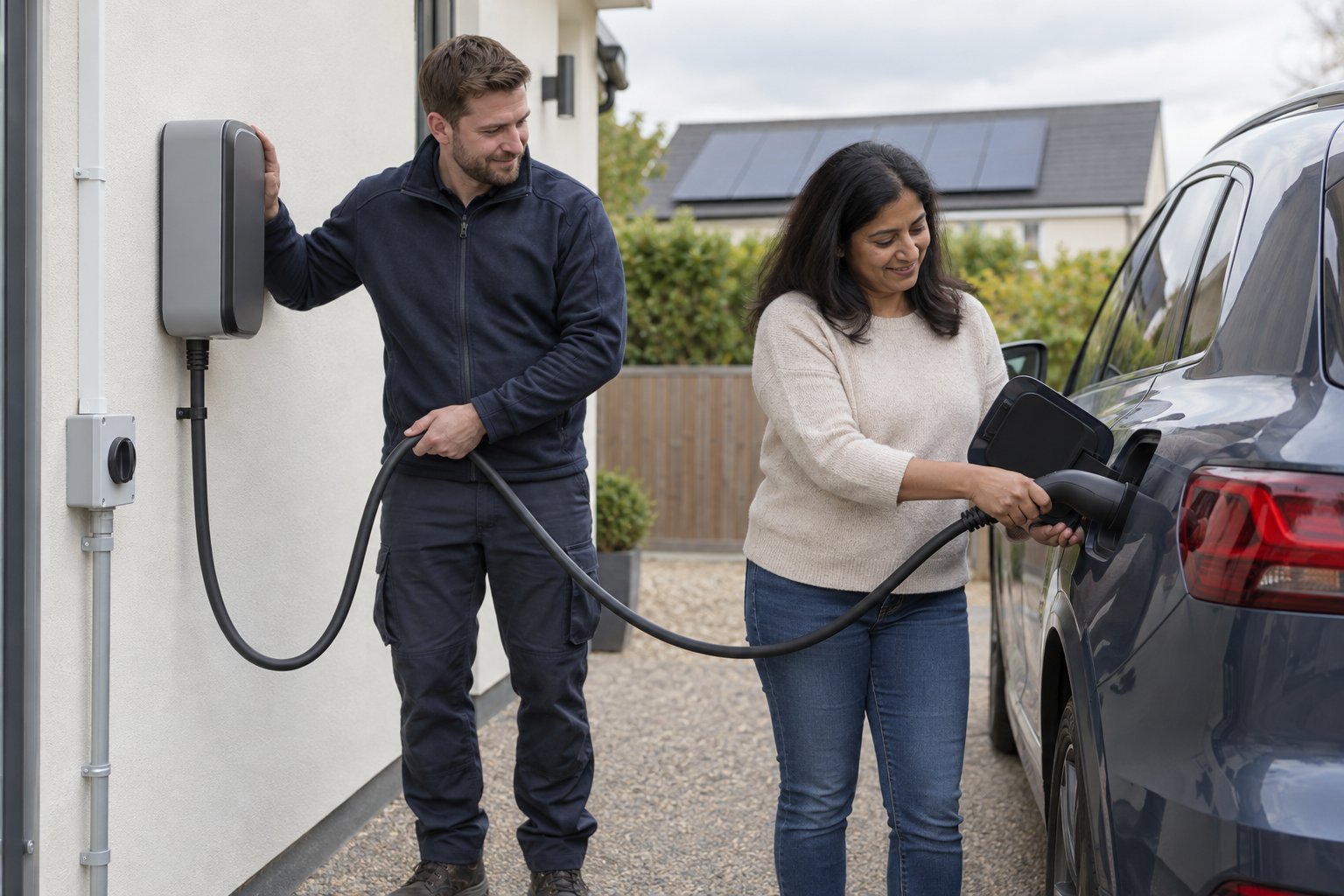
Electrical Capacity, Three-Phase Supply and Load Management
Most Scottish homes run on single-phase supply, which limits how much power a charger can draw without affecting other appliances. Three-phase supply is less common in houses but can be relevant for larger rural properties, farms and business premises. Whether you need it depends on the load you expect across the whole building, not just the charger.
How to Assess Your Supply Capacity
Start with the main fuse rating and the consumer unit. A qualified electrician can confirm the rating, check spare ways in the consumer unit, and carry out a load calculation that accounts for diversity, the fact that not every appliance draws its maximum at once. The calculation should include existing loads such as an electric shower, an immersion heater, a heat pump and any future battery or second charger you intend to add. If the result leaves little headroom, you have a decision to make rather than a problem to ignore.
Load Management Versus a Supply Upgrade
Load management allows a charger to adjust its output so that it does not overload your supply when kettles, cookers and heat pumps are running.
Decide between them by looking at your likely demand over the next five years. If the charger is the only significant new load, load management is usually sufficient. If you expect a heat pump, a second EV or electrified heating, the upgrade may be worth doing once rather than twice.
Watch out: a charger installed without load management on a constrained supply can trip the main fuse when other appliances run, and the fix is not always covered by the original quote.
The main decisions for a home charger come down to supply capacity and how the charger is managed, summarised below.
| Option | Best for | Key difference |
|---|---|---|
| Load management | Constrained supply, no immediate upgrade | Adjusts charger output to avoid overloading supply |
| Supply upgrade | Heat pump, second EV or electrified heating | Removes constraint but costs more and causes more disruption |
| Three-phase supply | Larger rural homes, farms, business premises | Depends on whole-building load, not the charger alone |
| Single-phase supply | Most Scottish homes | Limits how much power a charger can draw |
EV Charging Requirements for New Buildings Scotland: What Applies to You
Building standards for new homes are set nationally, and the requirements for charging provision in new buildings can differ from those for existing homes. If you are building or converting a property, check the current requirements with your local authority and building standards team before you finalise the design.
For an existing home, the rules are generally less prescriptive, but any new installation must still meet current electrical safety standards. Your installer should certify the work and confirm that it complies with the regulations that apply to your property.
A 2026-to-2030 Future-Proofing Checklist for Your Home Charger
Use this checklist to make choices that will still work when your next car or your next household appliance arrives.
- Confirm your current supply capacity and the consumer unit's condition
- Decide whether three-phase supply or load management will be needed within five years
- Choose a charger that supports software updates and smart charging
- Check the ingress rating and warranty for Scottish weather
- Ask for an itemised quote covering cable runs, trenching and any supply upgrade
- Plan solar panels and battery storage alongside the charger, if relevant
- Confirm that any grant you intend to use applies to your property type
- Book a free survey from a fully accredited installer to confirm the plan
Smarter Utility is a fully accredited and approved MCS solar and battery storage installer, offering expert design and installation of solar PV, battery storage and EV chargers. Find a solar and EV installer in Motherwell offering domestic charging and heat pump planning with a free property assessment. Book your FREE SURVEY to get a tailored plan for future-proofing your home charger.
Frequently Asked Questions
How do I future-proof a home EV charger?
Choose a charger with a software update path and open communication standards, size the supply cable and consumer unit for higher charging rates than you need today, and leave space for a future upgrade. Ask your installer to record the cable run and circuit specification so a later upgrade does not mean starting again. Planning for load management and smart charging now means the charger can work alongside a future heat pump or additional electric vehicle without a full rewire. Keep records of your installation and any firmware updates, as these help when you sell the property or change equipment.
Can I connect a home EV charger to solar panels and a battery?
Yes, many modern home chargers can be set to prioritise solar generation, directing surplus power from your panels into the car before exporting it to the grid. Pairing with a battery lets you charge overnight from stored solar energy. Compatibility depends on the charger's control features and your inverter, so confirm both before buying. Smarter Utility offers a free, no-obligation home survey covering solar, battery and EV charging.
Are there grants available for home EV chargers in Scotland?
Grant availability and eligibility change over time, so check the current position with Transport Scotland and the Energy Saving Trust before committing to an installation. Eligibility often depends on property type, whether you have off-street parking, and household circumstances. Public and workplace charging schemes are funded separately from home schemes. Ask your installer whether they are approved for any scheme that applies to your property, and confirm the grant terms in writing before work starts. Smarter Utility can advise on what may apply to your home during the survey.
Do I need a three-phase electricity supply for a home EV charger?
Most homes use a single-phase supply, and a single-phase home charger at around 7 kW is suitable for overnight charging of most electric cars. A three-phase supply allows faster charging and suits larger home loads, but it is not required for a typical domestic installation. Whether a supply upgrade is needed depends on your existing consumer unit, main fuse rating and total household demand. A qualified installer can assess this and advise whether load management would let you avoid an upgrade.