 how-to
How to Install Solar Panels on Industrial Rooftops
Table of Contents
- Understanding Your Industrial Rooftop Solar Project
- Industrial Solar Panel Planning Permission Requirements
- Conducting a Structural Survey for Commercial Solar Installation
- Assessing Commercial Solar PV Installation Costs and ROI
- DNO Application for Commercial Solar Systems
- Installation Methods: Ballasted vs. Fixed Mounting Systems
- Frequently Asked Questions
Last Updated: September 30, 2026
Understanding Your Industrial Rooftop Solar Project
Learning how to install solar panels on industrial rooftops requires structural assessment, regulatory compliance, and professional installation. At Smarter Utility, we help businesses navigate this transition with expert guidance and tailored solutions.
Industrial rooftops offer ideal conditions for photovoltaic systems: large unobstructed areas that maximise energy yield, and high daytime consumption that aligns with peak solar generation.
A typical industrial solar installation takes 8-12 weeks from survey to grid connection, involving structural engineers, electrical contractors, and your Distribution Network Operator (DNO).
Industrial PV systems generate revenue through electricity savings and export payments, with many businesses achieving ROI within 6-8 years and systems operating for 25+ years.
Industrial Solar Panel Planning Permission Requirements
Whether you need planning permission depends on your building's status and local authority rules.
Most industrial solar installations do NOT require planning permission in England, Scotland, and Wales. Critical exceptions: listed buildings, conservation areas, restrictive covenants, or specific local authority requirements.
Contact your local planning authority with: building location and postcode, roof dimensions and orientation, proposed system size in kW, and mounting system type. A phone call saves weeks of delays.
Building Regulations approval is almost always required to ensure safety and structural standards. Confirm your installer handles this submission before signing any contract.
Environmental assessments rarely apply to rooftop solar. However, if your facility is near a protected site or sensitive habitat, check with your local environmental health officer.
Conducting a Structural Survey for Commercial Solar Installation
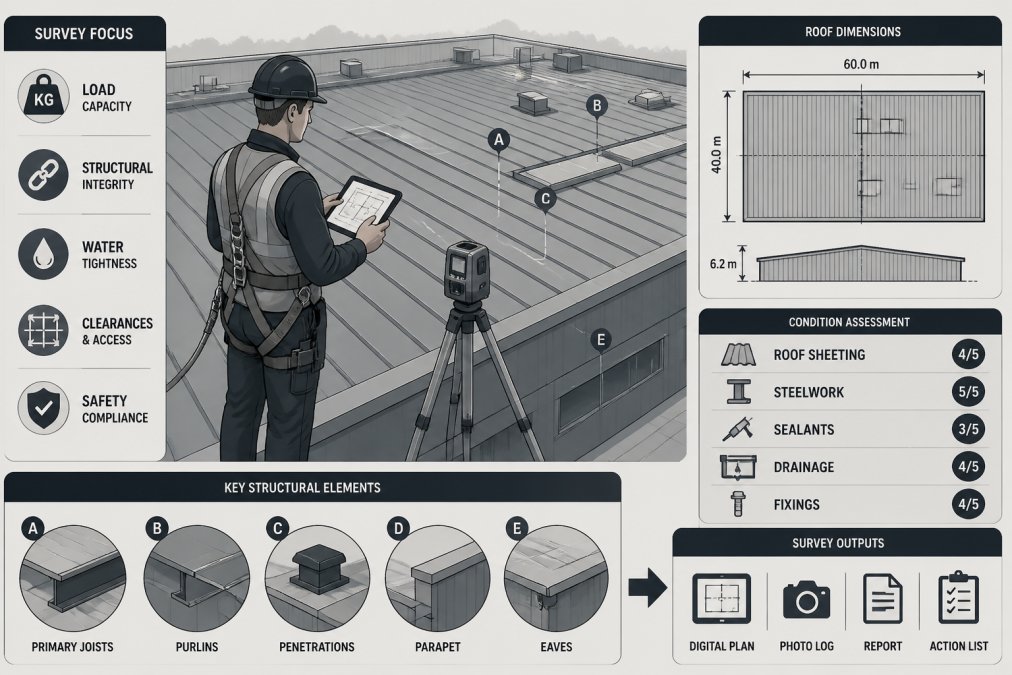
A structural survey determines whether your roof can safely support the additional load and identifies the best mounting approach.
A qualified surveyor inspects your roof membrane, structure, and load-bearing capacity, measuring dimensions and checking for damage. This typically takes 4-8 hours for a medium-sized industrial building.
The surveyor produces a detailed report covering:
- Current roof condition and remaining lifespan
- Maximum safe load capacity (expressed in kilograms per square metre)
- Recommendations for membrane protection during installation
- Suitable mounting system type for your structure
- Any roof reinforcement needed before panel installation
Load-bearing capacity is critical: most industrial buildings can handle 50-100 kg/m², accommodating typical solar arrays, though older structures may require reinforcement.
If your roof membrane is nearing end-of-life, replace it before solar installation to avoid long-term leak risk. Combining both projects is more cost-effective than doing them separately.
Assessing Commercial Solar PV Installation Costs and ROI
Installation cost depends on system size, roof condition, and mounting type. Request quotes from accredited installers for accurate pricing.
System size is the primary cost driver; cost per watt decreases as size increases. Roof condition, difficult access, membrane replacement, and structural reinforcement add expense. Ballasted systems cost less upfront but may require roof reinforcement later.
Calculate ROI before committing. Start with your annual electricity bill and consumption patterns. Industrial facilities typically use 15,000-50,000 kWh annually.
UK Financial Incentives and Tax Relief
Industrial solar installations qualify for several tax and financial schemes that significantly improve ROI. Understanding these is essential before finalising your business case.
Capital Allowances and Enhanced Capital Allowance (ECA)
Solar PV systems typically qualify for capital allowances under the Capital Allowances Act 2001, providing an immediate tax deduction of 19% of installation cost.
Click HERE for your FREE SURVEY today →
Smart Export Guarantee (SEG)
Exported electricity qualifies for payments of 5-15p per kWh under the Smart Export Guarantee scheme, typically offsetting 10-20% of annual electricity costs for industrial facilities. Your installer handles DNO registration and export meter installation as part of the DNO application process.
Business Rates Relief
Solar panels may not increase your rateable value under VOA guidelines, meaning no additional business rates liability. Contact your local authority's business rates team to confirm your property's status before installation.
Calculating True ROI with Financial Incentives
ROI depends on system size, energy yield, electricity rates, export payments, capital allowances tax relief, business rates relief, and maintenance costs. Many industrial businesses achieve payback within 5-7 years when financial incentives are included. Smarter Utility provides detailed financial projections during the survey process, modelling scenarios based on your actual consumption patterns and local electricity rates.
DNO Application for Commercial Solar Systems
Your Distribution Network Operator (DNO) must approve your solar installation before it connects to the grid. This is a mandatory regulatory requirement, not optional paperwork.
Your DNO (the company operating your local electricity distribution network) must assess whether your solar system affects grid stability and safety. This approval process typically takes 4-8 weeks.
Your installer submits the DNO application including system specifications, electrical diagrams, and confirmation of relevant standards. The DNO may request additional information or impose conditions such as protection equipment installation, notification requirements, or export limits. Smarter Utility includes DNO liaison in our service.
Grid connection happens only after DNO approval. Your installer schedules this with your electricity supplier. You'll receive a new meter that records both consumption and export, enabling you to receive payment for surplus energy.
Installation Methods: Ballasted vs. Fixed Mounting Systems
Two primary mounting systems dominate industrial rooftop solar: ballasted and fixed. Each has distinct advantages and limitations.
Ballasted mounting systems use weighted concrete blocks to hold panels without roof penetrations. Ideal for leased roofs, aging membranes, or waterproofing concerns. They cost slightly less upfront and install quickly, but require higher roof load capacity (75-100 kg/m²) and more roof space. Selecting this non-penetrating approach minimizes structural stress while simultaneously extending roof life by protecting the underlying membrane from thermal cycling and environmental degradation.
Fixed mounting systems use bolts to anchor panels permanently, sealed with waterproof flashing. Ideal for owned roofs, limited load capacity, space-constrained sites, or long-term infrastructure. They require careful installation to prevent leaks but are durable, use less roof space, and allow optimal tilt angles for maximum energy yield.
(/solar-panels-for-agricultural-buildings-a-2026-guide) on industrial rooftops transforms your facility's energy economics. The process requires structural assessment, regulatory compliance, and professional installation, but the payoff justifies the effort.Key Steps for Industrial Solar Installation:
| Step | Timeline | Responsibility |
|---|---|---|
| Free structural survey | Week 1 | Installer |
| Planning permission check | Week 1-2 | You + installer |
| DNO application submission | Week 2-3 | Installer |
| DNO approval | Week 4-8 | DNO |
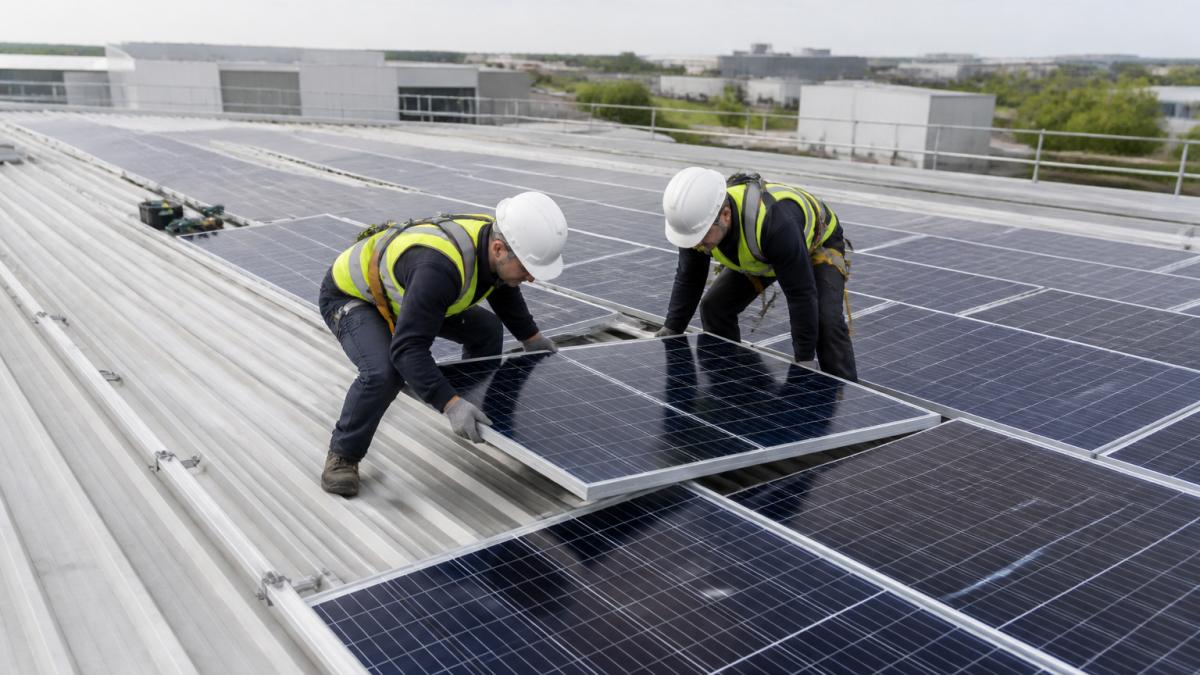
| System installation | Week 9-12 | Installer |
| Grid connection | Week 12-13 | Electricity supplier |
Health and Safety Executive guidance on working at height
British Standards for solar PV installation BS 7909
Smart Export Guarantee scheme details for renewable energy export
Frequently Asked Questions
Do I need planning permission to install solar panels on an industrial roof?
Most industrial solar installations fall under permitted development rights and do not require planning permission, provided they meet specific criteria including height, area, and distance from boundaries. However, some industrial properties, particularly listed buildings, conservation areas, or those with restrictive covenants, may need formal planning consent. A structural survey and DNO application are always necessary. Contact your local planning authority to confirm your building's status before proceeding with installation.
What structural assessments are required before installing solar on a factory roof?
A professional structural survey is essential to verify that your roof can support the weight of the PV system, mounting hardware, and additional loads. The survey examines roof membranes, joists, beams, and load-bearing capacity. Results determine whether ballasted or fixed mounting is suitable and identify any reinforcement needed. This assessment protects your building's integrity and is required by building regulations and insurance providers before installation can proceed.
How much does a commercial solar PV installation typically cost?
Commercial solar PV installation costs depend on system size, roof condition, mounting method, electrical infrastructure upgrades, and site accessibility. Costs vary significantly between facilities. For an accurate quote tailored to your industrial property, contact Smarter Utility for a free survey. Our team will assess your specific requirements.
What is the DNO application process for commercial solar systems?
The DNO (Distribution Network Operator) application is required for grid-connected systems exceeding 3.68 kW. You submit technical specifications and electrical drawings to your local DNO for approval before installation. The process typically takes 4-8 weeks. Your installer handles most documentation, but approval confirms your system meets grid safety standards and allows you to benefit from export payments under the Smart Export Guarantee scheme.