 How-to
7 Solar Power Decisions for Agricultural Water Pumps
Last Updated: November 24, 2026
Quick Summary
A solar water pump can run an agricultural water pump wherever the array is sized to the pump's daily duty and there is somewhere for the water to go. A photovoltaic array feeds a controller, the controller drives a pump motor, and water moves from a borehole, stream or tank to a trough or irrigation line. No grid connection is needed at the pump itself.
- Size the array to the pump's power draw at your duty point, adding 20-30% headroom for losses.
- Measure static lift from the lowest dry-season water level, not from ground level.
- Most systems run without a battery because a tank stores water more cheaply.
- Tank volume should cover two to three days of livestock demand as a minimum.
- Specify low-water shutoff so a marginal borehole cannot be pumped dry in summer.
Table of Contents
- Can solar power run an agricultural water pump?
- How solar water pumping systems work, from panel to trough
- Solar pump sizing for agriculture: a step-by-step method
- Choosing a solar irrigation pump for fields and polytunnels
- The solar-powered livestock water pump setup for grazing
- When to specify a solar water pump with battery storage
- Costs, payback and the risks nobody mentions
- Book a free farm survey before you buy
- Frequently Asked Questions
Can solar power run an agricultural water pump?
Yes. A solar water pump can run an agricultural water pump wherever the array is sized to the pump's daily duty and there is somewhere for the water to go.
That simplicity is why solar water pumping has spread quickly across farms, and why it goes wrong.
Below, we set out the seven decisions that determine whether a solar-powered water pump earns its place.
How solar water pumping systems work, from panel to trough
A solar water pumping system converts daylight into water movement, with no fuel and no mains supply at the point of use. Photovoltaic panels generate direct current, a pump controller conditions that current and manages the motor, and the pump lifts water from the source to a tank, trough or irrigation line. Output rises and falls with the sun rather than running at a fixed rate.
Panels, controller and pump: the three parts that matter
The array sets the ceiling on power. The controller protects the motor and decides when the pump runs, and it is the part most often skimped on.
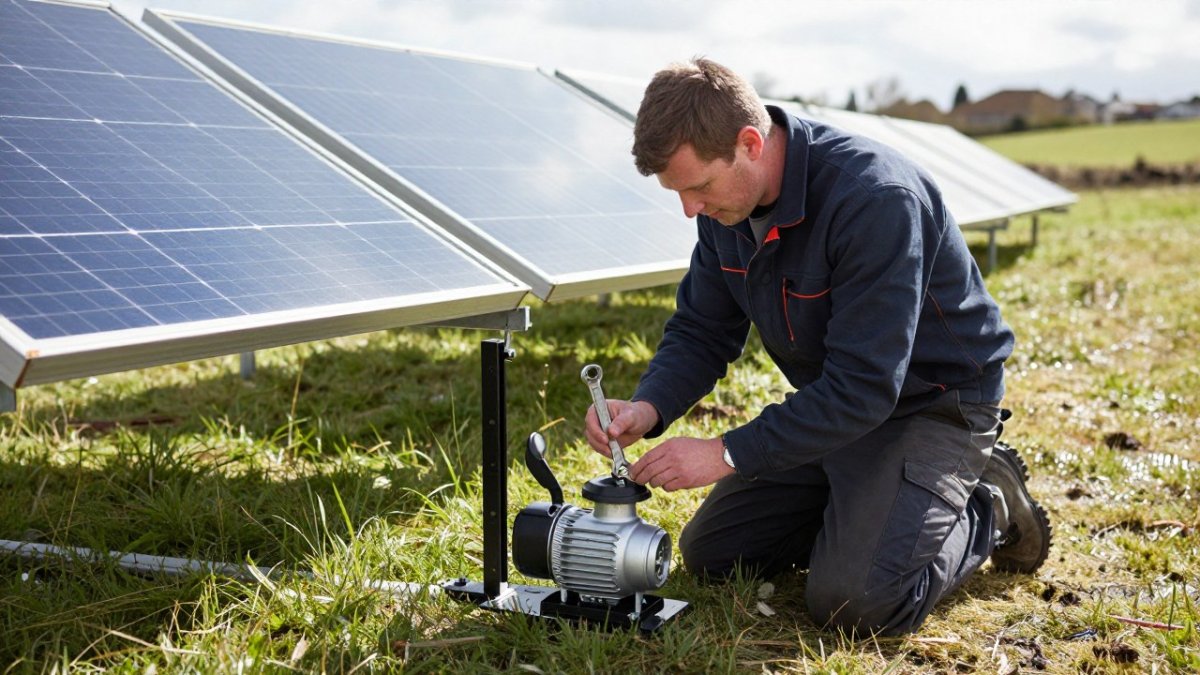
The pump itself is either submersible, sitting down the borehole or well, or surface-mounted, drawing from a stream, pond or tank. Submersible units suit deep lifts. Surface pumps suit shallow sources and short runs.
If you are weighing solar across a whole steading rather than one pump, our guide to solar panels for agricultural buildings covers roof loading, array orientation and the wider farm supply picture before you commit.
Where a battery fits and where it does not
Most solar water pump systems run without a battery. Water is the storage: you pump into a tank during daylight and draw from the tank afterwards.
A battery earns its place when you need water at a fixed time regardless of cloud, or when the pump must run outside daylight hours. It cannot rescue an array that is undersized for the lift.
Solar pump sizing for agriculture: a step-by-step method
Solar pump sizing for agriculture starts with the daily water volume you need, not the panel wattage. Work out litres per day, the total lift in metres from water level to discharge, and the pipe run. Then match a pump and array to that duty, allowing for pump efficiency and for days when output drops.
Here is the method we use, with the arithmetic shown.
Step 1: Calculate daily water demand
For livestock, multiply head count by litres per head per day and add a margin for hot spells and washdown. Livestock water requirements vary widely by species, climate and management, so check figures with your vet or agricultural adviser for your own herd.
For irrigation, demand is crop area × application depth. A polytunnel block needing 4 mm per day over 500 m² is 0.004 m × 500 m² = 2 m³, or 2,000 litres per day.
Step 2: Measure total dynamic head (TDH)
TDH is the number that catches people out. It is the vertical lift from the lowest water level in a dry season to the discharge point, plus friction losses in the pipe, plus any pressure required at the outlet.
- Static lift: measure from the water table when the borehole is at its lowest, not from ground level. A 40 m borehole with a 25 m summer water table has a 25 m static lift, not 40 m.
- Drawdown: pumping lowers the water level. Allow 2-5 m for a typical borehole; more for a low-yield source.
- Friction loss: depends on pipe diameter, length and flow. A 32 mm MDPE pipe carrying 1 m³/h loses roughly 1 m of head per 10 m of run; doubling the flow roughly quadruples the loss. Keep pipe runs short and diameters generous.
A worked example: 25 m static lift + 3 m drawdown + 8 m friction on a 60 m run + 2 m to a trough = 38 m TDH.
Step 3: Check the source yield
A borehole that recovers slowly will not support a pump running flat out all day, however large the array. Test the yield before sizing anything: a 0.5 m³/h yield caps daily output at 12 m³ over 24 hours, and realistically less because the pump cannot run dry. If yield is the constraint, size storage to buffer it rather than sizing the array to fight it.
Step 4: Pick the pump first
Match a pump whose flow at your TDH meets daily demand in the available pumping hours. If you need 1,000 litres per day and expect 5 effective pumping hours in winter, you need 200 litres per hour at 38 m head. Find the point on the manufacturer's pump curve where your required flow and head intersect and check the power draw there.
Step 5: Size the array to the pump
Once you know the pump's power draw at your duty point, size the array to deliver it under realistic irradiance, not laboratory conditions. A 1 kWp array delivers roughly 3.5-4 kWh per day in summer and 1-1.5 kWh per day in midwinter. If the pump draws 400 W and needs 5 hours of run time, that is 2 kWh per day, comfortably within a 1 kWp array in summer but marginal in December.
Step 6: Size storage to cover the gap
Tank volume should carry you through the longest likely run of poor pumping days. For livestock, two to three days of demand is a sensible minimum; for a critical dairy supply, five days.
Measuring lift from ground level rather than from the dry-season water table is a common sizing error, and it can leave the pump short of head exactly when demand peaks.
Choosing a solar irrigation pump for fields and polytunnels
A solar irrigation pump is selected on flow rate and pressure at the emitter, not on the pump's headline output.
For field irrigation, pump to a header tank and irrigate from that under gravity or a booster.
Horticulture adds a wrinkle: polytunnel crops often need water in the early morning or evening, outside peak solar hours.
Oversizing the pump to "future-proof" irrigation can be an expensive mistake in this category.
The solar-powered livestock water pump setup for grazing
A solar-powered livestock water pump setup for grazing is built around a trough, not a tap.
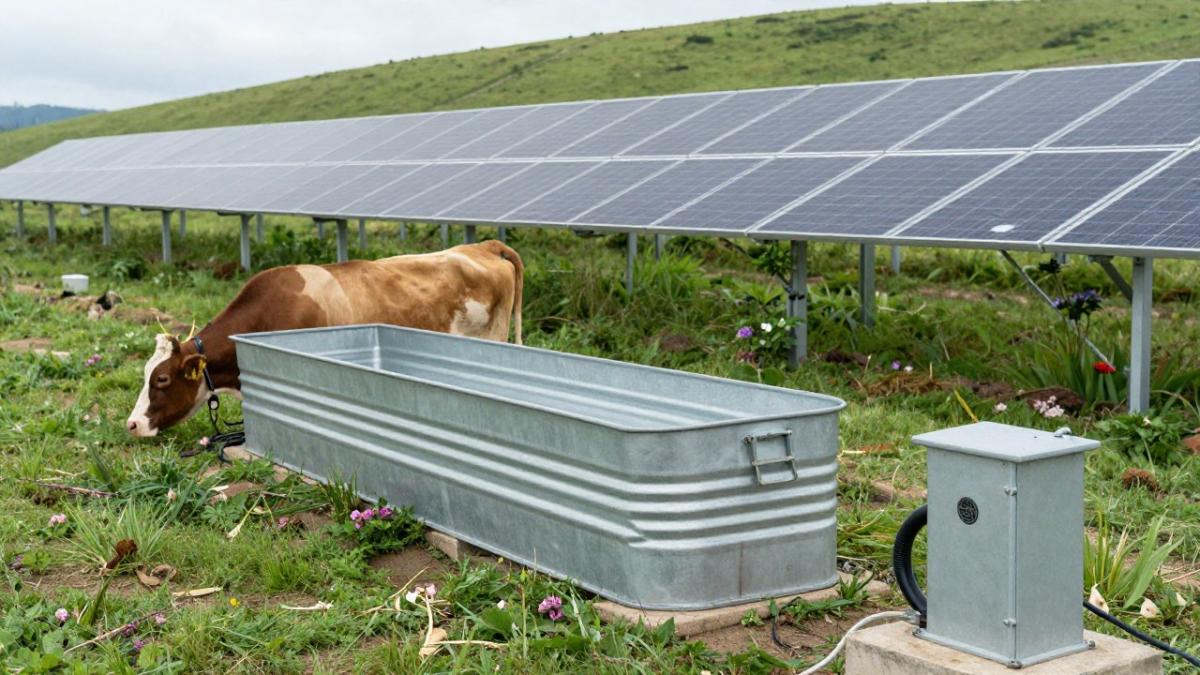
The components are straightforward:
- A ground-mounted or roof-mounted array, angled to catch the sun
- A submersible pump in the borehole, or a surface pump at the source
- A controller with dry-run and full-tank protection
Remote location is where solar wins outright. If the same remote site also needs power for a shed, our guide on how to power a remote farm building off-grid with solar shows how to design that alongside the pump.
When to specify a solar water pump with battery storage
Specify a solar water pump with battery storage when water must be delivered outside daylight hours, when the source is weak and pumping time is limited, or when the pump has a high starting load. Battery storage decouples pumping from the sun.
Three situations justify the cost:
- Timed irrigation. A polytunnel or glasshouse block that must be watered before dawn.
- High starting loads. Some larger pumps draw a surge on start-up that a battery buffers better than a controller alone.
- Critical supply. A dairy or livestock unit where a failed water supply is an animal welfare problem, not an inconvenience.
In every other case, put the money into a bigger tank instead. The Food and Agriculture Organization of the United Nations notes in its work on the benefits and risks of solar-powered irrigation that once a solar system is installed, power carries no per-unit cost, so there is less financial incentive to conserve the water being pumped.
Costs, payback and the risks nobody mentions
Solar water pumping costs depend on array size, pump depth, pipe run and storage, so pricing depends on your site and should be confirmed through a quote from Smarter Utility's website.
What the components cost
Indicative installed costs for a typical farm system, excluding VAT and groundworks, are:
| Component | Typical range (GBP) | What drives it |
|---|---|---|
| PV array and mounting | £800-£1,200 per kWp | Array size, ground-mount vs roof-mount |
| Pump and controller | £600-£2,500 | Lift, flow rate, protection features |
| Storage tank | £400-£1,500 | Volume, siting, plumbing |
| Pipework and troughs | £300-£1,200 | Run length, trough count |
| Installation and commissioning | £500-£1,500 | Access, cable runs, testing |
The payback arithmetic
The financial case for a solar pump often rests on avoided costs such as mains connection, fuel and labour, which vary by site.
A simple payback test is to take the installed cost, subtract any avoided connection cost, and divide by annual avoided fuel and labour. For a worked method to check the numbers, see our guide to calculating farm battery storage ROI.
Grants and support
Check current grant availability before committing. The Farming Investment Fund and its productivity strands have historically supported water and energy efficiency equipment, and the terms change between rounds. Your installer should be able to tell you what is open at the time of quoting; do not assume a scheme from a previous round still applies.
The risks nobody mentions
The risks deserve plain mention. The World Bank, in its guidance on navigating the opportunities and risks of solar irrigation, notes that farmers often keep more than one energy source, so a solar pump may not fully replace a fossil-fuel pump.
In the UK, abstraction of water may require a licence from the relevant environmental regulator, and the terms of any licence set the limit on what can legally be pumped.
A solar pump installed without a water-level cut-out can empty a marginal borehole in a dry summer, so low-water shutoff is worth specifying from the start.
Indicative installed costs of solar water pump components
Book a free farm survey before you buy
Every decision above depends on facts about your site: the lift, the source yield, the daily demand and the sun on the array. Those are measured, not guessed.
Smarter Utility is a fully accredited and approved MCS solar and battery storage installer, and offers a free, no-obligation survey so that any system is tailored to your specific energy needs. To arrange your survey, contact our renewables company in Hamilton.
The challenge is not choosing a pump. It is knowing your lift, your source yield and your daily demand before you commit to a specification.
Frequently Asked Questions
How many solar panels are needed to run a farm water pump?
It depends on the pump's daily water demand and the head it must lift. Work out litres per day, then the energy needed to move that volume, then divide by the usable daylight hours in your area. A small livestock trough pump may need only two or three panels, while a borehole feeding irrigation lines can need eight or more. Panel output also drops in winter, so size for the shortest day, not the sunniest. A site survey with flow and head measurements gives you a defensible number rather than a guess.
Does a solar water pump need a battery?
Not always. Many solar water pump systems pump directly into a storage tank during daylight and rely on that tank, not a battery, to buffer supply. A solar water pump with battery makes sense when you need water outside daylight hours, when the source is a borehole with low yield that must be pumped slowly over a long window, or when low-water and full-tank shutoff protection needs to keep working reliably. Adding a battery raises cost, so size the tank first and treat storage as the cheaper option.
Can a solar pump provide enough water for irrigation?
Yes, if it is sized against the crop's peak demand rather than the average. Drip and trickle lines suit solar well because they run at low flow rates over long periods, matching the hours of usable sunlight. Overhead sprinklers demand higher flow and pressure, which pushes up panel count. Plan for the driest, brightest week of the season and check the pump curve against your emitter rate and total head. Where peak demand outstrips the array, a tank filled overnight by a slower pump is often the cheaper fix.
Is solar power cheaper than diesel for agricultural water pumping?
Solar has no per-unit fuel cost once installed, so running costs are far lower than a diesel set. The trade-off is upfront capital and the fact that free power removes any financial incentive to conserve water, which is why groundwater extraction needs managing. A diesel pump still has a role as backup, and the World Bank notes many farms run more than one energy source rather than replacing fuel entirely. Compare total cost of ownership over the equipment's life, including servicing and fuel, not the purchase price alone.