 ultimate-guide
Solar Panels for Agricultural Buildings: A 2026 Guide
Table of Contents
- Why Solar Panels Make Sense for Agricultural Buildings
- Planning Permission for Agricultural Solar
- Rooftop vs. Ground-Mounted Systems for Farm Buildings
- Solar Grants for Farm Projects and Funding Options
- Battery Storage for Agricultural Businesses
- Installation, Grid Connection and Energy Bill Savings
- Structural Integrity, Insurance and Long-Term Maintenance
- Conclusion
Last Updated: August 26, 2026
Why Solar Panels Make Sense for Agricultural Buildings
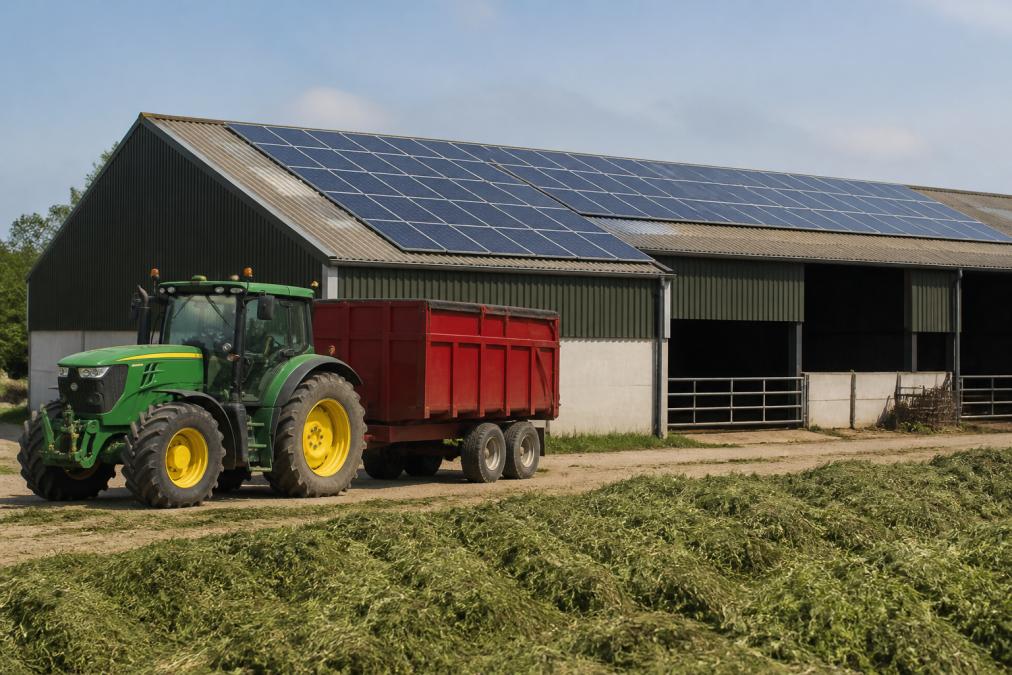
Solar panels for agricultural buildings have become a practical investment for farm operators seeking energy independence and operational cost reductions. Unlike residential properties with limited roof space, agricultural structures often offer expansive rooftops or available ground area, making them ideal candidates for solar PV installations.
The appeal goes beyond simple energy savings. Agricultural businesses face volatile energy costs that directly impact profitability. Feed mills, dairy operations, grain storage facilities, and irrigation systems consume substantial electricity throughout the year. By generating power on-site, farms reduce their exposure to grid price fluctuations and create a more predictable energy budget.
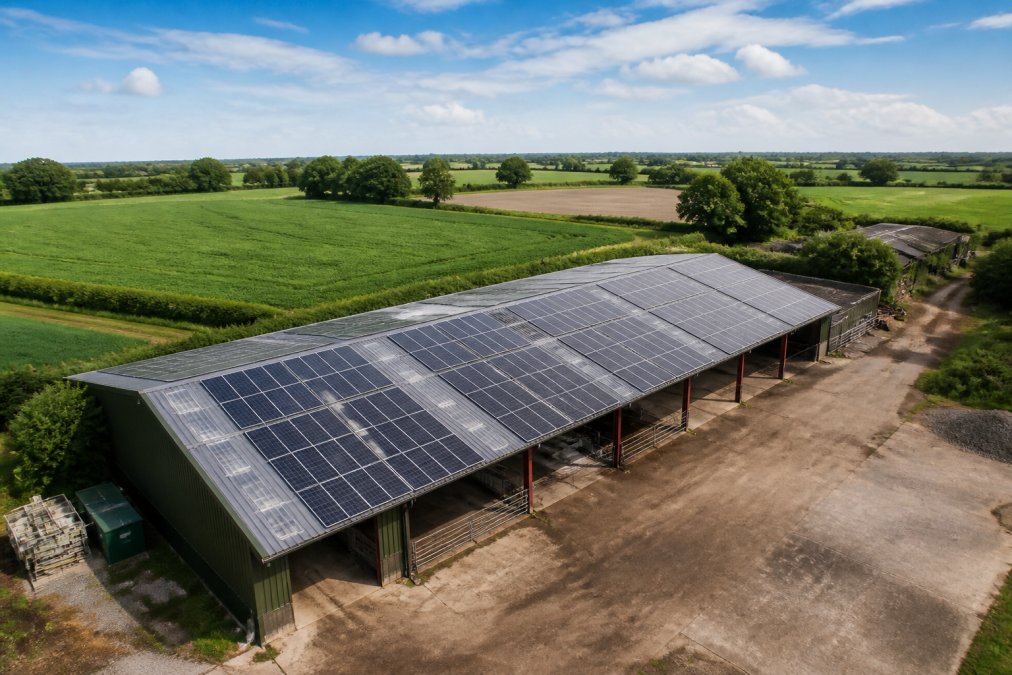
Energy diversification through renewable energy is increasingly recognised as part of sustainable agriculture strategy. Many farm operators are exploring how solar can complement their existing operations without disrupting day-to-day activities. The installation process, when properly planned, can work around seasonal workflows.
There's also the matter of future-proofing. As electricity demand grows, particularly with the rise of electric vehicles and potential heat pump installations, farms that generate their own power gain flexibility. Grid connection limits exist in many areas, meaning self-generation becomes not just an option but a necessity for expansion.
At Smarter Utility, we work with agricultural clients to assess whether their specific operation is a good fit for solar. The answer depends on your building structure, energy consumption patterns, and long-term plans. A free no-obligation survey can determine if solar panels for agricultural buildings make financial and operational sense for your farm.
Planning Permission for Agricultural Solar
Planning permission requirements vary depending on your installation type and building classification. In most cases, ground-mounted systems on agricultural land require formal planning consent, whilst rooftop installations on existing farm buildings may qualify for permitted development rights.
The key distinction hinges on whether your agricultural building falls within certain size thresholds and use classifications. A structure used primarily for agricultural purposes, such as a barn, storage facility, or milking parlour, often enjoys more flexible planning rules than buildings with mixed or commercial uses. However, conservation status, listed building designation, or proximity to sensitive areas can trigger additional requirements.
Before proceeding, check your local planning authority's guidance on permitted development rights for solar installations. Many authorities provide clear flowcharts to determine whether your project needs formal consent or can proceed under permitted development. This step is essential and should happen before you commit to any design or installation timeline.
Ground-mounted systems require particular scrutiny because they occupy land and may affect landscape character. Planning applications for ground-mounted solar typically require site plans, environmental impact assessments, and landscaping proposals. The process can take 8-12 weeks from submission to decision (gov.uk).
Rooftop installations on agricultural buildings have a higher chance of qualifying for permitted development, provided the system doesn't exceed certain size limits and the building itself isn't listed or in a conservation area. Even so, it's worth confirming with your local authority before design work begins. A quick phone call can save weeks of uncertainty.
Rooftop vs. Ground-Mounted Systems for Farm Buildings
The choice between rooftop and ground-mounted solar panels for agricultural buildings depends on structural capacity, available space, shading, and future flexibility.
Rooftop systems suit farms with sturdy agricultural buildings and south-facing roof planes. The primary advantage is using existing structure without consuming valuable land. Installation is faster because the building envelope is already in place. Rooftop systems also tend to be less visible from public roads, which matters in conservation areas or where landscape impact is a concern.
The structural integrity of your agricultural building is critical here. Older barns or converted structures may lack the load-bearing capacity for a full solar array. A structural survey before design is essential, it identifies whether reinforcement is needed and what costs that might entail. Roof condition also matters; if your building needs re-roofing within the next 5-10 years, it's worth coordinating that work with the solar installation.
Ground-mounted systems offer flexibility in orientation and tilt angle, often delivering slightly higher energy yield. They're ideal if your roof isn't suitable or if you have open land available. Ground-mounted installations are also easier to maintain and replace individual components without roof access complications.
The trade-off is land use and visual impact. Ground-mounted systems require planning consent in most cases and may face objections in sensitive landscapes. They also consume space that could otherwise be used for farming activities or future expansion.
Many farms benefit from a hybrid approach: a modest rooftop system on the main barn combined with ground-mounted capacity on less productive land. This spreads the installation across multiple structures and reduces the planning burden on any single application.
Solar Grants for Farm Projects and Funding Options
Several funding mechanisms exist to support renewable energy investment on farms, though eligibility and availability change annually. Understanding what's available is crucial for project budgeting.
The most relevant schemes for farm solar typically fall under agricultural improvement grants or rural energy support programmes. These vary by region and by farming type. Some schemes prioritise environmental outcomes (carbon reduction, biodiversity), whilst others focus on farm productivity and resilience.
Check with your regional agricultural development agency or farm business support service for current grant opportunities. Many schemes require applications well in advance of installation, so early planning is essential. Some grants cover a percentage of capital costs; others offer loan guarantees or subsidised interest rates.
Funding availability depends on your farm's classification, size, and location. A mixed farm in a disadvantaged area may access different schemes than a large-scale arable operation in a prosperous region. This variation makes it worth spending time investigating what's specifically available to you rather than assuming a particular scheme applies.
Beyond grants, many farms explore commercial financing options, leases, power purchase agreements, or traditional loans. The economics of each option depend on your energy consumption, available capital, and risk tolerance. A financial assessment alongside the technical survey helps clarify which funding route makes sense.
Battery Storage for Agricultural Businesses
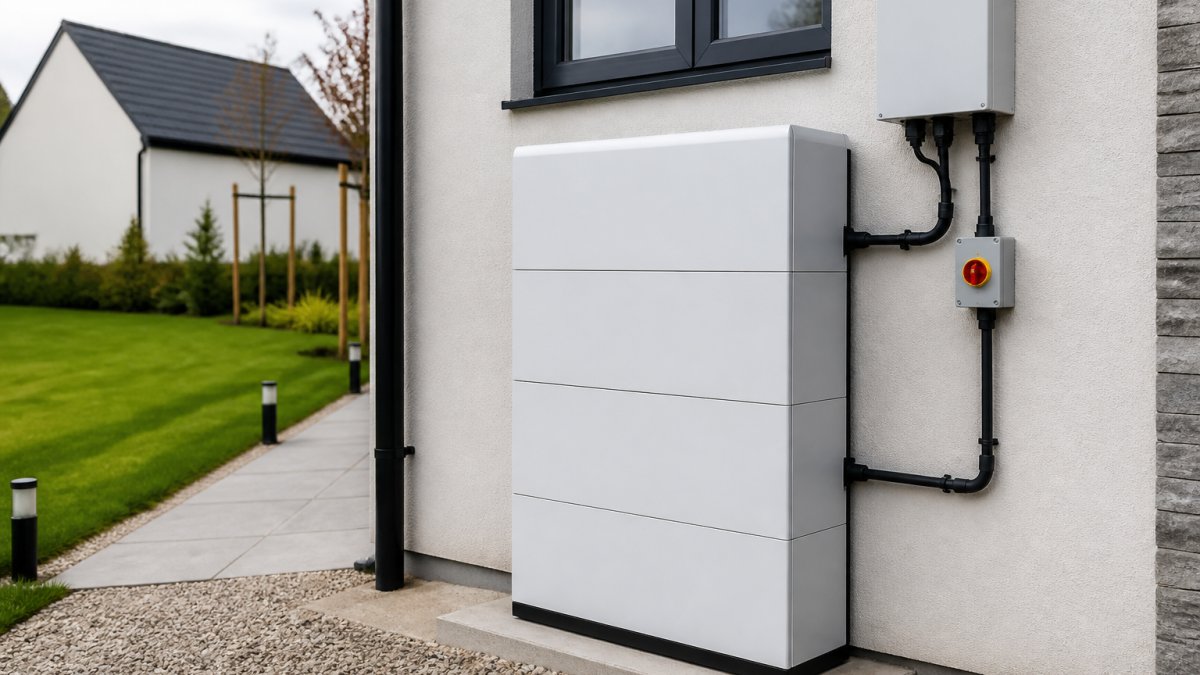
Battery storage transforms solar panels for agricultural buildings from a daytime-only power source into a round-the-clock energy asset. For farms with irregular energy demand, particularly those running irrigation, cold storage, or processing equipment at night, battery integration is often the difference between marginal and strong returns.
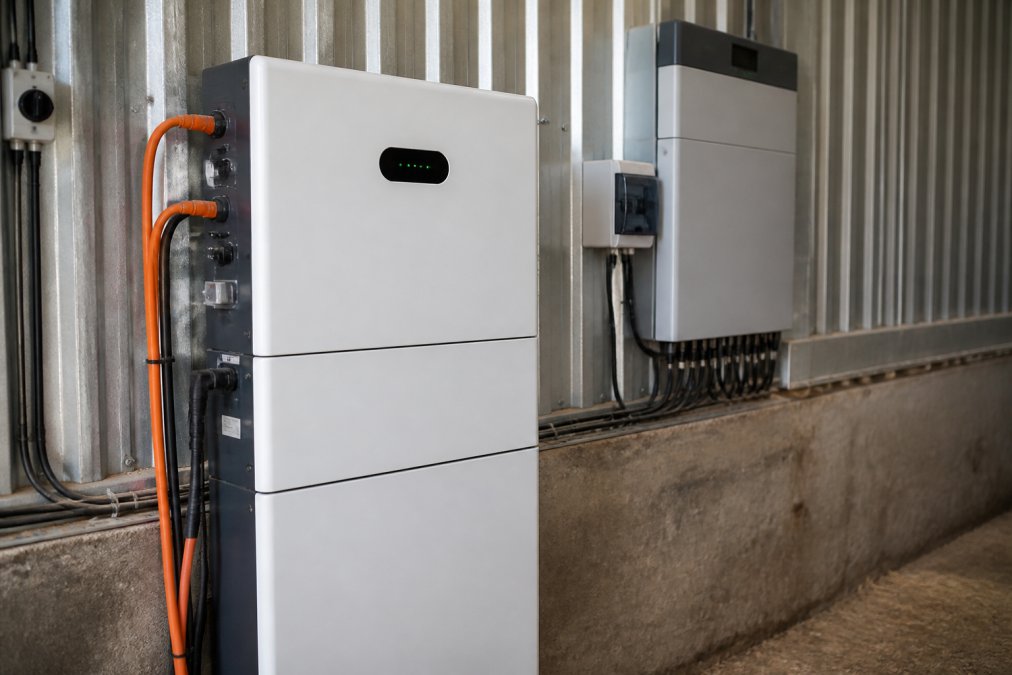
The core benefit is time-shifting. Solar generates power during daylight; batteries store that power for use when the sun isn't shining. For farms operating intensive equipment at specific times, this alignment can be crucial. A dairy operation milking at dawn and dusk, for example, can use stored solar energy during those peak demand windows rather than drawing from the grid.
Click HERE for your FREE SURVEY today →
Battery sizing is a common challenge. An undersized battery provides little benefit and wastes solar potential. An oversized system ties up capital without proportional returns. The right approach is to analyse your actual energy consumption patterns, hour by hour, season by season, and match battery capacity to your real needs.
Lithium-ion battery technology has become the standard for farm installations. These systems are compact, efficient, and have predictable degradation curves. A well-maintained lithium battery typically retains 80% capacity after 10 years, with many systems lasting 15-20 years (peer-reviewed research).
Integration with your existing electrical system requires careful design. The battery, inverter, and grid connection must work together seamlessly. Three-phase electricity systems (common on larger farms) require three-phase inverters and battery management systems. Single-phase systems are simpler but may limit future expansion.
At Smarter Utility, we design battery systems specifically for your farm's energy profile. A free survey includes analysis of your consumption patterns to right-size the battery and maximise your return on investment.
Installation, Grid Connection and Energy Bill Savings
The installation process for solar panels for agricultural buildings typically unfolds over 4-8 weeks from contract to grid connection, depending on system size and complexity.
Installation timeline includes design finalisation, equipment procurement, physical installation, electrical testing, and grid connection approval. For rooftop systems on straightforward buildings, the on-site work itself takes 1-3 weeks. Ground-mounted systems may take slightly longer due to foundation work and cabling runs.
Grid connection is the final hurdle. Your installer submits a connection application to the grid operator, who reviews the system specifications and confirms it meets safety and stability requirements. Most systems under 50kW qualify for simplified connection processes (ofgem.gov.uk). Larger systems may face additional scrutiny, particularly if your local grid section is heavily loaded.
Once connected, the system begins generating immediately. Energy bill savings depend on your consumption pattern and how much solar energy you use directly versus exporting to the grid. Farms with consistent daytime loads, irrigation, ventilation, refrigeration, see the highest savings because they consume their own generation.
Energy self-sufficiency is the real metric. A farm that generates 80% of its annual electricity need on-site has dramatically reduced exposure to grid price increases. The remaining 20% drawn from the grid is a small, manageable cost.
Return on investment timescales vary, but farms typically see payback within 6-10 years, depending on system size, energy costs, and available grants. After payback, the system generates essentially free electricity for the remaining 15-25 year lifespan.
Structural Integrity, Insurance and Long-Term Maintenance
Before committing to rooftop solar, a structural survey is non-negotiable. Agricultural buildings vary enormously in construction quality and load-bearing capacity. A 40-year-old barn may have perfectly sound timber trusses or may have hidden rot and weakening. Only a survey can tell.
The survey assesses whether the roof can safely carry solar panels and associated mounting hardware. A typical rooftop system adds 15-25 kg per square metre. For a large barn, that's many tonnes of additional load. Inadequate roof structure requires reinforcement, adding cost and complexity before installation even begins.
Insurance is another critical consideration often overlooked. Your farm's buildings insurance policy may need updating to reflect the solar installation. Some insurers charge additional premiums; others may exclude damage to the solar system itself unless you add specific solar coverage. Check with your insurer before installation to avoid surprises later.
Maintenance is straightforward but essential. Solar panels require occasional cleaning to maintain output, more frequent in dusty or coastal areas. Inverters and batteries have lifespan expectations (typically 10-15 years) and may need replacement before the panels themselves. Electrical connections should be inspected annually to ensure safety and performance.
Long-term durability is excellent. Modern solar panels retain 80-90% of their output after 25 years. Properly maintained systems often exceed 30 years of productive life. The real wear items are the inverter, battery (if present), and monitoring equipment, all of which are replaceable without replacing the panels.
End-of-life decommissioning and recycling are increasingly important considerations. Solar panels contain valuable materials and must be recycled responsibly. Most reputable installers have recycling partnerships in place. Planning for eventual panel recycling, even 25 years hence, ensures your system leaves no environmental burden.
Transitioning your agricultural operation to solar power requires careful planning, but the rewards, lower energy costs, greater resilience, and reduced carbon footprint, make it worthwhile. The decision hinges on your specific building, consumption patterns, and financial position. A professional assessment from accredited solar installers can clarify whether solar makes sense for your farm.
Smarter Utility offers free, no-obligation surveys to evaluate your agricultural building for solar suitability. Our fully accredited team will assess your roof or available land, analyse your energy consumption, and explain exactly what a system would cost and deliver. Click HERE for your FREE SURVEY today and take the first step toward energy independence.
| Consideration | Rooftop Systems | Ground-Mounted Systems |
|---|---|---|
| Planning permission | Often permitted development | Usually requires formal consent |
| Land use impact | None, uses existing structure | Occupies farmland; visual impact |
| Installation speed | Faster on suitable buildings | Slower due to foundation work |
| Maintenance access | Requires roof access | Ground-level access |
| Structural requirements | Depends on roof condition | Minimal; needs level ground |
| Future flexibility | Limited by building orientation | Can be repositioned or expanded |
Frequently Asked Questions
Q: Do I need planning permission for solar panels on agricultural buildings?
A: Most solar panel installations on agricultural buildings may qualify for permitted development rights under Town and Country Planning Regulations, meaning you might not need formal planning permission. However, listed buildings, conservation areas, and certain heritage sites have stricter rules. Check with your local authority first. Systems exceeding certain thresholds may require planning permission regardless of building type. A structural survey is also essential to confirm your barn can support the load.
Q: What solar grants are available for farm projects?
A: Various farm diversification schemes may offer support for renewable energy projects, though grant availability changes annually. Check with your local agricultural development organisation for current opportunities. Many farms may also benefit from schemes that pay for excess energy exported to the grid, potentially improving return on investment.
Q: How much can solar panels reduce my farm's energy bills?
A: Savings depend on system size, roof orientation, and current energy consumption. Battery storage can increase self-consumption and savings further by storing energy for evening use. A professional energy consumption profile assessment determines your actual potential before installation.
Q: Can I use solar panels on an agricultural building with battery storage for off-grid operation?
A: Yes, battery storage integration allows farms to operate partially or fully off-grid, providing energy resilience during grid outages. This is especially valuable for remote rural premises. However, off-grid systems require careful sizing based on your energy demand profile and seasonal variations. Grid-connected systems with battery backup offer a balance: you generate and store energy, use it when needed, and can export excess to the grid. A professional design ensures your system handles peak farm operations.
This article was written using GrandRanker