 ultimate-guide
Smart Energy Management for Scottish Homes: 2026 Guide
Table of Contents
- What Smart Energy Management Means for Your Home
- The Core Benefits of Solar Battery Storage Benefits for Households
- How to Start: A Step-by-Step Implementation Roadmap
- Home Energy Scotland Grants and Funding Options
- Optimising Solar PV and Battery Systems for Maximum Savings
- Integrating Smart Appliances, EV Chargers, and Heat Pumps
- Maintenance, Long-Term ROI, and Common Mistakes to Avoid
- Conclusion: Your Path to a Low-Carbon Home
- Frequently Asked Questions
Last Updated: September 4, 2026
What Smart Energy Management Means for Your Home
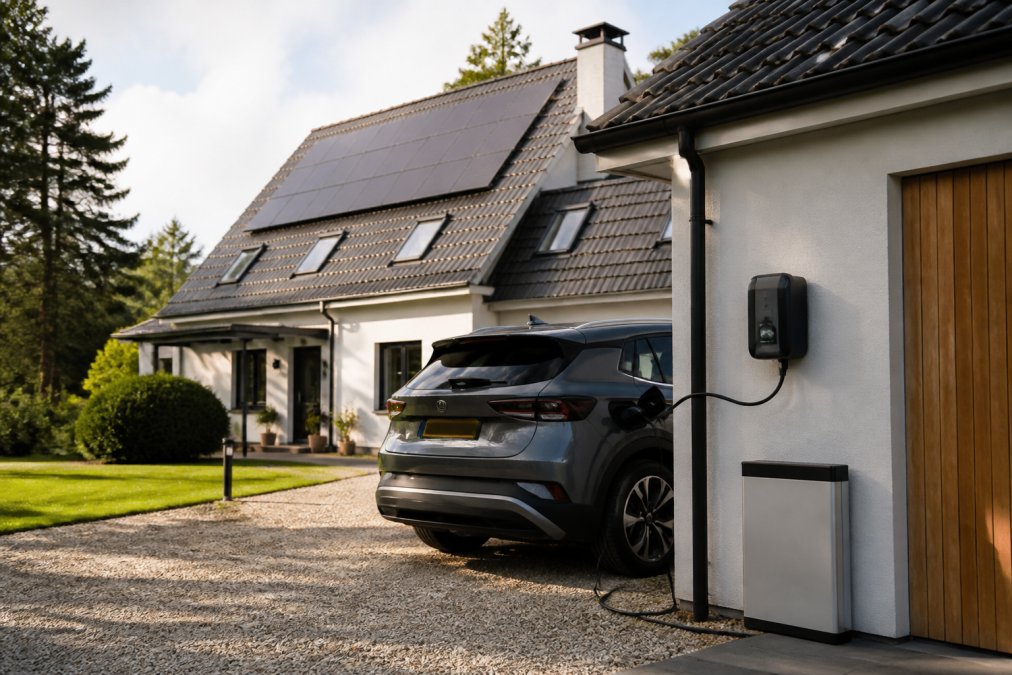
Smart energy management uses connected technology to monitor, control, and optimise your home's electricity consumption, generation, and storage in real time. For Scottish households, this combines solar panels, battery storage, and intelligent controls that shift usage to cheaper, cleaner moments, lowering bills while reducing grid reliance.
At Smarter Utility, we design systems around this concept daily. Rather than treating each device as a standalone purchase, effective smart energy management treats the whole property as one integrated system: solar feeds the battery, the battery powers appliances and the EV charger, and smart software decides when to draw from the grid based on live pricing and weather forecasts.
Energy prices remain volatile, and the shift toward low-carbon heating means homes are becoming more electrified. Managing electricity intelligently is the most practical route to long-term savings and a lower carbon footprint.

The Core Benefits of Solar Battery Storage Benefits for Households
Solar battery storage benefits extend far beyond backup power. A battery stores excess daytime solar generation for evening use, when grid prices typically rise, substantially reducing the electricity you buy from your supplier.
- Lower energy bills by using stored solar power during peak tariff periods
- Energy independence that insulates you from price spikes and grid instability
- Reduced carbon footprint by maximising the renewable energy you generate yourself
- Grid services potential through demand side response schemes that reward shifting your usage
A properly sized battery transforms a solar array from a daytime-only generator into a round-the-clock asset. Many Scottish homes cover over half of their annual electricity needs from their own roof, particularly when paired with a heat pump or EV charger scheduled to run on stored power.
How to Start: A Step-by-Step Implementation Roadmap
A phased approach protects your budget while building toward a fully integrated system.
- Audit your consumption. Review a year of energy bills and note when you use the most electricity. A household energy audit reveals whether your demand is morning-heavy, evening-heavy, or spread evenly.
- Check your property's potential. Assess roof orientation, pitch, and shading. South-facing roofs are ideal, but modern systems perform well on east-west splits. An energy performance certificate will also highlight insulation upgrades worth doing first.
- Install solar PV first. Generation is the foundation. A typical Scottish array is sized to match annual consumption, not to maximise roof coverage.
- Add battery storage. Size the battery to cover your evening peak, usually 5-10 kWh for an average household. Oversizing wastes money; undersizing forces you back onto the grid.
- Integrate smart controls. Connect your battery, EV charger, and heat pump to a single energy management system so they coordinate rather than compete.
- Monitor and refine. Review your in-home display and app data monthly. Small adjustments to schedules can yield meaningful savings over a year.
Solar panels deliver value immediately, but the full financial picture emerges once storage and smart appliances are layered on top.
Home Energy Scotland Grants and Funding Options
Funding can significantly reduce upfront costs. Home Energy Scotland operates interest-free loans and grants for renewable heating, solar PV, and battery storage, covering a meaningful portion of installation costs.
Eligibility and funding levels vary depending on your property type, existing heating system, and whether you receive certain benefits. The Home Energy Scotland funding pages provide the current loan and grant amounts, which are updated periodically. It is worth checking these figures directly, as they change.
Local authorities occasionally offer additional support. A qualified installer can advise on funding routes during a free survey. Many households combine a solar PV grant or loan with a separate battery storage loan.
Optimising Solar PV and Battery Systems for Maximum Savings
Once your system is live, optimisation determines how much you save. The difference between saving £200 and £600 a year is rarely the hardware; it is the control logic and tariff alignment you set up afterwards.
The Tariff Layer: Beyond the Standard Variable Rate
Most Scottish households default to a standard variable tariff, the single biggest drag on smart system returns. You need a tariff that prices electricity by the half-hour. The two main structures are:
- Time-of-Use (ToU) tariffs like Octopus Flux or OVO's Charge Anytime, which offer cheaper overnight rates (often 5p-10p/kWh) and higher daytime rates (30p-40p/kWh).
- Export tariffs such as Octopus Outgoing or Scottish Power's Smart Export Guarantee, which pay you for surplus generation. Rates vary from 5p to 15p/kWh depending on the provider and whether you have a battery.
The optimisation game is arbitrage: buy low, use your own solar when the sun shines, and avoid peak imports. A battery charged overnight at 7p/kWh and discharged at 6pm when the grid rate hits 35p/kWh earns 28p per kWh shifted, shifting 3 kWh per day adds up to roughly £300 in avoided costs annually.
Battery Settings: Self-Consumption vs. Arbitrage
Most modern inverters (from manufacturers like GivEnergy, SolarEdge, or Tesla) offer two distinct operating modes, and choosing the wrong one costs you money:
- Maximise self-consumption, the battery only charges from solar and discharges when your home draws from the grid. This is ideal if you are on a flat-rate tariff and want to reduce import.
- Arbitrage mode, the battery charges from the grid during cheap overnight hours and discharges during peak. This works best on ToU tariffs where the spread between night and day rates exceeds 15p/kWh.
A hybrid approach is often optimal: reserve a portion of capacity for solar charging during the day, while allowing overnight grid charging to fill the rest. Most systems let you set a 'target state of charge', for example, 80%, so you never arrive at the evening peak with an empty battery.
The Software Layer: Where Most Homes Leave Money on the Table
The energy management software that coordinates the hardware is where real savings live. Systems like GivEnergy's portal, SolarEdge's monitoring app, or Home Assistant with an Octopus Energy integration automate decisions you would never manage manually.
Practical examples of software-level optimisation:
- Weather forecast charging: If tomorrow is forecast to be overcast, the system pre-charges the battery overnight at cheap rates instead of waiting for solar that will not arrive.
- Dynamic load shifting: The system detects when your EV is plugged in and automatically delays charging until the cheapest half-hour window, rather than charging immediately at peak rate.
- Export threshold setting: On days when solar generation exceeds both home demand and battery capacity, the system decides whether to export or to divert surplus to an immersion heater or heat pump buffer tank. Exporting at 5p/kWh while your heat pump would otherwise import at 30p/kWh is a losing trade.
Real-World Performance Expectations
A well-optimised Scottish system typically achieves a 60-70% self-consumption rate, the proportion of solar generation used in-home rather than exported. Without optimisation, that figure often drops below 40%. The gap is purely a function of control settings and tariff alignment.
The Optimisation Audit
If your system is already installed, run this quick audit:
- Check your tariff: Are you on a ToU tariff? If not, is your battery charging overnight at cheap rates?
- Review your battery mode: Is it set to arbitrage or self-consumption? Does it match your tariff structure?
- Look at your export rate: Are you getting paid for surplus, or giving it away?
- Examine your app data: Find the last sunny day. What percentage of your solar generation was used in-home versus exported?
Most installers configure your system once and leave it. A good partner revisits those settings seasonally, the optimal configuration in July is not the same as in January.
Integrating Smart Appliances, EV Chargers, and Heat Pumps
The real value of smart energy management emerges when devices work together. Pairing solar with an EV charger and heat pump dramatically cuts bills and carbon emissions. The challenge is that most homes accumulate these devices over years, from different manufacturers, each with its own app and scheduling logic.
The Interoperability Problem
Before you buy anything, understand the communication protocols. The UK smart home ecosystem has consolidated around three main standards:
- Zigbee, a low-power mesh protocol used by many smart plugs, sensors, and some energy monitors. It is reliable and widely supported but requires a hub.
- Matter, the newer industry standard backed by Apple, Google, and Amazon. It promises cross-ecosystem compatibility, though support for energy-specific devices is still maturing.
- Proprietary ecosystems, GivEnergy, SolarEdge, and Tesla each have their own closed platforms. They work well within their own ecosystem but do not natively talk to devices from other manufacturers.
If you want a single dashboard that controls your battery, EV charger, and heat pump, you need either (a) devices from the same manufacturer, or (b) a central controller that speaks multiple protocols. managing home energy consumption.
Click HERE for your FREE SURVEY today →
The Central Controller Options
Three approaches dominate the Scottish market:
-
Manufacturer portals, GivEnergy's portal, SolarEdge's monitoring platform, or Tesla's app. These are the easiest to set up but only control that manufacturer's devices. If your EV charger is from a different brand, you are managing two apps.
-
Home Assistant, an open-source platform running on a Raspberry Pi or a small server. It integrates with over 2,000 device types, including Octopus Energy's Agile tariff API, most EV chargers (via the Open Charge Point Protocol), and heat pump controllers. The learning curve is steep, but it is the only option that gives you full control over automation logic.
-
Octopus Energy's intelligent platform, if you are on Octopus Agile or Intelligent Octopus, their system can coordinate charging and heating based on half-hourly price signals. It is the most consumer-friendly option but requires you to use Octopus as your supplier.
EV Charging: The Highest-Value Integration
For EV owners, this integration is particularly powerful. A smart charger like the Ohme Home Pro or Zappi can schedule charging to align with solar generation or off-peak tariffs. Daytime solar charging can effectively eliminate the fuel cost of daily commuting.
The key mechanism is the Open Charge Point Protocol (OCPP), which allows third-party controllers to send charging commands. Without OCPP support, your charger is locked to its own app. Confirm the charger supports OCPP 1.6 or newer before buying.
A common pattern is 'solar-only' mode during summer months and 'cheapest overnight rate' mode during winter. Some chargers allow both simultaneously: they use solar if available, otherwise fall back to the cheapest grid window.
Heat Pumps: The Thermal Battery
Air source heat pumps run most efficiently over long periods at a steady temperature rather than short, intense bursts. Smart controls can pre-heat your home during the afternoon when solar is abundant, letting thermal mass carry you through the evening.
Heating the buffer tank or underfloor thermal mass to 50°C during the solar window stores energy that discharges slowly through the evening, effectively a second battery at a fraction of the cost per kWh of storage.
Modern heat pumps from Mitsubishi Ecodan or Daikin support open protocols that allow external scheduling. If yours does not, a simple smart relay on the immersion heater can achieve a similar effect for hot water.
The Realistic Integration Roadmap
If you are starting from scratch, the order of integration matters:
- Install the smart meter, this is the data backbone. Without half-hourly consumption data, you cannot optimise anything.
- Add solar PV and battery, generation and storage are the foundation.
- Choose a central controller, decide early whether you are going with a manufacturer portal or Home Assistant. Changing later means reconfiguring everything.
- Add the EV charger, ensure it supports OCPP so it can receive commands from your controller.
- Integrate the heat pump, this is the most complex step. Budget for a professional to configure the communication between the heat pump controller and your energy management system.
Interoperability is the watchword here. Before purchasing any smart device, confirm it can communicate with your existing energy management system. The UK government smart meter rollout data shows that smart meters and in-home displays are now standard in most homes, providing the real-time monitoring backbone these integrations rely on. Devices that use open standards such as Zigbee or Matter are far easier to coordinate than those locked into proprietary ecosystems.
Maintenance, Long-Term ROI, and Common Mistakes to Avoid
Solar and battery systems require minimal maintenance, but neglecting the basics erodes returns. In Scotland's climate, rainfall cleans panels naturally, but moss or bird droppings on lower-pitched roofs can shade cells and reduce output noticeably.
Most modern lithium batteries are rated for 10-15 years, but deep discharges and frequent full cycling shorten lifespan. Smart systems typically limit depth of discharge, but it pays to understand your battery's warranty terms and recommended operating range.
The long-term ROI picture is strong, driven by three factors: avoided grid purchases, export payments, and protection against future price rises. While the payback period varies with system size and usage patterns, the combination of rising energy costs and falling equipment prices has made the financial case more compelling than it was five years ago. The UK Government net zero strategy confirms that household low-carbon technology will play a central role in meeting carbon targets through 2030 and beyond.
Conclusion: Your Path to a Low-Carbon Home
Making the shift to smart energy management is a sequence of informed decisions, not a single leap. Start with an honest audit of your consumption, layer in generation and storage, then connect the appliances that deliver the biggest savings.
The complexity lies in the details: sizing the battery correctly, scheduling the heat pump, coordinating the EV charger. That is where professional guidance earns its keep. Smarter Utility provides free, no-obligation home surveys across Scotland, with fully accredited MCS solar and battery storage installation and expert design tailored to your energy needs. Our team helps you make an educated decision about solar, ensuring your system handles future additions like heat pumps or EV chargers without starting over.
Get started with Smarter Utility and book your free survey today.
Frequently Asked Questions
What is smart energy management and how does it work?
Smart energy management links your solar PV, battery storage, and appliances so they work together automatically. A central system monitors generation and usage in real time, charging your battery when solar output is high and drawing from it when prices rise. This reduces reliance on the grid and lowers bills. For Scottish homes, it also helps manage the seasonal variation in daylight, ensuring you store energy when it is plentiful.
Can I get a Home Energy Scotland grant for a solar battery?
Home Energy Scotland administers funding for energy efficiency and low-carbon heating. Grants and interest-free loans have covered solar PV, battery storage, and air source heat pumps for eligible homeowners. The exact offer depends on your property, income, and current heating system. You should contact Home Energy Scotland directly for the latest scheme details, as funding rounds change and eligibility criteria apply.
How does battery storage improve energy management in Scottish homes?
Battery storage captures excess solar generation during daylight hours and releases it in the evening when you need it most. This directly reduces the electricity you buy from the grid, cutting bills and your carbon footprint. In Scotland, where winter days are short, a battery also allows you to charge on a cheaper overnight tariff and use that stored power during peak times, adding further savings.
Are smart meters mandatory for homeowners in Scotland?
Smart meters are not mandatory. Energy suppliers are required to offer them to all homes, but you can refuse the installation. However, a smart meter is a practical foundation for smart energy management. It provides the real-time usage data and in-home display that help you see where energy is wasted and measure the performance of your solar and battery system accurately.
This article was written using GrandRanker
Frequently Asked Questions
What is smart energy management and how does it work?
Smart energy management links your solar PV, battery storage, and appliances so they work together automatically. A central system monitors generation and usage in real time, charging your battery when solar output is high and drawing from it when prices rise. This reduces reliance on the grid and lowers bills. For Scottish homes, it also helps manage the seasonal variation in daylight, ensuring you store energy when it is plentiful.
Can I get a Home Energy Scotland grant for a solar battery?
Home Energy Scotland administers funding for energy efficiency and low-carbon heating. Grants and interest-free loans have covered solar PV, battery storage, and air source heat pumps for eligible homeowners. The exact offer depends on your property, income, and current heating system. You should contact Home Energy Scotland directly for the latest scheme details, as funding rounds change and eligibility criteria apply.
How does battery storage improve energy management in Scottish homes?
Battery storage captures excess solar generation during daylight hours and releases it in the evening when you need it most. This directly reduces the electricity you buy from the grid, cutting bills and your carbon footprint. In Scotland, where winter days are short, a battery also allows you to charge on a cheaper overnight tariff and use that stored power during peak times, adding further savings.
Are smart meters mandatory for homeowners in Scotland?
Smart meters are not mandatory. Energy suppliers are required to offer them to all homes, but you can refuse the installation. However, a smart meter is a practical foundation for smart energy management. It provides the real-time usage data and in-home display that help you see where energy is wasted and measure the performance of your solar and battery system accurately.