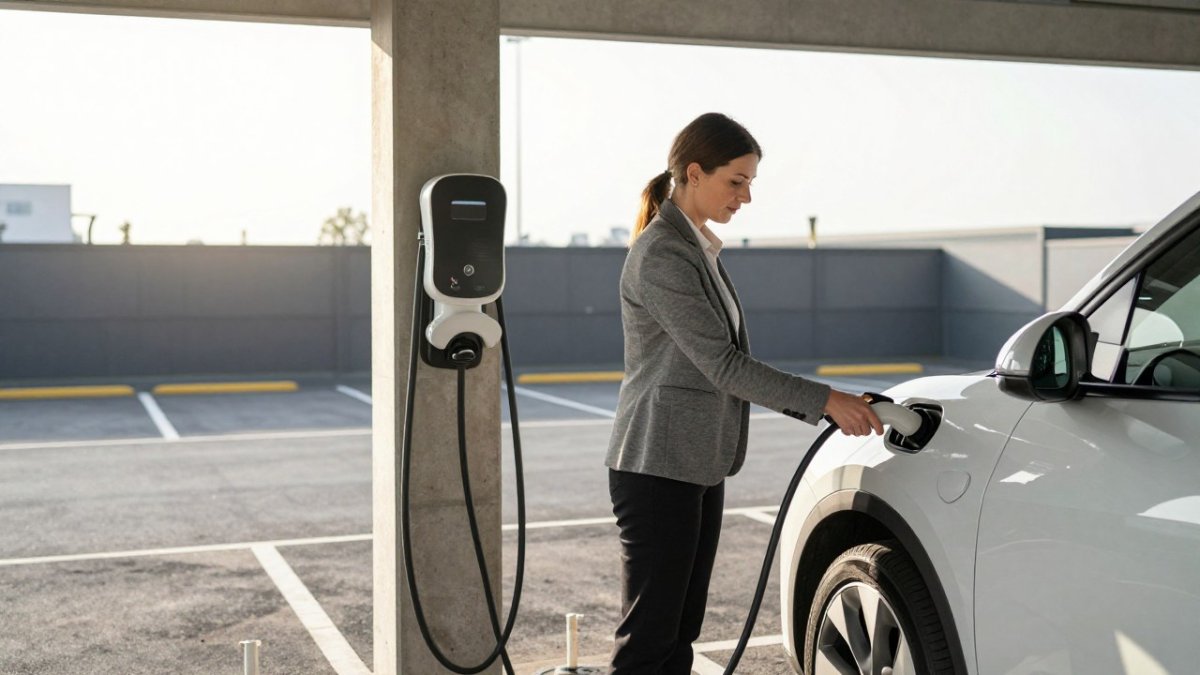
 How-to
Are Workplace EV Charging Payment Systems Worth It?
Last Updated: November 14, 2026
Quick Summary
EV charging payment systems are worth it for most workplaces because they recover electricity costs, prevent all-day bay hogging and produce the session records finance needs. Pay per kWh with RFID cards or an app is usually the fairest model for employees, while contactless card payment suits visitors. Decide your tariff and access model before buying hardware.
- Free charging fails once demand exceeds supply, attracting long-stay parkers and queueing at peak times.
- Pay per kWh is the fairest model for most workplaces because it tracks actual energy consumption.
- Time-based billing discourages staff leaving cars plugged in long after charging finishes.
- A hybrid tariff pairs pay per kWh during the working day with an overstay charge after a set window.
- Offer at least two payment routes plus a fallback such as a grace period or override code.
Table of Contents
- Why Workplace EV Charging Payment Systems Decide Whether Your Chargers Get Used
- Choosing EV Charging Payment Methods That Fit Your Site and Staff
- Workplace EV Charger Billing Models Compared: Tariffs, Fees and Who Pays
- Employee EV Charging Reimbursement and Business Mileage Claims
- EV Charging Software for Businesses: Access, Reporting and Reconciliation
- Payment Security, Accessibility and What Happens When a Payment Fails
- What a Workplace Charging System Really Costs to Run
- Planning Your Charging Rollout with Smarter Utility
- Frequently Asked Questions
Why Workplace EV Charging Payment Systems Decide Whether Your Chargers Get Used
Workplace EV charging payment systems determine whether staff actually plug in, and whether your investment earns its keep. Chargers installed with good intentions can sit idle when nobody has thought through who pays, how, and how much.
Free charging sounds generous. The UCLA Luskin Center research on workplace charging behaviour examined how pricing shapes charging behaviour at work, and the core finding is intuitive: price signals change when and how long people charge.
The UK picture reinforces the point. Plug In America's 2026 EV Driver Annual Survey reports that the share of drivers using workplace charging or workplace incentives rose from 14.1% the previous year, a clear signal that workplace charging is moving from perk to expected benefit.
Below, we break down the payment models, the billing mechanics, the finance workflows and the real running costs, so you can decide with numbers rather than guesswork.
Free Charging, Paid Charging and the Cost Problem in Between
Free charging works well for a small site with two chargers and a handful of EV drivers. It fails once demand exceeds supply. The moment staff arrive early to bag a bay they do not need, the charger stops serving the people who do.
Paid charging solves the allocation problem but introduces administration. You need a tariff, a payment method, a record of every session and a way to reconcile income against electricity spend. The middle ground, subsidised charging where the employer covers part of the cost, is often the most practical: it keeps the benefit attractive while discouraging all-day occupancy.
Watch out: the most common mistake is installing hardware first and deciding the commercial model later.
Choosing EV Charging Payment Methods That Fit Your Site and Staff
The right payment method depends on who charges, how often, and how much control you want over access. There is no single best answer, but there is a clear best answer for each site type.
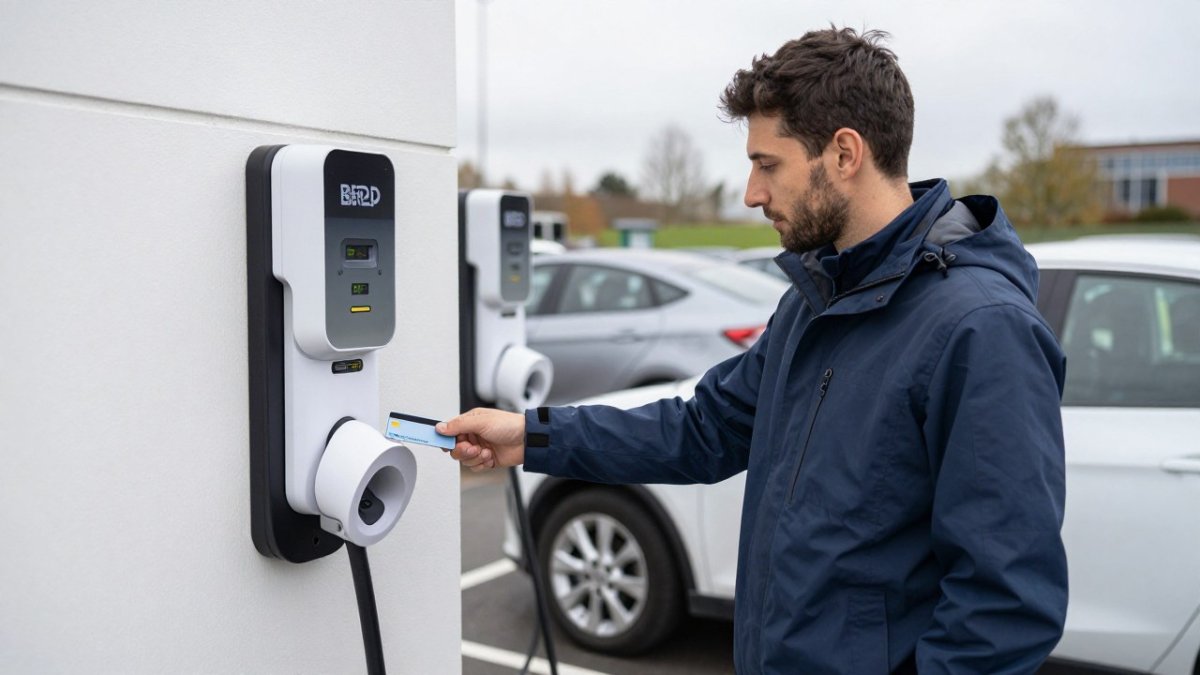
Contactless card payment suits visitor and short-stay charging. Drivers pay with a debit or credit card at the terminal, no app or account needed.
RFID cards and mobile apps suit regular employees. A registered card or app ties each session to a named user, which makes billing, reporting and reimbursement straightforward.
Automated billing and salary deduction suits large employers who want charging treated like any other workplace benefit. Sessions are logged against the employee and settled monthly.
For the access rules that sit underneath any of these models, our guide to employee access rules for workplace EV chargers sets out who should be allowed to plug in, and when.
Workplace EV Charger Billing Models Compared: Tariffs, Fees and Who Pays
Workplace EV charger billing comes down to three variables: what you charge for, how you charge it, and who ultimately bears the cost. Get these right and the scheme runs itself. Get them wrong and you either subsidise all-day parking or spend your evenings reconciling spreadsheets.
| Billing model | How it works | Best for | Main drawback |
|---|---|---|---|
| Free to use | Employer covers all electricity | Small sites, early adoption | Overuse and queueing |
| Pay per kWh | Driver pays for energy consumed | Fair cost recovery | Needs metering per session |
| Time-based billing | Driver pays per hour connected | Discouraging all-day parking | Penalises slow chargers |
| Flat session fee | Fixed charge per plug-in | Simple admin | Unfair on short top-ups |
| Subsidised | Employer covers a share | Recruitment and retention | Ongoing budget commitment |
| Subscription | Fixed monthly fee for unlimited or capped charging | Predictable staff benefit | Risk of underuse by low-mileage drivers |
| Reimbursement | Driver pays, then claims back | Business mileage and company car drivers | Admin burden and delayed records |
Pay per kWh is the fairest model for most workplaces because it tracks actual energy consumption. Time-based billing has a specific job: it discourages staff leaving cars plugged in long after charging finishes, which is the single biggest cause of charger underuse.
The choice also depends on who is charging.
Watch out: a flat session fee looks simple but penalises drivers who only need a short top-up, and it can encourage staff to plug in for longer than necessary to get value from the fixed charge.
Before you settle on a model, map your site's real usage pattern: how long cars typically stay, how many drivers share each charger, and whether visitors need access. That map will tell you more about the right tariff than any generic comparison.
Employee EV Charging Reimbursement and Business Mileage Claims
Employee EV charging reimbursement is where workplace schemes most often get messy. If staff pay to charge a company vehicle at work, or charge a personal vehicle for business mileage, someone has to record it properly.
Two situations need separating. First, charging a company car at a workplace charger the employer owns: the energy is a business cost, so there is usually nothing to reimburse, but you still need session records for reporting. Second, charging a personal EV for business journeys: the driver may be entitled to claim mileage at the approved rate, and your charging records become the evidence.
The practical answer is to let software do the work. A system that logs every session against a named user produces the billing records and usage reporting your finance team needs, without staff submitting spreadsheets. Keep session data for at least as long as your normal expense retention period, and make sure personal and business use are tagged separately from day one.
Watch out: if you cannot distinguish personal from business charging in your records, reimbursement claims become guesswork, and that is where disputes start.
EV Charging Software for Businesses: Access, Reporting and Reconciliation
EV charging software for businesses is the layer that turns hardware into a managed service. It handles access control, session logging, tariff setting, payment collection and the reporting that finance actually needs.
The reconciliation workflow matters more than most buyers expect. Each month, someone has to match electricity purchased against revenue collected and identify the gap. Good charge point management software produces that automatically: energy consumption per charger, income per session, transaction fees deducted, and a clean export for your accounts.
If you run commercial vehicles, the same software typically extends to fleet charging, with driver-level reporting and cost allocation by vehicle or department. Our overview of smart charging software for commercial electric fleets covers what that looks like in practice.
What most guides miss is that reporting is not a back-office nicety. It is how you justify the scheme, spot underused chargers, and decide where the next installation goes.
Payment Security, Accessibility and What Happens When a Payment Fails
Payment security and accessibility are the two areas where workplace schemes quietly fail compliance. Both need designing in, not bolting on.
On security, card payments should comply with the payment card industry standard, PCI DSS. Under UK GDPR, session data linked to a named employee can be personal data, so it is worth checking your lawful basis, retention period and privacy notice.
Accessibility matters for any workplace charging scheme. Bays should allow space for wheelchair users to manoeuvre, and terminals and instructions should be easy to reach and read. A charger nobody can reach is a charger nobody uses.
Payment failure handling is the overlooked one. Cards decline, apps lose signal, and RFID cards get left at home. A sensible scheme offers at least two payment routes and a clear fallback: an authorisation window, a grace period, or an override code from reception.
What a Workplace Charging System Really Costs to Run
Running costs fall into four buckets: electricity, transaction fees, software subscription and maintenance. Electricity is usually the largest, and it scales directly with utilisation, which is why the payment model and the tariff interact so closely. A scheme that recovers cost per kWh will see electricity spend offset by revenue; a free-vend scheme absorbs the whole bill.
Transaction fees are charged per card payment by your provider, so contactless-only schemes carry a per-session cost that RFID schemes avoid. Those fees are typically a small fixed amount plus a percentage of the transaction, and they add up quickly on a busy site with many short sessions.
A total-cost-of-ownership view helps here. Add up the hardware cost (chargers, mounting, cabling), the installation cost (groundworks, electrical upgrades, commissioning), the annual software subscription, the expected electricity spend at your utilisation level, the transaction fees at your expected session volume, and the maintenance allowance. Then compare that total against the revenue you expect from your chosen tariff.
Before committing to a payment system, it is worth understanding the future-proofing trade-offs: whether the hardware can be upgraded, whether the software supports additional chargers, and whether the site has capacity for growth. Our article on why future proofing business EV charging matters covers that decision. For installation figures to sanity-check the total, see our EV charging point installation cost guide.
We do not publish fixed prices, because cost depends on charger count, site power and groundworks. A free site survey gives you an accurate figure rather than a guess.
Planning Your Charging Rollout with Smarter Utility
The difference between a charging scheme that works and one that frustrates staff comes down to planning the commercial model before the hardware. Tariff, access, payment method and reporting should all be decided together, and they should match how your site is actually used.
Smarter Utility offers a free, no-obligation home survey so the system is sized to your real demand. As a fully accredited MCS solar and battery storage installer, we also design solar and battery systems that can help power your chargers.
Visit the Smarter Utility website to request your FREE SURVEY today.
A workplace charging scheme only pays back when the tariff, access and reporting are designed together. Smarter Utility offers a free, no-obligation site survey, expert design and installation of EV charging, solar PV and battery storage, and fully accredited MCS workmanship. Click here for your free survey today.
Frequently Asked Questions
How do workplace EV charging payment systems work?
A charge point management platform sits behind the chargers and decides who can start a session and what it costs. Drivers identify themselves with a contactless card, mobile app or RFID card, the system checks their access rights, then records the energy drawn and bills it to the right account. Demand for a workable EV charging payment setup keeps growing as more drivers rely on workplace charging.
Can employees charge their electric cars at work for free?
Yes, and many workplaces start that way. Free charging is simple to run and popular with staff, but it leaves the business carrying the full electricity bill with no control over demand. A middle path works well: free or discounted charging for a set daily allowance, then a tariff once a session passes it. That keeps the benefit visible while stopping one vehicle from occupying a charger all day.
Can workplace chargers bill staff and visitors differently?
Yes. Access control lets you set separate tariffs by group, so employees might pay cost price while visitors pay a higher rate or a flat session fee. The same setup can ring-fence chargers for fleet vehicles overnight. Decide the groups before you buy hardware, because the payment terminal and software need to support the split from day one rather than being retrofitted later.
What should a business check before choosing EV charging software for businesses?
Check four things: whether it exports billing records your finance team can reconcile without manual work, whether it supports the payment methods your staff already carry, what it charges per transaction, and how it handles a failed payment or a lost RFID card. Ask for a demonstration of the reporting dashboard using your own tariff structure. If the vendor cannot show a clean monthly reconciliation, keep looking.