 How-to
7 Employee Access Rules for Workplace EV Chargers
Last Updated: November 12, 2026
Quick Summary
Employee access to workplace EV chargers works best when planned before the first cable is plugged in, following three steps: assess the site and electrical capacity, choose an access control method, then register users and vehicle registration numbers. Registering every authorised user against a vehicle registration number is the single most useful record you will keep, letting you match sessions to people and remove leavers quickly.
- Complete an electrical capacity check before any chargepoint socket is fitted.
- RFID cards and fobs are the simplest access option for most workplaces.
- Keep the user register simple and update it monthly to stop ex-employees charging.
- A workplace charging policy should be plain language, one page, and published where drivers park.
- An EV charger booking system is worth it once demand exceeds supply.
Table of Contents
- Why Employee Access to Workplace EV Chargers Needs a Plan
- Step-by-Step: Setting Up Employee Access to Workplace EV Chargers
- RFID Cards, Mobile Apps and Vehicle Registration: Comparing Access Control Options
- Writing a Workplace EV Charging Policy That Staff Actually Follow
- Workplace Charging Etiquette: Fair-Use Rules and Resolving Conflicts
- Do You Need an EV Charger Booking System for Employees?
- Charging Employees for Workplace EV Charging: Costs, Grants and Tax
- Troubleshooting Access Problems and Planning for Contingencies
- Frequently Asked Questions
Why Employee Access to Workplace EV Chargers Needs a Plan
Employee access to workplace EV chargers works best when it is planned before the first cable is plugged in. Research from the UCLA Luskin Center for Innovation study on workplace charging shows that charging behaviour at work responds strongly to how pricing and access are structured.
A workplace chargepoint is a shared resource. Treat it like a meeting room, not a parking space.
- Limited supply: most staff car parks have far fewer sockets than vehicles.
- Long dwell times: cars sit parked for a full shift, so one session blocks many drivers.
- Mixed users: staff, visitors and fleet vans often compete for the same chargepoint.
Below, we set out seven access rules that keep a workplace charging policy fair, workable and easy to enforce.
Step-by-Step: Setting Up Employee Access to Workplace EV Chargers
Setting up employee access to workplace EV chargers follows three steps: assess the site, choose an access control method, then register users and vehicles. Each step builds on the last, so skipping the assessment usually means paying for access control you cannot use.
Step 1: Complete a Site Assessment and Electrical Capacity Check
Start with the electrical capacity check, not the app. An installer needs to confirm your supply can carry the extra load before any chargepoint socket is fitted. Older commercial boards often have little spare capacity, and upgrading the supply is the cost that surprises people.
The assessment should record:
- Available capacity at the distribution board
- Cable routes from the board to the parking bays
- Number of bays you could realistically serve now and later
For shared or multi-occupier car parks, our guide to installing an EV charger in shared parking walks through the practical constraints.
Step 2: Choose Your Access Control Method
Access control decides who can start a charging session. The three common options are RFID cards or fobs, a mobile app, and vehicle registration recognition. Most sites combine two: an app for staff and a fob for fleet drivers, for example.
If you are weighing back-end providers alongside access methods, our business EV charging providers comparison sets out how the options differ.
Step 3: Register Users and Vehicle Registration Numbers
Register every authorised user against a vehicle registration number. This is the single most useful record you will keep. It lets you match a charging session to a person, resolve disputes, and remove leavers from the system quickly.
Keep the register simple:
- Employee name and team
- Vehicle registration number
- Access method issued (app account or RFID fob)
Update it monthly. A stale register is how ex-employees keep free charging for months.
RFID Cards, Mobile Apps and Vehicle Registration: Comparing Access Control Options
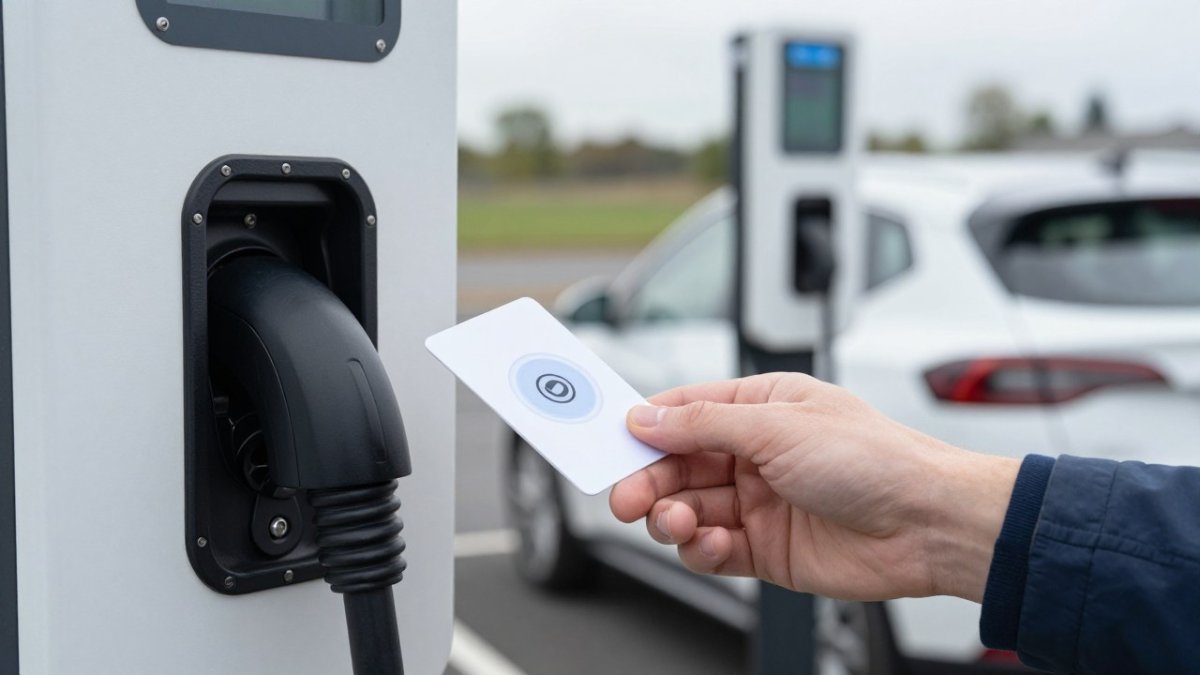
RFID cards and fobs are the simplest option for most workplaces, mobile apps suit sites that want usage data, and vehicle registration recognition removes the need for a card entirely. Each has trade-offs in cost, admin and reliability.
| Method | Best for | Watch out for |
|---|---|---|
| RFID card or fob | Fleets and shift workers | Lost fobs; reissue admin |
| Mobile app | Sites wanting session data | Staff without smartphones |
| Vehicle registration | Hands-free sites | Misread plates; shared cars |
How to choose between the methods
Work through four questions before you commit:
- Who needs access? If drivers are a stable, known group, RFID is cheap and robust. If you have visitors, contractors or agency staff, an app or registration-based access is easier to add and remove.
- What data do you need? If you want to see who charged, when and for how long, choose a method that ties each session to a named account. RFID and app accounts both do this; vehicle registration ties a session to a plate, which may be shared.
- How reliable is the site? RFID works without a mobile signal, which matters in basement or multi-storey car parks. App-based access depends on connectivity at the bay.
A common pattern is to combine two methods: an app for permanent staff and a fob for fleet drivers or shift workers who may not carry a smartphone on site. That gives you the data you need without leaving anyone unable to charge.
Setting up each method in practice
RFID cards and fobs. Order fobs in a batch, label each one against the employee register, and keep a small stock of spares on site.
Vehicle registration recognition. Load each plate into the system and test it with the actual vehicles before going live.
Whichever you pick, the access control should connect to charger management software so you can see who charged, when, and for how long.
Writing a Workplace EV Charging Policy That Staff Actually Follow
A workplace EV charging policy only works if staff can read it in two minutes and see the logic in it. Write it in plain language, publish it where drivers park, and keep it to one page.
Cover these points:
- Who is eligible for charging access
- Maximum charging duration per session
- How to book or queue for a chargepoint socket
Watch out: a policy that bans all-day charging without offering a booking system will be ignored. Drivers leave cars plugged in because they fear losing their slot.
Workplace Charging Etiquette: Fair-Use Rules and Resolving Conflicts
Workplace charging etiquette comes down to three fair-use rules: charge only what you need, move your car when the session ends, and leave the charger usable for the next driver. Congestion is the main risk. A University of California, Davis paper on reducing congestion at workplace chargers found that managing access and turnover matters as much as adding sockets.
Set rules staff can act on:
- Cap sessions at a set number of hours during peak demand
- Ask drivers to move cars once charging finishes, even if the bay is free
- Reserve one socket for visitors or fleet vans
When two drivers clash over a bay, the register settles it. Whoever booked the slot has priority. That is why the booking record matters more than the argument.
Do You Need an EV Charger Booking System for Employees?
An EV charger booking system for employees is worth it once demand exceeds supply, which on most sites happens quickly. A booking system turns a first-come scramble into a schedule, and it gives you data on utilisation.
You need one if:
- More drivers want to charge than there are chargepoint sockets
- Sessions regularly overrun
- Fleet vehicles need guaranteed charging windows
You can skip it while sockets outnumber regular users, but plan for it. Our article on why future proofing business EV charging matters explains how to size access and booking systems so they still work as EV uptake grows.
Charging Employees for Workplace EV Charging: Costs, Grants and Tax
Charging employees for workplace EV charging is a decision about cost recovery, not revenue. Many employers offer free charging as a benefit, while others pass on the electricity cost through the charger management software. The choice affects access design: a free-for-all charger attracts all-day parking, while a priced or time-limited session encourages turnover.
The three pricing models
- Free to the employee. Simple to administer and popular as a benefit, but it offers no incentive to move a car once charging finishes. Pair it with a session cap and a booking system or congestion follows.
- Cost recovery. The employer charges the electricity cost, usually through the charger management software or a payment app. This is the most common model on shared or multi-occupier sites, and it makes usage data worth collecting.
- Commercial rate. The employer charges above cost. This is rare for staff charging and can create a taxable benefit issue, so take advice before setting a rate above cost recovery.
Whichever model you choose, decide how payment is collected before you install. Some chargepoint management platforms bundle payment, access control and reporting; others need a separate payment provider. Our EV charging point installation cost guide explains what drives the installation number, and our business EV charging providers comparison covers how back-end and payment options differ.
Grants and funding
Grant schemes for workplace chargepoints can change over time, and eligibility depends on the applicant, the site and the installer. Check the current official scheme guidance before you budget. Our round-up of commercial EV charging grants in Scotland covers the devolved schemes that sit alongside the UK-wide one.
Tax treatment
The tax treatment of workplace charging depends on the specifics of the arrangement and can change. Do not rely on a general article, including this one, for a tax position. Ask an accountant who works on employee benefits to confirm the treatment for your model, particularly if you charge above cost or provide charging to directors and family members.
What to put in the policy
Whatever pricing model you choose, state it plainly in the workplace charging policy:
- Whether charging is free, at cost, or at a commercial rate
- How and when payment is taken
- What happens if a session overruns or a payment fails
Watch out: a pricing model that is not connected to the access control creates disputes. If a driver can start a session with a fob but the payment is collected separately, you have no reliable way to match a charge to a person when a bill is queried.
Troubleshooting Access Problems and Planning for Contingencies
Most access problems fall into four groups: a fob that will not read, an app that will not connect, a charger offline, and a driver who is not on the register. Have a named contact and a fallback for each.
- Fob failure: keep one spare fob on site for emergencies.
- App outage: allow a phone-in override logged by reception.
- Charger offline: display a fault number and expected fix time.
Plan for the charger network going down entirely. A printed notice with a contact number beats a queue of frustrated drivers.
A workplace chargepoint that nobody can access fairly is a wasted investment. Smarter Utility designs and installs EV charging for commercial sites, backed by our accreditation as an MCS solar and battery storage installer and a free, no-obligation survey.
Frequently Asked Questions
Can employees charge their electric cars at work for free?
Employers can offer free charging, and many do as a staff benefit. There is no legal requirement to charge, and the tax position should be confirmed with an accountant. If you do charge, you will need a clear method such as a tariff through your charger management software. Whichever route you choose, set it out in your workplace EV charging policy so staff know what to expect before they plug in.
How should employers manage access to workplace EV chargers?
Start with a site assessment to confirm electrical capacity, then pick an access control method: RFID cards or fobs, a mobile app, or vehicle registration number checks through charger management software. Register approved users, publish fair-use rules, and review utilisation regularly. A booking system helps where demand outstrips chargepoint sockets. Access control also lets you keep chargers employee-only rather than open to public access, which protects availability for staff.
Can an employer charge staff for using workplace EV chargers?
Yes. Employers can recover the cost of electricity, either per charging session or per kWh, usually through the charger management software or a booking system. Set the rate clearly in your workplace EV charging policy, state how payment is collected, and confirm the tax position with an accountant before you start. Charging employees for workplace EV charging is a commercial decision, not a legal obligation, so the policy matters more than the rate itself.
Can employers get a grant to install workplace EV chargers?
Grant schemes for workplace chargepoint installation have changed over time, and eligibility rules on chargepoint sockets, installer accreditation and site requirements are updated periodically. Check the current scheme guidance before you budget, and confirm your installer is accredited. A site survey will establish what your electrical capacity supports, so you can plan charging infrastructure and installation costs against the funding actually available.