 how-to
How to Claim EV Charger Grants Scotland 2026: Step-by-Step
Table of Contents
- What You'll Need Before You Apply
- OZEV Grant Eligibility Criteria: Who Qualifies in Scotland
- Step-by-Step: How to Claim Your EV Charger Grant
- EV Charger Installation Costs and Grant Amounts
- EV Charger Grant for Renters and Flat Owners
- Cross-Pavement Charging and Local Council Grants
- Common Application Rejection Reasons and How to Avoid Them
- Frequently Asked Questions
Last Updated: September 14, 2026
What You'll Need Before You Apply
Before starting any application, gather four things: proof of vehicle ownership or a confirmed order, your off-street parking evidence, your electricity supply details, and a registered installer who can confirm the installation meets current smart charge point regulations requirements. Missing any one of these is the most common reason applications stall.
The domestic grant covers up to 75% of the purchase and installation cost of a home chargepoint, capped at £350 per grant and limited to one per eligible household (Workplace Charging Scheme). You must own or have permission to modify the property, and the charger must be installed by an approved installer.
OZEV Grant Eligibility Criteria: Who Qualifies in Scotland
The Office for Zero Emission Vehicles (OZEV) sets the eligibility criteria for the domestic chargepoint grant, and these apply uniformly across Scotland. You qualify if you own an eligible electric or plug-in hybrid vehicle, have dedicated off-street parking, and live in a property where you can legally install a chargepoint.
Domestic Chargepoint Grant Requirements
To qualify for the domestic grant, you must meet all of the following:
- Own or lease an eligible low-emission vehicle, or have one on order
- Have off-street parking at the property
- Use an OZEV-approved installer
- Live in a flat or rented property for the separate landlord grant, or own the property for the standard domestic grant
The grant is not means-tested and does not depend on income.
Workplace Charging Scheme Criteria
The Workplace Charging Scheme (WCS) is a separate voucher-based grant that covers a portion of the upfront cost of installing chargepoints for staff and fleet use. Businesses, charities, and public sector organisations can apply. The scheme provides a voucher per socket, capped at a set number of sockets per applicant, and the installation must be carried out by an approved installer.
Step-by-Step: How to Claim Your EV Charger Grant
The claim is installer-led: your chosen approved installer submits the application through the official portal and claims the grant, then deducts it from your invoice. You supply the evidence; they handle the submission. Most delays come from evidence gaps rather than the portal itself, so treat the steps below as a checklist you complete before your installer logs in.
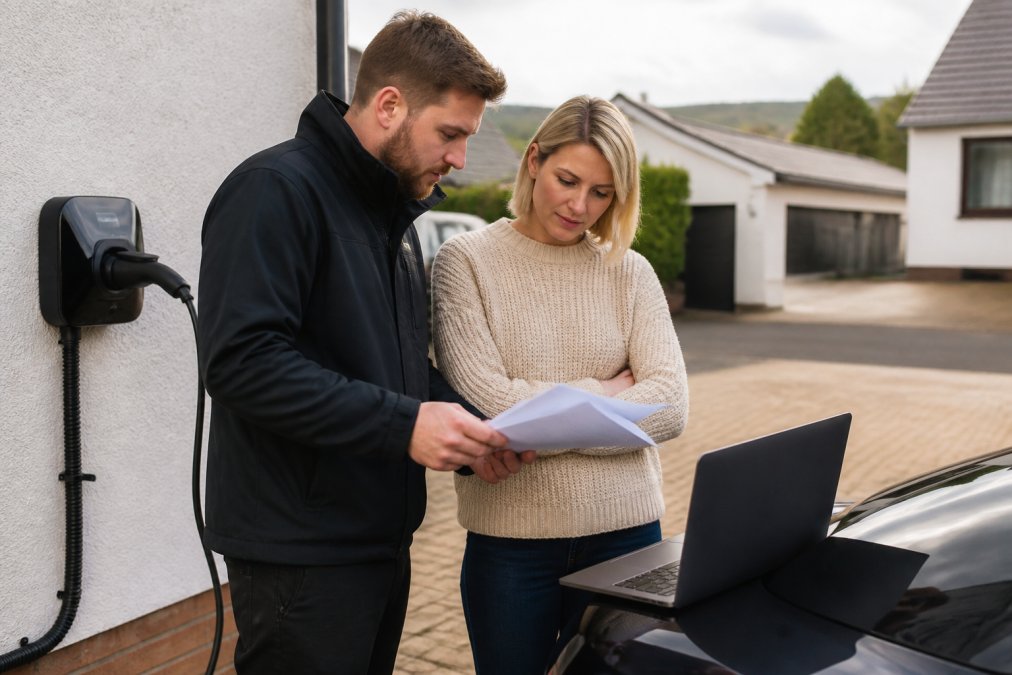
Step 1: Confirm your vehicle and property evidence
Have these ready before you contact anyone:
- Vehicle proof: the V5C logbook showing you as keeper, or a signed order confirmation if the vehicle has not been delivered yet
- Parking proof: a photograph or plan showing the dedicated off-street space, plus evidence you own or have permission to modify the property
- Electricity supply details: your meter location, consumer unit position and the proposed cable route
- Property status: owner-occupier, private tenant, flat owner or landlord, since this determines which grant route applies
Step 2: Find and verify an approved installer
Use the official Find a Grant portal to locate an approved installer. Before booking a survey, ask them to confirm in writing that they are currently approved for the specific grant you intend to claim, approval status can lapse, and an installer who was approved last year may not be today.
Step 3: Book the survey and agree the specification
The installer surveys the property and confirms the chargepoint model, cable run and any consumer unit or earthing upgrades. This specification goes into the application, so changes after submission can trigger a re-application. Ask for the fixed quote at this stage, not after installation.
Step 4: Your installer submits the application
The installer completes the portal submission with your vehicle details, property information and installation specification. You may be asked to countersign or confirm ownership and parking arrangements. Keep a copy of everything submitted, you will need it if the claim is queried.
Step 5: Approval and installation
Once the application is approved, the installer books the installation. Do not let installation proceed before approval is confirmed in writing; work carried out ahead of approval is generally not eligible for retrospective claim.
Step 6: Grant applied and balance paid
The grant is applied as a deduction on your invoice and you pay the remaining balance directly to the installer. Retain the installation certificate, the commissioning paperwork and the invoice showing the grant deduction, these are your proof of a compliant installation and are useful if you sell the property or need to evidence the work later.
EV Charger Installation Costs and Grant Amounts
EV charger grants like the domestic grant contribute up to 75% of the cost, capped at £350. The Workplace Charging Scheme provides a fixed voucher per socket. Exact EV charger installation costs vary with cable runs, consumer unit upgrades, and charger model, so get a fixed quote before committing.
| Grant | Who It's For | What It Covers | Cap |
|---|---|---|---|
| Domestic Chargepoint Grant | Homeowners | Up to 75% of purchase and install | £350 per grant |
| Workplace Charging Scheme | Businesses and charities | Voucher per socket | Fixed per-socket cap |
| Landlord Grant | Landlords and flat owners | Up to 75% of purchase and install | £350 per grant |
EV Charger Grant for Renters and Flat Owners
Renters and flat owners can access the EV charger grant for renters through the landlord grant route, but the property owner must consent. The application is still installer-led, and the landlord typically needs to confirm permission in writing.
If you rent, speak to your landlord first. Many are willing once they understand the grant reduces their outlay and adds a chargepoint to the property.
Cross-Pavement Charging and Local Council Grants
This is the area where most applicants get stuck, because there are two separate funding layers and they do not always combine cleanly.
Cross-pavement charging
Cross-pavement solutions let households without a driveway route a cable safely across the pavement to a chargepoint on the vehicle. In practice this requires permission from the local roads authority, because the pavement is adopted public infrastructure. The process typically involves:
- A formal application to the council's roads or highways team for a crossing permission
- A specification for the cable channel, ramp or covered duct that meets the council's safety requirements
- Confirmation from your installer that the chargepoint and cable route comply with the permission granted
Approval times vary considerably between councils, and some authorities have no established process at all. Start this conversation early, it can run longer than the grant application itself.
Local council grants and stacking with national funding
Some local authorities operate their own top-up schemes for residents, and these sit alongside the national grant rather than replacing it. The critical point most guides miss is that stacking is not automatic and is not universal:
- Not every council runs a top-up scheme. Check your own council's current published position before assuming one exists.
- Where a top-up does exist, it usually has its own eligibility rules, its own application route and its own evidence requirements, which may differ from the national grant.
- Some schemes require the national grant to be claimed first and evidenced before the local portion is released. Others require the local application to be lodged before installation. Getting the order wrong is the most common reason a local top-up is refused.
- A single installation cannot normally be funded twice for the same cost element. Where schemes overlap, the local top-up typically covers costs the national grant does not, or applies a separate cap.
How to sequence a stacked claim
A workable pattern that most practitioners follow:
- Confirm your council's position and the required order of applications
- Verify your installer is approved for both the national grant and any local scheme
- Submit the national application first unless your council explicitly requires otherwise
- Keep the approval reference for the national claim, local schemes often ask for it
- Only then proceed to installation, once both funding decisions are confirmed
If your council has no scheme, the national grant is your only route and the sequencing question disappears. If it does have one, treat the two applications as separate projects with separate evidence packs, even though they fund the same installation.
Common Application Rejection Reasons and How to Avoid Them
The most frequent rejection reasons are using a non-approved installer, missing vehicle proof, and incomplete parking evidence. Double-check every document before your installer submits.
- Non-approved installer: verify OZEV approval first
- Missing vehicle proof: keep your V5C or order confirmation ready
- Unclear parking evidence: photograph your off-street space
- Wrong grant type: match the grant to your ownership situation
Frequently Asked Questions
Can I get a grant for an EV charger in Scotland?
Yes, there are grants available for EV charger installations in Scotland. The OZEV grant provides up to £350 towards the cost of a home chargepoint, and the Workplace Charging Scheme offers up to £350 per socket for businesses. Additionally, some local councils offer top-up funding. Eligibility depends on your property type and vehicle ownership. Check the official eligibility criteria before applying.
How do I claim my EV charger grant?
The claim process is installer-led. First, find an OZEV-approved installer. They will apply on your behalf through the official portal, providing details of your property and vehicle. After installation, the grant amount is deducted from your invoice or reimbursed. Ensure your installer is registered and that you meet the eligibility criteria for EV charger grants.
Am I eligible for the OZEV chargepoint grant?
To be eligible for the OZEV chargepoint grant, you must own or lease an eligible electric vehicle, have off-street parking, and use an approved installer. Renters and flat owners may qualify under specific schemes. The grant covers up to 75% of the installation cost, capped at £350. Check the latest OZEV grant eligibility criteria for 2026.
What is the difference between the landlord and homeowner grants?
The landlord grant is designed for rental properties and covers multiple chargepoints, while the homeowner grant is for owner-occupiers and covers a single chargepoint. Both require an approved installer and eligible EV. Landlords can claim up to £350 per socket. Homeowners can claim up to £350 for one chargepoint.
The application process rewards preparation, not speed. Smarter Utility is Scotland's leading installer of solar PV, battery storage, and EV charging, fully accredited as an MCS installer, and we offer a free, no-obligation home survey so your system is designed around your actual energy needs. Get started with Smarter Utility and power your EV charger efficiently. Click HERE for your FREE SURVEY today.