 ultimate-guide
EV Home Charger Installation Process Scotland: 2026 Guide
Table of Contents
- What the EV Home Charger Installation Process Involves
- Choosing the Right Home Charge Point for Your Vehicle
- EV Charger Installation Cost and Hidden Fees
- Home Energy Scotland Grant Funding for EV Chargers
- EV Charger Installation Time and the DNO Application
- Rural vs Urban Installation Challenges and Smart Charging
- Certified Electricians, Safety Certification and Building Regulations
- Maintenance and Long-Term Care of Your Wallbox
- Frequently Asked Questions
Last Updated: September 12, 2026
What the EV Home Charger Installation Process Involves
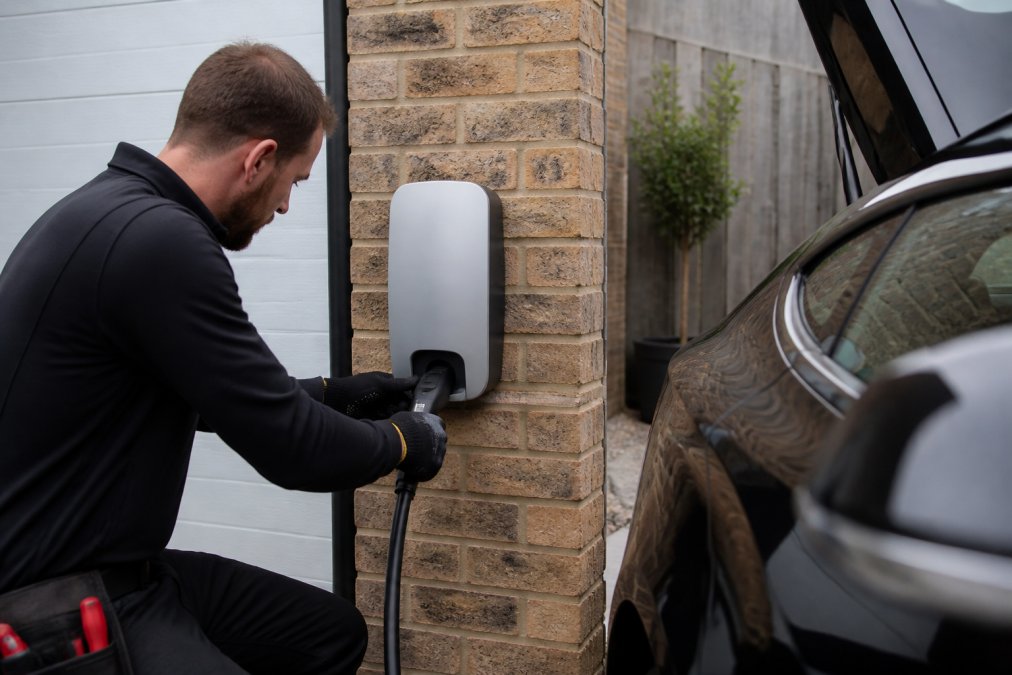
The EV home charger installation process in Scotland moves through five stages: a home energy assessment, an electrical system check, charger selection, a Distribution Network Operator notification, and commissioning by a certified electrician. Most domestic installations complete within a few weeks of survey, though rural properties and older wiring can extend that.
This guide from Smarter Utility covers each stage, Home Energy Scotland grant funding, and wallbox maintenance.
A common mistake is treating installation as a purely electrical job. The survey decides whether your supply, earthing arrangements and consumer unit can carry the load, shaping everything that follows.
Home Energy Assessment and Site Survey
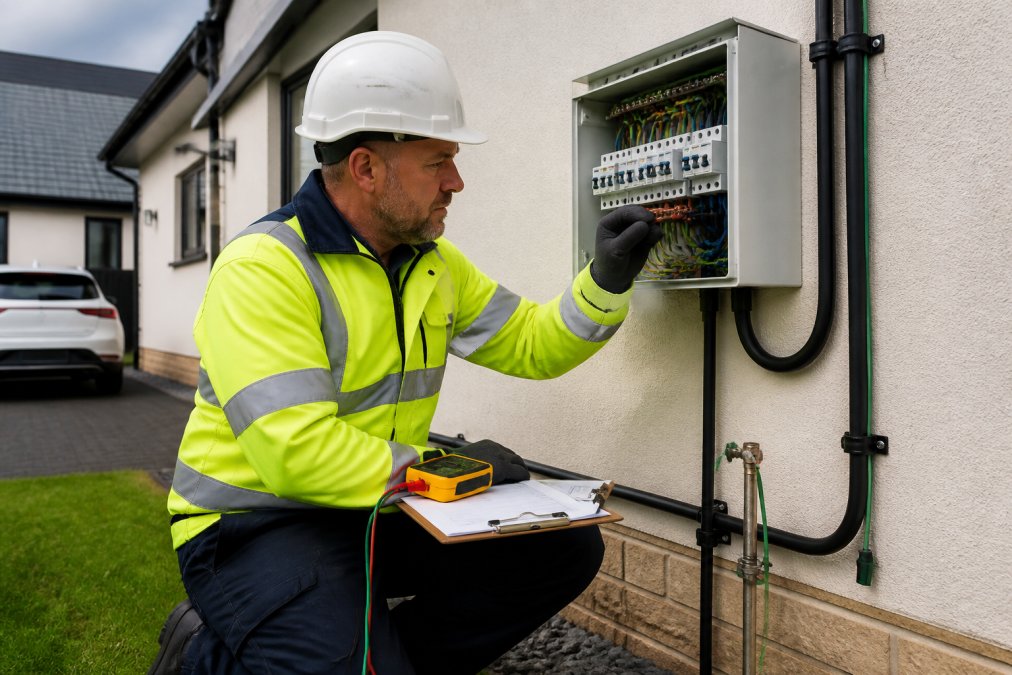
The site survey is where a good installation is won or lost. An accredited installer examines your consumer unit, earthing arrangements, cable routes and proposed charge point position, then confirms whether your infrastructure can support the load.
Expect the surveyor to check:
- Available capacity on your consumer unit and whether a spare way exists
- Earthing arrangements, particularly on older properties with TT systems
- Cable run distance from the consumer unit to the proposed wallbox position
- Whether load balancing is needed to avoid exceeding your supply rating Integrating intelligent load management systems ensures that your domestic supply remains stable even when multiple high-demand appliances operate simultaneously alongside your vehicle charging.
A free, no-obligation home survey removes the guesswork and flags awkward cases early, such as a detached garage 30 metres from the house or a supply needing upgrade.
Electrical System Assessment and Consumer Unit Checks
An electrical system assessment determines whether your consumer unit can safely carry an additional high-draw circuit. Older fuse boards often cannot, and replacing one adds cost and time.
Where capacity is tight, load balancing lets a charge point share the supply with the rest of the house rather than demanding a costly supply upgrade. Ask about it at survey stage, not after signing the quote.
Choosing the Right Home Charge Point for Your Vehicle
The right home charge point matches your vehicle's onboard charger, parking layout and electricity tariff. Most domestic wallboxes deliver 7kW, which suits the majority of EVs for overnight charging.
Tethered vs Untethered and Kilowatt Output
Tethered charge points have a cable permanently attached; untethered units have a universal socket, so you use your own cable. Tethered suits a single-vehicle household; untethered suits two-EV households or anyone wanting a tidier wall.
Kilowatt output matters less than most buyers think. A 7kW unit adds roughly 30 miles of range per hour, covering overnight top-ups comfortably. A 22kW unit only helps if your vehicle's onboard charger supports three-phase power, which most domestic models do not.
| Decision | Choose this | Why |
|---|---|---|
| One EV, fixed parking spot | Tethered 7kW | Cable always ready, no fumbling in the rain |
| Two EVs, shared driveway | Untethered 7kW | Universal socket works with both cables |
| Three-phase supply, compatible car | 22kW | Faster top-ups, but only if the vehicle supports it |
| Older property, limited supply | 7kW with load balancing | Avoids an expensive supply upgrade |
EV Charger Installation Cost and Hidden Fees
EV charger installation cost is not a single figure. It is the sum of four variables: the charge point, the labour and materials for the circuit, remedial work on your existing electrical installation, and any network or groundworks cost. Because those variables move independently, a quote that gives one number without breaking them out is not comparable to another.
What actually drives the price up
Watch for these common additions that push a quote upward:
- Consumer unit replacement where no spare capacity exists, including a new enclosure and RCBOs
- Cable runs beyond the standard included length, priced per metre, the rate varies with cable size and whether it is clipped, buried or in conduit
- Groundworks for a cable trench to a detached garage or outbuilding, including reinstatement of paving or turf
- Earthing upgrades on older properties, particularly where a TT system needs an earth electrode
- Scaffolding or access equipment for awkward mounting positions
- DNO reinforcement or a new or upgraded supply, quoted separately by the network operator and potentially dwarfing the installation cost itself
How grant funding changes the net cost
Home Energy Scotland grant funding is applied against the eligible cost of the charge point and its installation, not the whole invoice. Remedial work, groundworks and any supply upgrade are usually excluded. The net cost is the quoted price minus the grant award, and the award is capped, so an expensive installation does not attract a proportionally larger award.
This is the most misunderstood part of the cost picture. Two homeowners can receive the same grant award but face very different net costs, because their underlying installation costs differ. Always calculate your net figure after the grant.
How to compare quotes properly
Ask for a fixed written quote that states:
- The make and model of the charge point
- The included cable run length and the per-metre rate beyond it
- Whether a consumer unit upgrade is included, excluded or conditional
- Whether load balancing is included
- Whether the DNO notification is handled by the installer and at what cost
- The grant paperwork the installer will provide
Vague quotes are where surprises live. A quote silent on cable run length and consumer unit condition is not cheaper, it is incomplete.
Home Energy Scotland Grant Funding for EV Chargers
Home Energy Scotland grant funding can offset part of the cost of a home charge point, and the scheme has changed over recent years. Eligibility depends on where you live, your property type and whether you own or rent.
The practical steps are straightforward:
- Check current eligibility and award amounts directly with Home Energy Scotland before committing
- Confirm your chosen installer is accredited and can supply the paperwork the scheme requires
- Keep your survey report, invoice and commissioning certificate together for the application
Award amounts and eligibility rules change, so treat any figure you read online as out of date until you confirm it with Home Energy Scotland or the official Energy Saving Trust guidance.
EV Charger Installation Time and the DNO Application
EV charger installation time runs from a few hours on site to several weeks end to end. The physical fitting usually takes a few hours; the waiting happens elsewhere, the DNO notification and, sometimes, a supply upgrade.
Click HERE for your FREE SURVEY today →
Distribution Network Operator and Grid Capacity
The Distribution Network Operator, or DNO, owns and maintains the local electricity network. Most domestic charge point installations only require a notification after commissioning, not prior approval. Where the charger pushes total demand above your supply rating, or your supply is already constrained, the DNO may need to assess grid capacity first.
This is the step most guides skip, and it most often delays rural installations. If your property sits at the end of a long overhead line, ask about DNO requirements at survey stage.
Rural vs Urban Installation Challenges and Smart Charging
The installation process is the same everywhere, but the obstacles are not. Knowing which set applies to your property tells you more about your likely timeline and cost than any generic guide.
Rural installation challenges
Rural properties tend to share a cluster of related problems:
- Long supply runs. A property at the end of a long overhead line or a private supply cable may have voltage drop issues that a charger will expose. The surveyor needs to measure this, not assume it.
- Weaker grid capacity. The local network may already be close to its limit, which is the most common trigger for a DNO assessment before work can proceed.
- Earthing complications. Many rural properties use a TT earthing arrangement rather than the TN-C-S arrangement common in towns. TT systems need an earth electrode and often an upfront RCD, which adds cost and complexity.
- Groundworks. A detached garage or outbuilding 30 metres from the house means a trench, and a trench means reinstatement.
- Access and weather. Exposed positions, long drives and seasonal ground conditions all affect scheduling.
Urban installation challenges
Urban properties face a different set:
- Tight access. Narrow lanes, shared entries and restricted parking can make cable routing and equipment delivery harder than the electrical work itself.
- Shared walls and boundaries. If the cable route crosses a boundary you do not own, you need permission before you dig or clip.
- Parking you do not control. If your parking space is not on your title, a charger installation may not be permissible at all.
- Older housing stock. Tenement flats and older terraces frequently have consumer units with no spare capacity, and communal supplies that complicate any upgrade.
- Conservation areas and listed buildings. External mounting positions and cable routes may need consent.
When the DNO gets involved
Smart charging and energy tariff integration
Smart charging and energy tariff integration change the economics more than the hardware does. Your charge point can be scheduled to draw power only during off-peak windows, when electricity is cheapest. Paired with a time-of-use tariff, the same charge costs materially less than an unscheduled top-up at peak rates.
The practical steps are:
- Check whether your supplier offers a time-of-use tariff suitable for overnight charging
- Confirm your chosen charge point supports scheduled charging, either natively or via an app
- Set the schedule to match your tariff's off-peak window, not just a convenient bedtime
- Review the schedule after any tariff change or price cap movement
For a rural property with a long supply run, combining smart charging with solar panels and battery storage is often the difference between a marginal and a genuinely worthwhile installation. The battery absorbs daytime solar generation and releases it overnight, reducing how much the charger draws from the grid.
Certified Electricians, Safety Certification and Building Regulations
A home charge point must be installed by a certified electrician working to current safety certification and building regulations. In practice this means an installer registered with a competent person scheme, who issues an Electrical Installation Certificate and notifies the work through GOV.UK building regulations guidance where required.
Ask for these before work starts:
- Proof of registration with a recognised competent person scheme
- Confirmation that the charge point is approved under the relevant grant scheme
- A written commissioning report after installation
Maintenance and Long-Term Care of Your Wallbox
Maintenance on a home wallbox is light but not zero. A visual check of the charging cable for fraying, a wipe-down of the connector pins, and an annual firmware review keep most charge points running for years.
What most owners miss is the tariff side. Reviewing your off-peak charging schedule once or twice a year, especially after an energy price change, often saves more than any hardware tweak. If your installer offers a service visit, take it; a loose connection or degraded earth is far cheaper to catch early than to repair after a fault.
The installation process is manageable, but the survey, DNO check and certification are where projects go wrong. Smarter Utility handles all three as standard, combining an accredited MCS installation service with a free, no-obligation home survey so you know exactly what your property needs before you commit. Our team designs each system around your vehicle, your tariff and your roof, and we can integrate solar and battery storage alongside your charge point. Click HERE for your FREE SURVEY today and get a tailored plan for your home.
Frequently Asked Questions
How can I get an EV home charger installed in Scotland?
Start by booking a free, no-obligation home survey with an accredited installer. They will assess your consumer unit, earthing arrangements and where the charge point should sit. Next comes a quote, then a Distribution Network Operator notification if needed. Once approved, a certified electrician fits the wallbox, commissions it and issues safety certification. The whole process usually runs from a few days to a few weeks depending on grid checks and grant paperwork.
How much does it cost to install an EV charger in Scotland?
EV charger installation cost depends on cable runs, whether your consumer unit needs upgrading, and any groundworks for a detached garage. Grants such as Home Energy Scotland funding can reduce what you pay, but eligibility rules apply. Because every property differs, ask for an itemised installation quote rather than a headline figure. That way you can see exactly what is included and avoid surprise charges later.
How long does an EV charger installation take?
A straightforward install on a suitable consumer unit often takes a few hours on the day. EV charger installation time stretches when the electrician needs to run a long cable, upgrade the consumer unit, or fit load balancing. If a Distribution Network Operator application is required, add one to several weeks for approval. Rural properties with weaker grid capacity can wait longer, so book your survey early.
Can a normal electrician install an EV charger?
Not just any electrician. The work should be done by a certified electrician who is competent in electric vehicle supply equipment and familiar with the relevant building regulations and safety certification requirements. They must also understand earthing arrangements and load balancing. Using an accredited installer protects your warranty, keeps your insurance valid and ensures the commissioning paperwork is correct.
Do I need permission to install an EV charger at home?
Most home charge point installations fall under permitted development, so you rarely need planning permission. You may need approval if you live in a listed building or a conservation area. Separately, your installer must notify the Distribution Network Operator about the new load, and some properties need formal approval before work starts. Always confirm both points before booking the installation date.
What grants are available for EV charger installation?
Home Energy Scotland grant funding can help with charge point costs, and there are separate schemes for rural and remote areas where grid connections are harder. Eligibility depends on your property, your vehicle and whether you meet the scheme criteria. Grant pots change, so check current terms before you commit. A free survey will tell you which funding you can realistically claim.
What is the difference between tethered and untethered chargers?
A tethered unit has a charging cable permanently attached, so you simply plug in and go. An untethered unit uses a universal socket, and you supply your own cable. Tethered suits most households for convenience, while untethered gives flexibility if you own more than one EV or want a tidier look. Both options come in different kilowatt outputs, so match the unit to your vehicle's onboard charger.