 how-to
Scottish Coastal Salt and Solar Panels: What It Does
Last Updated: October 30, 2026
Quick Summary
Salt rarely causes sudden failure on coastal salt solar installations, but over time it can block light reaching the cells, speed up corrosion on frames and fixings, and steadily reduce output. Regular checks and cleaning help keep losses under control.
- Salt can travel inland on wind, so homes near the shoreline face the heaviest exposure.
- One study reported peak power falling from 8.2 W to 6.8 W under salt build-up.
- Check fixings and connectors during routine inspections, not just the glass.
- Rinse salt film with a hosepipe and soft brush; never use a pressure washer.
- After a salty spell, check generation figures as well as the glass appearance.
Table of Contents
- How Salt Air and Salt Spray Reach Solar Panels
- Salt Film on Panel Glass and Lost Light
- Salt Air Corrosion of Frames, Fixings and Wiring
- Marine-Grade Solar Panel Mounting Systems for Exposed Sites
- Cleaning Solar Panels Near the Sea Safely
- Separating Salt Damage From Other Causes of Lost Output
- Booking a Coastal Survey Before You Install
- Frequently Asked Questions
Salt is one of the quieter threats to a solar array on the Scottish coast, and understanding the risks of coastal salt solar exposure is the first step to protecting output.
The research we could find is limited, so we have kept the claims to what sources actually support. A salt-deposition study reported peak power falling from 8.2 W to 6.8 W and fill factor dropping from 71.2% to 63.47% under salt build-up National University of Sciences and Technology research on salt deposition and floating solar panels.
How Salt Air and Salt Spray Reach Solar Panels
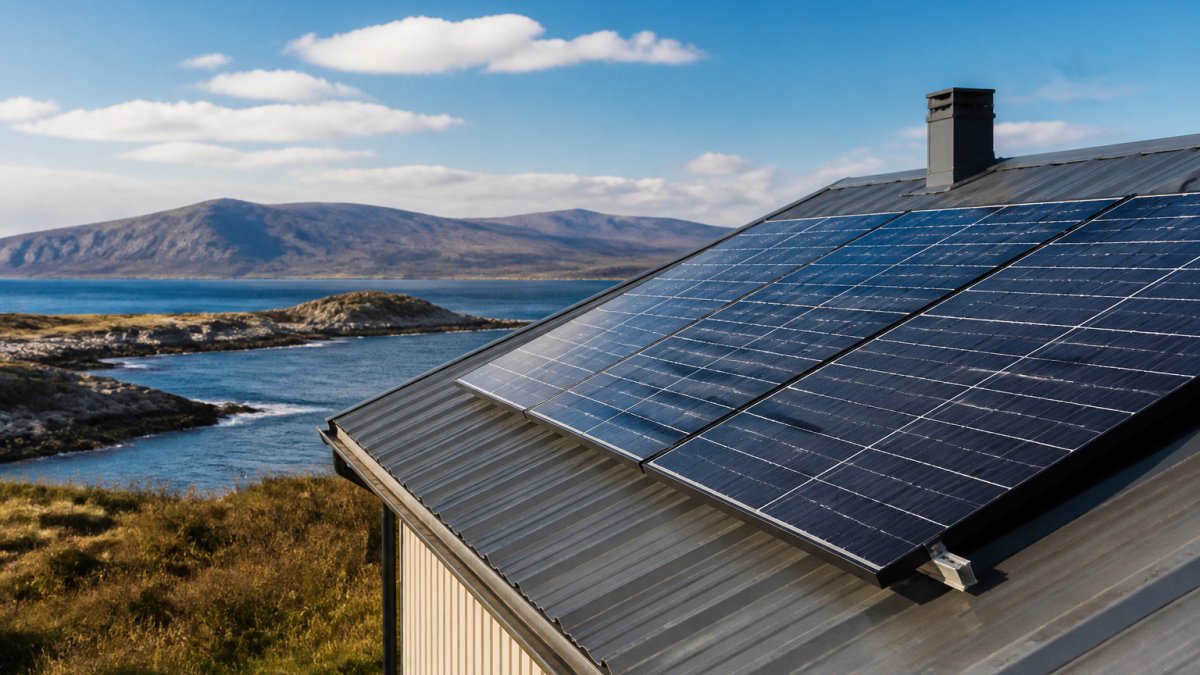
Salt does not need to be on the panel to cause harm. Wind carries fine salt particles inland, and in coastal salt solar installations they settle on every exposed surface.
The salt itself is only part of the problem. Once it lands, rain and damp air keep it active. A dry coastal day can leave a thin film behind that the next shower turns into a sticky layer.
- Exposure is highest on seafront and headland properties.
- Sheltered gardens inland may see far less salt.
- Roof pitch and orientation change how much salt collects.
Salt Film on Panel Glass and Lost Light
Solar panels only work when light reaches the cells. A salt film can block that light, which lowers output. One source notes that salt film can gradually block light, reducing the energy a system produces Solar Panel Cleaners guidance on salt film and light blocking.
The glass itself is tough.
Watch out: a film that looks like light dirt can still cut output noticeably. Check your generation figures after a salty spell, not just the appearance of the glass.
Salt Air Corrosion of Frames, Fixings and Wiring
Metal parts take the brunt of coastal salt. Aluminium frames, steel fixings and exposed electrical connections are the components most likely to degrade over time. Salt accelerates that process, so corrosion can appear well before the panels themselves wear out.
One Scottish source warns that salt can build up on frames and fixings and may reduce efficiency if not cleaned Eco Energy on frame and fixing corrosion. Another coastal UK source says salt exposure does not usually cause sudden failure, but describes a steady decline in efficiency if it goes unmanaged Solar Cleaning South West on coastal UK salt damage.
The practical takeaway is simple. Look at fixings and connections during routine checks, not just the glass.
Marine-Grade Solar Panel Mounting Systems for Exposed Sites
On an exposed coastal site, the mounting system matters as much as the panels.
When you are specifying a system for a seafront or headland property, ask your installer which materials they use for brackets, rails and bolts.
Best for: exposed roofs and seafront properties where salt spray is constant. Skip if: your property is sheltered inland and sees little salt in the air.
Cleaning Solar Panels Near the Sea Safely
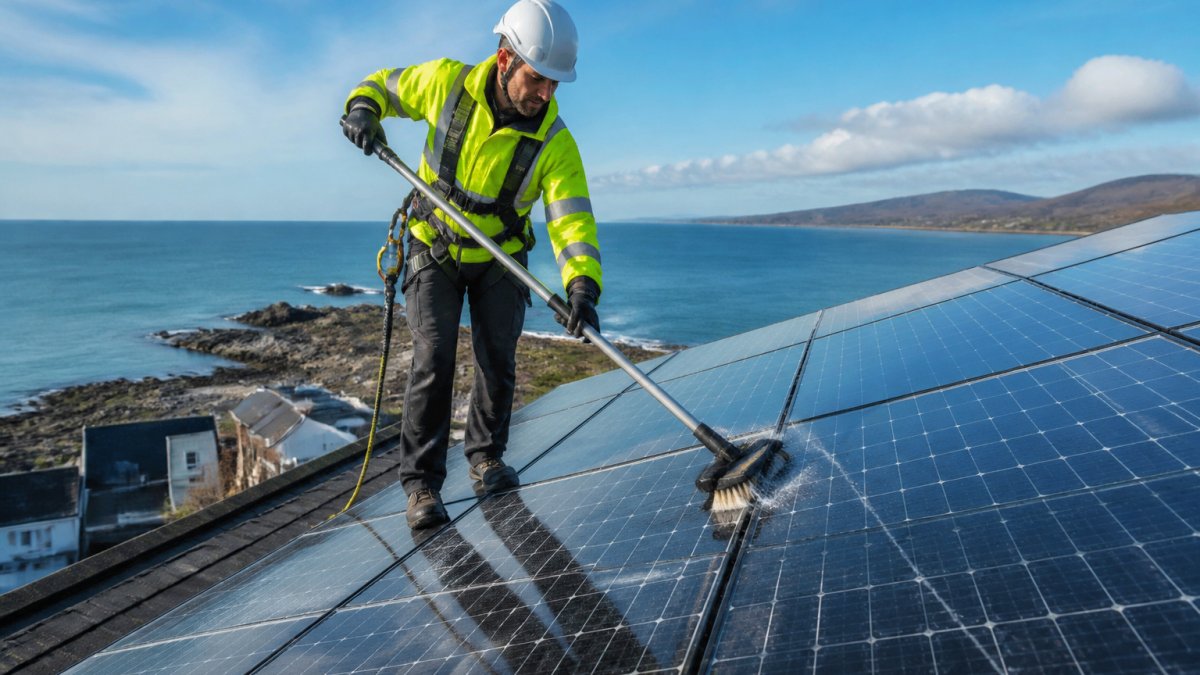
Cleaning is a practical way to remove salt film before it hardens and cuts output, but coastal cleaning carries risks that inland cleaning does not. Salt residue is abrasive, roof surfaces near the sea are often damp with condensation or spray, and the same wind that deposits salt can make ladders and access equipment unstable. Securing the perimeter of your installation is equally vital, as selecting the right fencing materials for salt-heavy environments prevents windborne debris from causing further damage to the panels.
Step-by-step cleaning method
- Work from the ground or a fixed platform wherever possible. A telescopic water-fed pole lets you reach ground-floor and low-pitch arrays without climbing. If you must go on the roof, use a properly secured roof ladder or harness point, never stand on a wet, sloping surface without fall protection.
- Rinse first, brush second. A gentle pre-rinse with a hosepipe loosens loose salt and grit. Brushing dry salt across glass can micro-scratch the surface and dull the anti-reflective coating over time.
- Use a soft brush or microfibre pad. Natural-bristle or soft synthetic brushes are suitable; abrasive pads, scouring sponges and metal scrapers are not. Avoid anything that can trap grit against the glass.
- Use plain water of drinking quality. Tap water is fine in most areas, but hard water leaves mineral spotting that looks like salt film and can be mistaken for it. If your supply is very hard, a filtered water-fed pole or a final rinse with deionised water reduces spotting.
- Never use a pressure washer. High-pressure jets can force water past frame seals, damage junction-box gaskets and dislodge cable clips. A gentle hose and brush is sufficient for salt film.
- Clean early in the day or on an overcast day. Rapid evaporation on a hot, sunny panel leaves streaks and can bake residue onto the glass. Cool glass also reduces thermal shock risk.
- Check fixings and connectors as you go. While you are at the array, look for white powdery deposits on aluminium frames, rust staining around bolts, cracked cable insulation or green corrosion on connector pins. Note anything suspicious for a qualified installer.
How often to clean on the coast
Cleaning intervals vary, but a starting point for coastal properties is often every few months, with seafront sites needing more frequent attention than sheltered inland ones. Treat that as a baseline, not a rule: after a period of strong onshore winds, check the glass and clean if you can see a visible haze or if generation has dipped.
Click HERE for your FREE SURVEY today →
When to hire a professional
Book a professional clean if any of the following apply:
- The array is on a steep or fragile roof, or access requires ladders above gutter height.
- You are unsure whether the glass is salt-filmmed or has a coating defect.
- You spot corrosion, cracked connectors or loose fixings during your own inspection.
Professional cleaning on the coast can involve extra access and safety requirements, so ask for a fixed quote. Ask for a fixed quote rather than an hourly rate, and confirm the contractor carries insurance and will not use pressure washers.
What not to do
- Do not clean panels that are hot to the touch or in direct strong sun.
- Do not use washing-up liquid, bleach or abrasive cleaners, residues can leave a film that attracts more dirt.
- Do not walk on the glass or stand on the frame.
Solar Panel Cleaners guidance on salt film and light blocking
Separating Salt Damage From Other Causes of Lost Output
A fall in generation is a symptom, not a diagnosis. Salt film is only one of several common causes, and the fix, and the cost, is very different depending on which one you are dealing with. The method below helps you narrow it down before you spend money on cleaning or call out an installer.
The main suspects
| Cause | Typical signature | What to check |
|---|---|---|
| Salt film | Gradual decline after onshore winds; dull haze on glass; worse on exposed edges | Visual inspection after a dry, windy spell; compare with a known-clean period |
| Ordinary soiling (dust, pollen, bird droppings) | Patchy or streaky pattern; often worse near trees or rooflines | Look for localised marks rather than an even film |
| Shading | Sharp drop at particular times of day; often seasonal as sun angle changes | Note the time of day output falls; check for new trees, buildings or aerials |
| Seasonal variation | Lower output in winter and shoulder months across the whole array | Compare like-for-like months, not month-on-month |
| Inverter or wiring fault | Sudden drop, error code, or one string performing poorly | Check inverter display and monitoring app for alerts |
| Panel degradation | Very slow decline over many years, affecting all panels evenly | Compare against the manufacturer's warranted degradation curve |
A practical diagnostic sequence
- Check the inverter first. Most inverters log error codes and string-level data. A fault code or a single underperforming string points to an electrical issue rather than surface soiling.
- Compare like with like. Use your monitoring portal to compare the same calendar month across two or three years, and compare a clear day this month with a clear day in the same month last year. Weather-driven variation is normal; a step change is not.
- Look at the array in flat light. Early morning or late afternoon on an overcast day shows surface film and shading patterns more clearly than bright midday sun.
- Clean a test area. If you can safely reach one panel, clean a small section and compare it with an uncleaned neighbour after a sunny day. A measurable difference confirms surface soiling; no difference points elsewhere.
- Check for shading changes. New growth, a satellite dish, a chimney or a neighbouring extension can all cast shadows that did not exist when the system was commissioned.
- Inspect fixings and connectors. Corrosion on frames, bolts or connector pins is a separate issue from glass soiling and needs a qualified installer, not a cleaner.
Using monitoring data properly
Most modern systems log daily, hourly or even per-panel data. Useful comparisons include:
- Same month, previous years, smooths out seasonal sun-angle changes.
- Clear days only, removes cloud-driven noise.
- Per-string or per-panel views, isolates a single affected panel or string.
If your system has no monitoring, a clamp meter reading on a clear day, taken by a qualified person, can still show whether a string is underperforming relative to its expected current.
When to call a professional
Call a qualified installer or surveyor if:
- Output has dropped suddenly rather than gradually.
- The inverter shows an error or has shut down.
- You see corrosion, cracked connectors, loose fixings or damaged cable insulation.
A professional survey can help separate surface soiling from corrosion risk and from electrical faults.
Solar Cleaning South West on coastal UK salt damage
Booking a Coastal Survey Before You Install
If you are planning a system on a coastal property, a survey before installation is the best way to plan for salt. It lets the installer assess exposure, pick suitable fixings and agree a realistic maintenance routine.
Smarter Utility offers a free, no-obligation home survey, so you can understand what your site needs before committing. To book a free survey, get your free survey today and we will look at your roof, exposure and wiring.
For a wider view of hidden costs to budget for before you book, see our guide to avoiding hidden solar installation costs. If you are ready to plan cleaning and upkeep, our guide to maintaining solar panels through a Scottish winter covers a practical routine.
Frequently Asked Questions
Can salt air damage solar panels?
Salt air is unlikely to cause sudden panel failure, but it can build a thin film on the glass that blocks some sunlight and lowers output over time. The bigger risk is corrosion of exposed aluminium frames, steel fixings and electrical connections, which accumulates gradually if left unmanaged. Regular rinsing and an inspection of fixings and wiring by a qualified installer help catch problems early, before they affect performance or safety.
How often should solar panels near the coast be cleaned?
The right cleaning interval depends on your exposure, so ask your installer to advise on a schedule for your site. Properties closer to the shoreline or facing prevailing winds may need more frequent attention. Rain removes some salt, but it often leaves residue on the glass. Ask your installer to set a schedule based on what they see at your site.
Does salt build-up affect solar panel warranties?
Warranty terms vary by manufacturer and installer, so check the documents supplied with your system rather than assuming cover. Many warranties depend on the system being installed and maintained to the manufacturer's specification, which can include appropriate mounting materials and reasonable cleaning. Keeping a record of cleaning and inspections is sensible.
What materials help solar panels withstand coastal conditions?
Marine-grade or corrosion-resistant mounting rails, fixings and fasteners are the most important choices for a coastal site, because they resist the salt that drives corrosion. Matching metals help prevent galvanic reactions between dissimilar components. Panels with a suitable certification and a durable frame are also worth considering. Pricing depends on system size, site conditions and specification, so request a quote for a tailored recommendation.