 how-to
Solar Inverter for Livestock Buildings: A How-To Guide
Last Updated: October 23, 2026
Quick Summary
A solar inverter livestock buildings converts DC power from solar panels into AC power your livestock building can use, with the right choice depending on whether you need grid connection, battery backup, or both. Sizing your inverter to peak load plus 20% headroom and selecting equipment rated IP65 or higher protects against barn dust, ammonia, and moisture while ensuring continuous power for ventilation and water systems.
- Size your inverter to handle peak load plus 20% headroom to prevent shutdowns during motor startup and brief load spikes.
- Choose an inverter with IP65 or higher rating to resist dust, ammonia gas, and moisture in harsh livestock building environments.
- Use a hybrid inverter with battery backup to maintain power for critical loads like ventilation fans and water pumps during grid outages.
- Match your solar array capacity to your inverter using a DC-to-AC ratio between 1.2:1 and 1.5:1 for optimal annual energy production.
- Hire a qualified electrician to ensure your system meets UK electrical standards, agricultural building regulations, and safety requirements.
Table of Contents
- Understanding Solar Inverter Types for Livestock Buildings
- Step 1: Calculate Your Livestock Building's Electrical Loads
- Step 2: Size Your Solar Inverter and Array Correctly
- Step 3: Account for Harsh Barn Conditions and Environmental Factors
- Step 4: Ensure Three-Phase Compatibility for Larger Farms
- Solar Power for Livestock Ventilation and Water Systems
- Step 5: Verify Safety, Compliance, and Warranty
- Common Mistakes to Avoid When Choosing a Livestock Building Inverter
- Frequently Asked Questions
Understanding Solar Inverter Types for Livestock Buildings
A solar inverter converts DC power from your solar panels into AC power your livestock building can use, making solar inverter livestock buildings an increasingly practical choice for farms. Choosing the right solar inverter for livestock buildings means matching the type to your farm's power needs, backup requirements, and grid connection status. Learn how solar panels integrate with inverter selection to create a complete system for your agricultural building.
Three main types exist: grid-tied, off-grid, and hybrid systems. Each has distinct advantages for agricultural operations.
Grid-tied inverters
Grid-tied inverters connect your solar array directly to the utility grid.
The main benefit is cost: no battery storage keeps your upfront investment lower, and you gain income from excess power exported during peak solar production hours.
The trade-off is obvious: when the grid fails, your system shuts down for safety reasons. This matters for livestock buildings where ventilation fans, water pumps, or heating systems run continuously.
Off-grid inverters
Off-grid inverters work independently from the utility, managing power flow between your solar array, battery storage, and loads.
They handle battery charging, load management, and DC-to-AC conversion in one device, maintaining consistent power delivery during cloudy periods by drawing from stored energy.
The downside is complexity and cost. Battery systems add significant expense, and you need oversized arrays and larger battery banks to cover winter and cloudy stretches.
Hybrid inverters for agricultural buildings
Hybrid inverters combine grid and battery capabilities, working like grid-tied systems when the grid is available but switching automatically to battery backup when it fails.
Hybrid systems let you earn grid export income while keeping backup power for critical loads.
The cost sits between grid-tied and off-grid options. You get battery protection without the full expense of a standalone off-grid system. Many farms find this the best balance for their needs.
Step 1: Calculate Your Livestock Building's Electrical Loads
You cannot size a solar inverter correctly without knowing what it must power. Livestock buildings have load profiles that differ sharply from homes or standard commercial buildings.
Start by listing every electrical device in your building. Include ventilation fans, water heaters, heat lamps, milking equipment, grain augers, and refrigeration. Write down the wattage for each item, you'll find this on the device nameplate or manual.
Identifying peak demand and operating schedules
Peak demand is the total wattage when all major equipment runs simultaneously, and it determines your inverter's minimum capacity. An undersized inverter will overload and shut down when animals need power most.
Livestock buildings often run equipment on staggered schedules to avoid peaks:
- Ventilation fans run continuously during warm months
- Heat lamps activate only during cold weather
- Water pumps cycle on and off throughout the day
- Milking equipment operates during specific hours
Calculate two numbers: total connected load (everything plugged in) and actual peak load (realistic simultaneous use). Most farms find actual peak load is 60-75% of total connected load.
Accounting for motor surge requirements
Motors create surge current when starting: a 2 kW motor might draw 4-5 kW for a few seconds. Your inverter must handle these spikes without tripping.
Choose an inverter with surge capacity at least 1.5 times your peak load. If your peak load is 10 kW, select an inverter rated for at least 15 kW surge capacity.
Many farms size the inverter to average power consumption, then watch it shut down when the water pump or grain auger starts.
Step 2: Size Your Solar Inverter and Array Correctly
Inverter sizing and solar array sizing work together. You need the right ratio between DC power from your panels and AC power your inverter outputs.
DC-to-AC ratio and array-to-inverter sizing
The DC-to-AC ratio compares total solar array capacity (kW DC) to inverter capacity (kW AC). Most systems use a ratio between 1.2:1 and 1.5:1.
Solar panels rarely operate at full rated capacity because cloud cover, temperature, angle, and shading reduce output.
However, don't exceed 1.5:1 ratio. Beyond that, your inverter clips excess power during peak sun hours, wasting it. You're paying for solar panels that your inverter can't use.
Solar inverter sizing for farms
For solar inverter livestock buildings, size your inverter to handle peak load plus 20% headroom. If your peak load is 10 kW, choose a 12-13 kW inverter.
This headroom prevents nuisance shutdowns during brief load spikes and accommodates future expansion if you add milking equipment, heat lamps, or other systems later.
Match your solar array capacity to your seasonal needs. A livestock building in winter needs different sizing than one in summer.
Step 3: Account for Harsh Barn Conditions and Environmental Factors
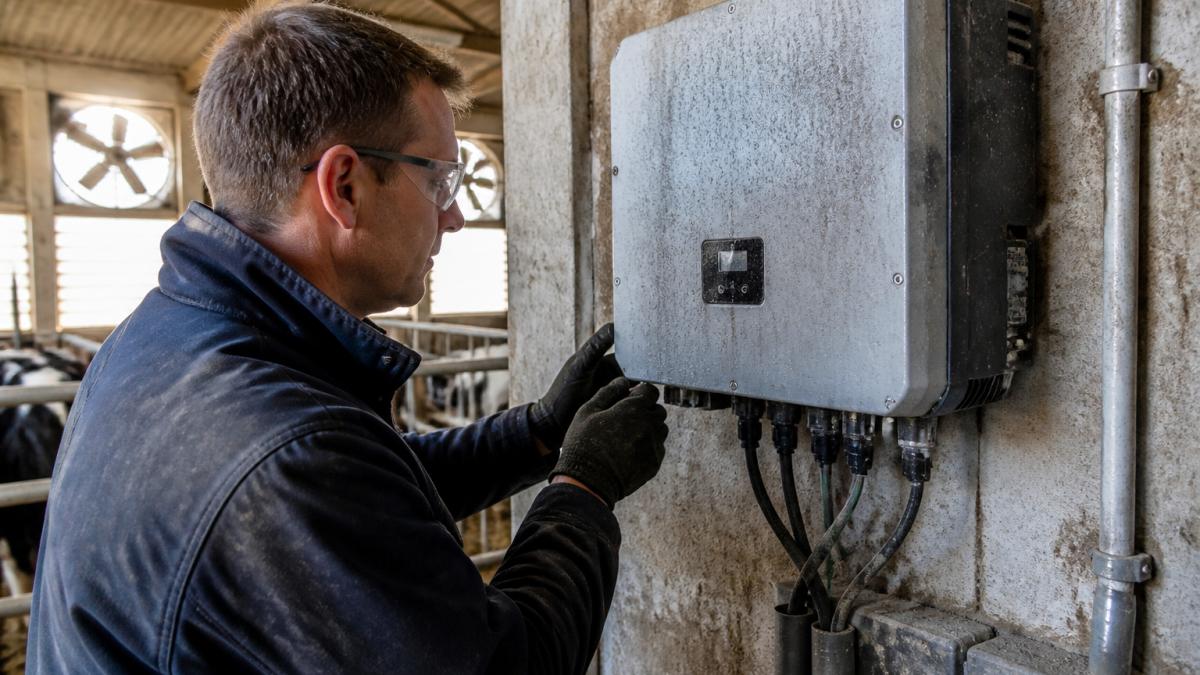
Livestock buildings are harsh environments. Dust, ammonia, moisture, and temperature swings damage inverters faster than residential installations. Your inverter choice must account for these realities.
Dust, moisture, and corrosive gases
Livestock buildings produce ammonia from animal waste. This corrosive gas attacks inverter components, especially circuit boards and connectors.
Moisture from animal respiration and water systems causes condensation inside the inverter, leading to corrosion and faults.
Choose an inverter with an IP65 or higher rating. This means dust-tight and water-resistant construction.
Click HERE for your FREE SURVEY today →
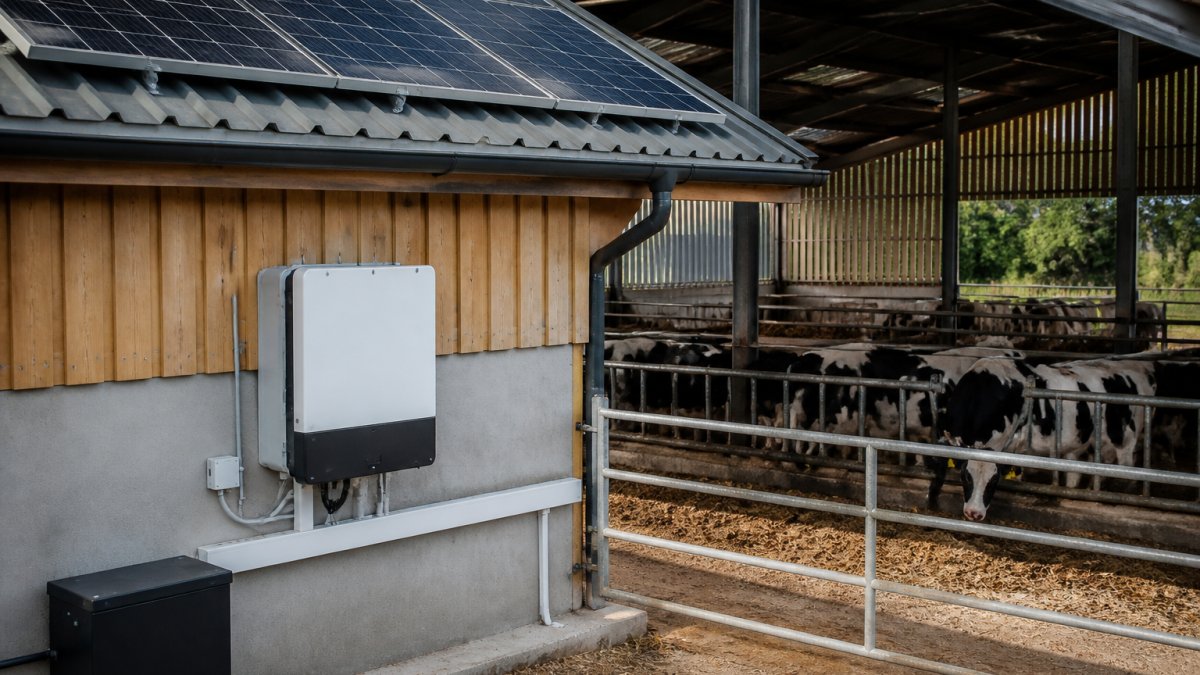
Consider mounting your inverter outside the main livestock area if possible.
Operating temperature and cooling requirements
Livestock buildings swing between freezing in winter and 30°C or hotter in summer.
Choose an inverter with a wide operating temperature range. Some models handle -20°C to 50°C, which suits farms in colder regions or those with unheated barns.
Ensure adequate ventilation: leave at least 30 cm clearance on all sides, install away from direct summer sunlight, and shield it from rain and snow.
| Environmental Factor | Impact on Inverter | Mitigation Strategy |
|---|---|---|
| Ammonia gas | Corrodes circuit boards and connectors | Choose IP65+ rated unit; mount outside main barn area |
| Dust accumulation | Blocks cooling vents; reduces efficiency | Clean vents monthly; use sealed enclosure |
| Moisture and condensation | Causes electrical faults and corrosion | Select wide operating temperature range; ensure ventilation |
| Temperature extremes | Reduces efficiency; triggers shutdown | Choose inverter rated for local climate range |
| Water spray from cleaning | Damages electrical components | Mount above livestock areas; use weatherproof enclosure |
Step 4: Ensure Three-Phase Compatibility for Larger Farms
Single-phase inverters work fine for small farms with under 20 animals and modest power needs.
Three-phase inverters cost more upfront but handle larger loads more efficiently. They also integrate better with agricultural equipment designed for three-phase operation.
Check your existing electrical infrastructure before deciding. If your barn already has three-phase service from the grid, a three-phase inverter matches your system naturally.
Solar Power for Livestock Ventilation and Water Systems
Livestock depend on continuous power for ventilation and water. A power outage lasting hours can stress animals and create health risks.
Ventilation removes ammonia, carbon dioxide, and excess moisture, preventing heat stress in summer and controlling humidity in winter. Water systems must run reliably so animals always have fresh water.
Backup power and animal welfare continuity
This is where hybrid or off-grid systems shine. A grid-tied inverter alone cannot protect your animals during a blackout.
With battery backup, your inverter automatically switches critical loads to stored energy when grid power fails.
Battery size determines how long backup runs.
The Scottish Government's guidance on farm resilience emphasises the importance of backup power for agricultural operations.
Consider coupling your solar inverter with a battery storage system designed for agricultural use.
Step 5: Verify Safety, Compliance, and Warranty
Before installation, verify that your chosen inverter meets UK electrical standards and agricultural safety requirements.
All solar inverters sold in the UK must comply with BS 7909 (electrical safety) and BS EN 62109 (safety of photovoltaic systems). Check that your inverter carries CE marking and relevant certification.
Agricultural code requirements and electrical safety
Livestock buildings fall under agricultural building regulations. Your solar system must integrate safely with existing wiring, distribution boards, and earthing systems.
The Building Standards Technical Handbook Section 4 covers electrical safety in agricultural buildings. Your installation must include:
- Proper earthing and bonding to prevent electric shock
- Overcurrent protection on all circuits
- Residual current devices (RCDs) on all AC circuits
- Isolation switches between solar array and inverter
- Proper cable sizing and conduit protection
This is not a DIY project. Hire a qualified electrician experienced with solar installations. They ensure your system meets standards and operates safely around livestock.
Warranty, service support, and future expansion
Choose an inverter from a manufacturer with strong UK support. Check that spare parts are readily available and repair services exist locally.
Ask about expandability. Can you add more solar panels later? Can you integrate battery storage if you upgrade from grid-tied to hybrid?
Explore renewable energy services that handle design, installation, commissioning, and ongoing maintenance. A reliable service partner ensures your system performs reliably for decades.
Common Mistakes to Avoid When Choosing a Livestock Building Inverter
Undersizing the inverter is the most common error.
Always size for peak demand plus 20% headroom.
Ignoring environmental factors comes second. Barns are dusty, corrosive, and wet.
Choosing grid-tied only for critical loads is a third mistake.
Skipping professional installation is risky. Work with a qualified commercial solar installation provider that understands agricultural requirements.
Finally, overlooking future expansion limits your options.
Frequently Asked Questions
How do you choose the correct solar inverter for a livestock building?
Start by calculating your peak electrical loads, including ventilation fans, water pumps, and heating systems. Determine whether you need grid-tied, off-grid, or hybrid capability based on your grid reliability and backup requirements. Size your inverter to handle 125% of your maximum simultaneous load to account for motor surge. Consider three-phase inverters for larger farms with heavy equipment. Finally, select equipment rated for livestock barn conditions: dust, moisture, and temperature extremes. A professional survey ensures your inverter matches your specific building's needs.
What size solar inverter does a farm building need?
Inverter size depends on your peak electrical demand. A small livestock shelter with basic ventilation might need a 3-5 kW inverter, while a large dairy or poultry facility could require 10-30 kW or more. Calculate total wattage of all equipment running simultaneously, then add 25% headroom for surges and future expansion. Use a DC-to-AC ratio of 1.2:1 to 1.4:1 for optimal energy capture. Oversizing wastes money; undersizing causes overload shutdowns during peak animal-care operations.
Can a solar inverter run livestock ventilation fans and water pumps?
Yes, but only if properly sized. Ventilation fans and water pumps draw high surge currents when starting, often 3-5 times their rated power. Your inverter must handle these inrush demands without tripping. A hybrid or off-grid inverter with battery storage provides the most reliable power for critical animal-care systems, preventing shutdowns during cloudy weather or grid outages. Grid-tied systems alone cannot guarantee continuity if the grid fails, risking animal welfare.
Should a farm solar system use a hybrid inverter or a grid-tied inverter?
Hybrid inverters offer greater resilience by storing excess solar energy in batteries, ensuring backup power during grid outages or cloudy periods. This is essential for livestock buildings where ventilation failure can endanger animals. Grid-tied inverters are cheaper and simpler but provide no backup. Off-grid systems are fully independent but require larger battery storage. For most agricultural buildings, hybrid systems balance cost, reliability, and animal welfare protection, making them the recommended choice.