 how-to
How to Prepare for EV Charger Installation
Table of Contents
- Assessing Your Home's Electrical Capacity for EV Charger Installation
- Off-Street Parking and Cable Routing Considerations
- Choosing the Right EV Charger for Home
- Safety Standards, Building Regulations, and Professional Installation
- DNO Notification for EV Charger: What You Need to Know
- EV Charger Installation Time: What to Expect
- Future-Proofing Your Setup: Load Management and V2G
- Frequently Asked Questions
Last Updated: September 21, 2026
Assessing Your Home's Electrical Capacity for EV Charger Installation
The most common reason an EV charger installation gets delayed is an electrical supply that can't take the extra load. Before you book anything, it pays to know what your home can handle.
This guide from Smarter Utility walks through how to prepare for EV charger installation, from checking your fuse board to notifying your network operator. Getting these steps right first saves time, money, and a second visit from an electrician.
A home charger draws a lot of power. Most units run at 7kW, which is roughly 30 amps on a single phase supply. Older homes often have a 60-amp main fuse. Add a charger and an electric shower and you're close to the limit.
So the first job is a load calculation. This sums up the maximum demand of everything in your home against the capacity of your supply.
Understanding Your Electrical Panel and Load Calculation
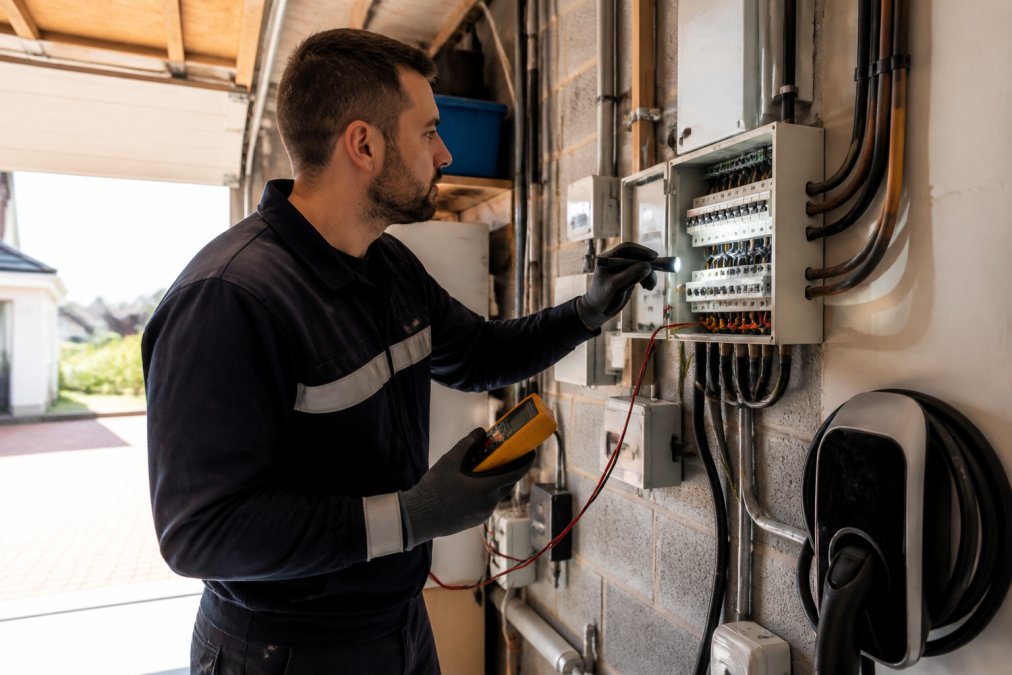
A load calculation is an assessment of your home's total electrical demand. It compares what you draw at peak times against the size of your main fuse and consumer unit.
A qualified electrician carries this out. They check:
- The rating of your main fuse, often 60A, 80A or 100A
- The size and condition of your consumer unit
- Existing circuits and their protective devices
- Whether spare ways are available for a new dedicated circuit
If your supply is too small, you may need a service upgrade from your network operator. That adds cost and time, so find out early.
Single Phase vs Three Phase: What Your Supply Actually Delivers
Most homes have a single phase supply at 230V. That caps your practical charger size at 7kW (about 32A) on a dedicated circuit. A three phase supply at 400V between phases can support 11kW or 22kW chargers, but only if your vehicle's onboard charger accepts three-phase input. Many popular models do not.
You can usually tell which you have by looking at the main fuse and meter tails. A single-phase supply has two main tails (live and neutral); a three-phase supply has four or five. If you're unsure, your electrician can confirm it in minutes.
When Load Management Beats a Service Upgrade
This is the angle most guides skip. If your fuse board is tight, a load management system (also called dynamic load balancing) can avoid a full service upgrade entirely.
How it works: a current transformer (CT) clamp sits on your main incoming tail and continuously measures total household draw. The charger's controller then reduces or pauses charging when other appliances, oven, shower, immersion heater, push demand near the fuse rating. When demand drops, charging resumes at full rate.
In practice this means a 60A supply with an electric shower can still run a 7kW charger, because the two rarely peak at the same time for long. The charger simply waits.
What to weigh up:
- Cost: load management hardware typically adds a modest amount to the install, far less than a DNO service upgrade
- Speed: no waiting weeks for the network operator
- Trade-off: charging can be slower on evenings when the house is busy, so overnight scheduling matters more
- Compatibility: not every charger supports it out of the box, check before you buy
If your electrician proposes a service upgrade as the only option, ask whether load management has been considered. For many homes it is the cheaper, faster route.
Off-Street Parking and Cable Routing Considerations
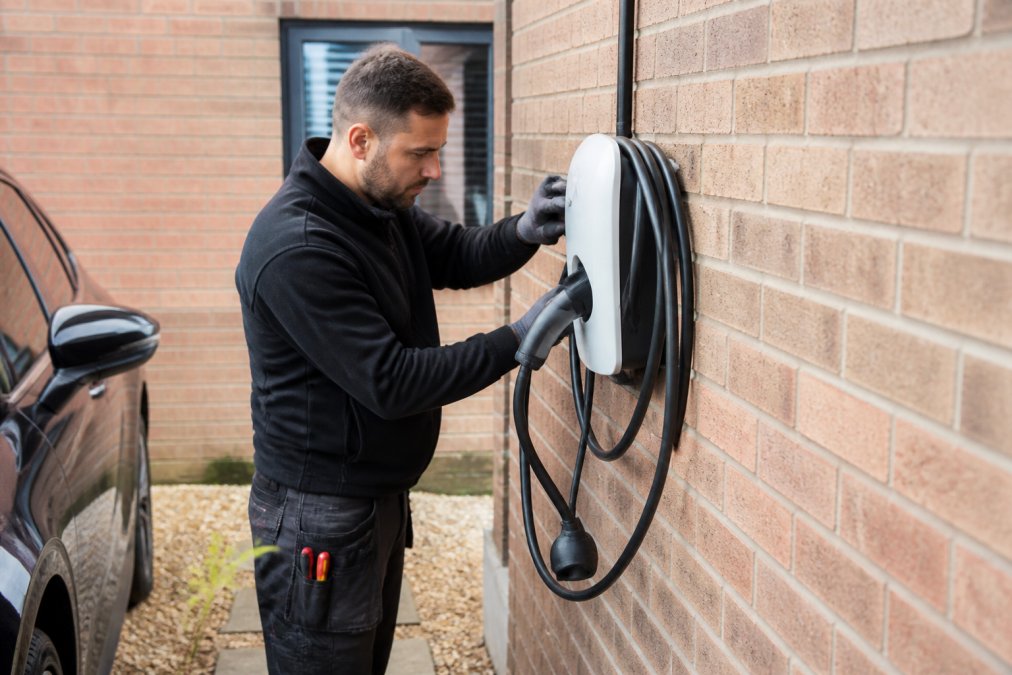
Off-street parking is the practical starting point for most home charging. If you have a driveway or garage, you can usually mount a charger on an external wall close to where you park.
Where you park shapes where the charger goes. A few things to plan:
- Distance from the consumer unit to the charger position
- Whether the cable run needs to cross a garden, path or driveway
- Whether you want the cable hidden in conduit or surface-mounted
- Access for the electrician and any groundworks
Long cable runs cause voltage drop. If the run is too long, the cable size must increase to compensate. That affects cost and how tidy the job looks.
A common mistake is picking the charger spot for looks alone.
Click HERE for your FREE SURVEY today →
Choosing the Right EV Charger for Home
Most homes suit a 7kW charger, which adds roughly 20 to 30 miles of range per hour. A 22kW unit only helps if your car supports three-phase charging and your home has a three-phase supply.
Tethered vs Untethered Chargers
A tethered charger has a cable attached permanently. An untethered charger has a socket, and you use your own cable.
| Feature | Tethered | Untethered |
|---|---|---|
| Cable | Built in | You supply it |
| Convenience | Plug in and go | Fetch your cable each time |
| Tidy look | Cable to store | Cleaner when not in use |
| Best for | One car, daily use | Shared or changing cars |
Safety Standards, Building Regulations, and Professional Installation
All home charger work must meet BS 7671, the wiring regulations. This covers earthing, bonding, RCD protection and isolation.
A compliant install includes:
- A dedicated circuit from the consumer unit
- RCD protection, either in the unit or the board
- Correct earthing and bonding
- An isolation switch so the supply can be cut safely
- An installation certificate on completion
The Paperwork That Protects You
When the job is done you should receive:
- An Electrical Installation Certificate (EIC) or a Minor Electrical Installation Works Certificate, depending on the scope
- A Building Regulations Compliance Certificate if the work is notifiable
- The DNO notification reference (see the next section)
- The charger manufacturer's commissioning record and warranty registration
Keep all of these together. If you sell the property, a buyer's solicitor will ask for them. If you ever need to claim on insurance, they are the first thing an assessor requests.
Insurance and Warranty: The Hidden Cost of Cutting Corners
Home insurance. Most policies require electrical work to be carried out by a competent person and certified. If a fire or fault traces back to an uncertified charger circuit, an insurer can reduce or refuse a payout. Tell your insurer the charger has been installed and keep the certificate on file.
Why DIY Isn't an Option
Charger circuits carry high current for hours at a time. Faults don't always trip immediately, they can smoulder. The risks are real:
- Sustained high current stresses terminations and can cause overheating at joints
- Earthing and bonding errors can leave the vehicle chassis live in a fault
- Missing RCD protection removes the primary shock safeguard
- No certification means no insurance cover and no warranty
DNO Notification for EV Charger: What You Need to Know
DNO notification for EV charger work is a formal step, not a formality. Your DNO (distribution network operator) manages the local electricity network, and they need to know when a charger is added.
Why it matters:
- A charger adds load to your local network
- The DNO checks whether your supply can take it
- Some installations need approval before work starts
- Others fall under a notify-after route
EV Charger Installation Time: What to Expect
EV charger installation time is usually a single day for a straightforward job. A simple wall-mounted unit close to the consumer unit can take three to four hours.
Timelines stretch when the job is more complex:
- Long cable runs or groundworks: add a day
- Consumer unit upgrade: add half a day
- Service upgrade from the DNO: add weeks
- Load management setup: add an hour or two
Future-Proofing Your Setup: Load Management and V2G
A load management system monitors your home's demand and slows or pauses charging when other appliances draw power. This lets you run a 7kW charger on a supply that couldn't otherwise take it.
Frequently Asked Questions
What is the 80% rule for EV charging?
The 80% rule is a common guideline for load management, suggesting you should not continuously draw more than 80% of a circuit's rated capacity. For EV charger installation, this means a 32A charger on a 40A circuit. Following this helps prevent overheating and ensures safety, especially during long charging sessions. A qualified electrician will apply load calculation to determine if your home can support this.
Can a normal electrician install an EV charger?
Not all electricians are qualified to install EV chargers. You need an electrician certified to work to BS 7671 and experienced with EVSE. They must understand RCD protection, earthing, and DNO notification requirements. Using a non-specialist could lead to safety issues and invalidate your insurance. Always check credentials and ask for examples of previous EV charger installations.
How long does an EV charger installation take?
A standard home EV charger installation typically takes 3 to 6 hours. This includes mounting the unit, running the cable, and testing. If your property needs a service upgrade or long cable run, it can take longer. The EV charger installation time also depends on whether you need a DNO notification, which can add days or weeks if approval is required.
Do I need DNO approval for a home EV charger?
You may need DNO notification if your charger's rating exceeds 13.8 kVA or if your supply is looped. Most standard 7kW chargers do not require approval, but you must notify your DNO after installation. For higher-powered chargers or if your service is shared, you'll need to apply for permission. Your installer will handle this process as part of the job.