 how-to
7 Steps to Choose the Best Home EV Charger in Scotland 2026
Last Updated: October 25, 2026
Quick Summary
To choose the best home EV charger in Scotland, first check your car's maximum onboard charging rate and your typical daily mileage, then match charger compatibility and speed to your vehicle and electricity supply. Most households should pick a 7kW unit, since it fills a typical battery overnight and matches what most cars accept.
- A 7kW unit adds roughly 30 miles of range per hour, so overnight charging covers a normal week.
- A standard single-phase domestic supply supports a 7kW charger, while three-phase properties can support 22kW where the vehicle allows it.
- Home EV charger installation typically takes a few hours for a straightforward job, from survey to testing and paperwork.
- Specify a solar-compatible charger now if panels are on your roadmap, rather than replacing it later.
- A free, no-obligation home survey ends with a written specification you can compare against other quotes.
Table of Contents
- Start With Your Car's Onboard Charger and Daily Mileage
- Match EV Charger Compatibility to Your Vehicle and Supply
- Pick the Right Charging Speed: 3.7kW, 7kW or 22kW
- What Home EV Charger Installation Involves
- Understand Home EV Charger Cost Before You Commit
- Choose a Solar-Compatible EV Charger If You Plan to Add Panels
- Book a Free Home Survey to Confirm Your Specification
- Frequently Asked Questions
Start With Your Car's Onboard Charger and Daily Mileage
The fastest way to narrow your options is to check two numbers before you look at a single charger: your car's maximum onboard charging rate and your typical daily mileage. Your onboard charger caps what any wall unit can deliver, so a 22kW charger on a car limited to 7kW is money spent on capability you will never use.
Here is how to find your figures:
- Onboard charger limit: Check your vehicle handbook or the manufacturer's specification sheet. Most current models accept 7kW on AC; a smaller group accepts 11kW or 22kW.
- Daily mileage: Most drivers cover well under 40 miles a day. A 7kW unit adds roughly 30 miles of range per hour, so an overnight charge covers a normal week comfortably.
- Longer journeys: If you regularly drive beyond your battery's range in a day, plan around public rapid charging rather than paying for a faster home unit.
Write both numbers down. Every decision that follows should be measured against them.
Match EV Charger Compatibility to Your Vehicle and Supply
EV charger compatibility comes down to three things: the connector your car uses, whether your charger and car can communicate, and what your electricity supply can support. In the UK, almost all home charging uses a Type 2 connector, and untethered units let you use your own cable.
The communication point matters more than most buyers realise. Smart charging features, scheduled charging and solar diversion all depend on the charger and vehicle exchanging data, so confirm your shortlisted unit lists your model as tested.
Then look at the supply. A standard single-phase domestic supply supports a 7kW charger. Three-phase properties can support 22kW where the vehicle allows it. A quick check of your consumer unit and meter will tell you which applies.
Watch out: older properties with limited spare capacity often need an upgrade before a charger can be fitted, and this is the cost that catches people out. If that sounds like your home, our guide on installing an EV charger on an old electrical panel walks through what the assessment involves.
Pick the Right Charging Speed: 3.7kW, 7kW or 22kW
Charging speed is the decision most buyers overthink. The honest answer for most households is 7kW, because it fills a typical battery overnight and matches what most cars can accept.
| Charging speed | Typical use case | Supply needed | Best for |
|---|---|---|---|
| 3.7kW | Slow overnight top-ups | Single-phase, low spare capacity | Low-mileage drivers, flats, shared supplies |
| 7kW | Full overnight charge | Single-phase | Most homes and most current EVs |
| 22kW | Fast AC charging | Three-phase | High-mileage drivers with 22kW-capable cars |
A 3.7kW unit suits a second car or a very low-mileage driver. It is slower, but it is also gentler on an older electrical setup. A 7kW unit is the sensible default. A 22kW unit only makes sense if your car accepts it and your property has three-phase power; otherwise you are paying for a bigger unit that performs exactly like a 7kW one.
Best for: most households choosing 7kW. Skip if: your car caps at 3.7kW or your supply cannot support the load without an upgrade.
What Home EV Charger Installation Involves
Home EV charger installation typically takes a few hours for a straightforward job: a survey, a cable run from your consumer unit to the mounting point, the unit fitted and tested, and the paperwork completed. More complex properties take longer. Budgeting for these professional services becomes significantly more manageable when factoring in the available installation grants that help offset the total cost of your home charging setup.
The practical sequence looks like this:
- Confirm the charger location and cable route
- Check the consumer unit has a spare way and adequate protection
- Run and secure the cable, often in conduit on external walls
- Mount and wire the unit
- Test, commission and hand over the documentation
Two things drive the timescale. The first is distance between the consumer unit and the parking spot; a long run through a stone-built property takes more work than a short one. The second is whether your electrical setup needs attention first.
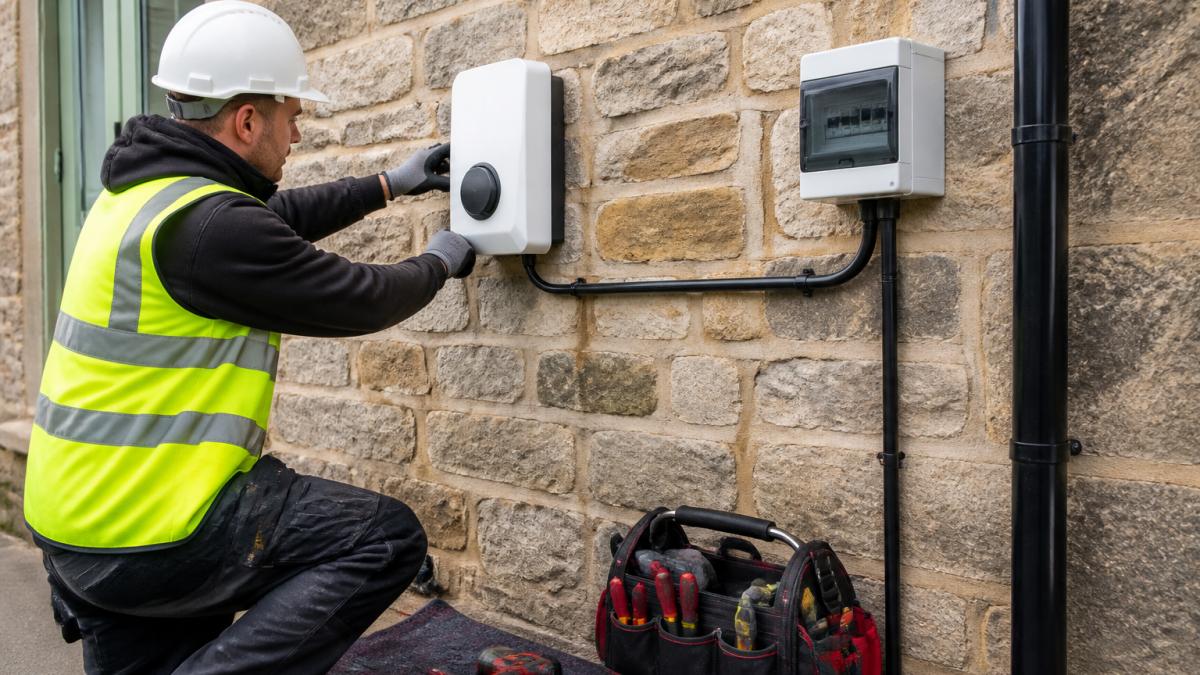
Ahead of the visit, our guide on how to prepare for EV charger installation covers the access, parking and paperwork details that keep the day on schedule.
Click HERE for your FREE SURVEY today →
Understand Home EV Charger Cost Before You Commit
Home EV charger cost is driven by the unit, the cable run, any electrical remedial work and whether groundwork is needed. For a detailed breakdown of installation costs, see our EV charging point installation cost guide. Two quotes for the "same" charger can differ substantially because the installation behind them is different, not because one installer is overcharging.
Break your quote into these lines and compare like for like:
- Unit and mounting: the charger itself and its bracket
- Cable run: length, route and whether conduit or trunking is needed
- Electrical work: consumer unit changes, protective devices, earthing
- Groundworks: cable across a driveway, lawn or outbuilding
- Certification: testing and the paperwork you should receive on completion
Pricing depends on your property and specification, so we confirm figures after the survey rather than quoting blind.
Watch out: a quote that omits the cable run or electrical remedial work is not a cheaper quote, it is an incomplete one. Ask for the assumptions in writing.
Choose a Solar-Compatible EV Charger If You Plan to Add Panels
A solar-compatible EV charger can divert surplus solar generation into your car instead of exporting it, which turns daylight hours into free motoring. This only works if the charger can talk to your solar inverter or energy management system, so compatibility is the whole game.
The order you do things in matters. If panels are on your roadmap, specify a charger that supports solar diversion now rather than replacing it later. If you already have panels, check the charger supports your inverter brand and metering setup.
Best for: households planning solar within the next couple of years. Skip if: you have no intention of generating your own electricity, since the extra cost buys you nothing.
If panels are part of the plan, our domestic solar panel installation service is designed alongside the charger so the two work as one system rather than two separate purchases.
Book a Free Home Survey to Confirm Your Specification
A home survey is the only reliable way to confirm your specification, because supply capacity, cable routes and earthing cannot be judged from a photo or a phone call. Before booking, read our guide on how to choose a reliable EV installer. At Smarter Utility, our survey is free and carries no obligation, and it ends with a written specification you can compare against other quotes.
Smarter Utility is a fully accredited and approved MCS solar and battery storage installer, and we design every charger around the property it serves. Book your free survey and we will confirm the right charger, the right speed and the full cost before you commit.
Frequently Asked Questions
What should I look for when choosing a home EV charger?
Check four things: the maximum charging rate your car accepts, whether the unit is smart (so you can schedule off-peak charging), its weather rating for outdoor mounting, and whether it can be paired with solar panels later. A 7kW smart charger suits most homes. Confirm the installer is accredited and can issue the paperwork your energy supplier or insurer may ask for, and ask them to size the cable run and protective device correctly at survey stage.
How do I know which home EV charger is compatible with my car?
Almost every EV sold in the UK uses a Type 2 connector for AC charging, so physical compatibility is rarely the issue. The real limits are your car's onboard charger (many accept 7kW, some only 3.7kW, a few 11kW) and your home's electrical supply. Check your vehicle handbook for the maximum AC charge rate, then have an installer confirm your consumer unit and supply capacity can support it before ordering.
How much does it cost to install a home EV charger?
Home EV charger cost depends on the unit you pick, cable run length, whether your consumer unit needs upgrading, and any groundworks for a detached garage or driveway post. Older properties with dated electrical panels often need extra work. Because quotes vary widely, get a free no-obligation survey so the installer can inspect your supply and give a fixed price rather than an estimate over the phone.
Can a home EV charger work with solar panels or a home battery?
Yes, if you choose a solar-compatible EV charger. These units can divert surplus solar generation into the car instead of exporting it, and some coordinate with a home battery. If you already have panels, or plan to add them within a few years, specify solar compatibility at the design stage. Retrofitting later is possible but often costs more than choosing the right unit first time.
Choosing a home EV charger is really a matching exercise: your car's limit, your supply, your mileage and your plans for solar. Get those four aligned and the shortlist writes itself. Smarter Utility handles that matching through a free, no-obligation home survey, expert design and professional installation, with MCS accreditation behind the solar and battery work. Get started with Smarter Utility and specify a charger that fits your home, your car and your electricity bills.