 how-to
Integrating Solar Panels With Heat Pumps: A How-To Guide
Table of Contents
- Why Combine Solar Panels With Heat Pumps
- How Many Solar Panels to Run a Heat Pump
- Heat Pump and Solar Panel System Design Essentials
- Solar Battery With Heat Pump: Storage and Self-Consumption
- Using Solar Electricity to Heat Hot Water
- Controlling Your System for Maximum Solar Use
- Funding, Grants, and Running Cost Savings
- Getting Started With a Professional Survey
- Frequently Asked Questions
Last Updated: October 18, 2026
Why Combine Solar Panels With Heat Pumps
Pairing solar panels with heat pumps cuts energy bills significantly.
A heat pump running on grid electricity costs far more than one using solar power, and battery storage captures surplus generation for evening heating.
Here's what makes this pairing work so well:
- Solar provides consistent electricity during peak daylight
- Winter heating demand aligns with improved generation in late autumn and early spring
- Battery storage bridges the gap between generation and heating demand
The real advantage isn't just environmental, it's financial. Homes integrating solar panels with heat pumps in Scotland see measurable reductions in annual energy consumption.
How Many Solar Panels to Run a Heat Pump
Sizing a solar array to a heat pump requires matching three things: the heat pump's annual electricity demand, the array's annual generation in your location, and the battery capacity that shifts daytime generation into evening heating demand. A well-sized system often covers 40-60% of a heat pump's annual electricity use, with the remainder drawn from the grid.
Start with the heat pump's annual electricity demand
A heat pump's electricity use depends on the home's heat loss, its efficiency (Seasonal Coefficient of Performance, or SCOP), and heating and hot water demand. A well-insulated three-bedroom semi in central Scotland might need around 10,000 kWh of heat annually; an air source heat pump with a SCOP of 3.0 would use roughly 3,300 kWh of electricity.
These are illustrative figures. A proper survey uses the home's Energy Performance Certificate (EPC) data, room-by-room heat loss calculations, and manufacturer performance data at design conditions.
Estimate annual solar generation for your roof
A south-facing roof in Scotland typically receives around 900-1,100 kWh of solar irradiation per installed kilowatt peak (kWp) per year, depending on location, shading, and tilt. East or west-facing roofs generate 15-25% less, and north-facing roofs are usually not viable. A 4 kWp array (roughly 10 panels at 400 W each) on a good south-facing roof might generate 3,600-4,400 kWh per year.
Match array size to heat pump demand
Using the examples above:
- 3,300 kWh heat pump demand: A 3-4 kWp array (8-10 panels) generating around 3,000-3,600 kWh per year would cover most of the annual demand, but the timing mismatch means a battery is essential to use it for heating.
- 5,400 kWh heat pump demand: A 5-6 kWp array (12-15 panels) generating around 4,500-5,400 kWh per year would be needed to make a meaningful contribution.
In practice, most integrated systems are sized so the array covers baseload electricity plus a substantial share of heat pump demand, with the battery absorbing surplus daytime generation for evening use.
Account for Scottish seasonal variation
Scotland's solar generation is highly seasonal: a south-facing array might generate 400-500 kWh in June but only 100-150 kWh in December, while heat pump demand peaks in December and January.
A common pattern is to size the array for the shoulder months (March-April and September-October), when generation and heating demand overlap reasonably well, and accept that December-January will be grid-dominated.
Battery sizing in practice
Battery capacity should cover the evening heating and household demand solar cannot meet after sunset. A typical evening heat pump demand might be 3-6 kWh, plus 2-4 kWh of household baseload. A 5-10 kWh battery covers most shoulder-month evenings, while 10-15 kWh provides more winter resilience and summer self-consumption.
Roof space and orientation constraints
A typical 400 W panel occupies around 1.7-2 m². A 4 kWp array needs roughly 17-20 m² of unshaded roof space, and a 6 kWp array needs 26-30 m².
A professional survey remains the only reliable way to size the system correctly. Undersizing leaves you reliant on grid electricity; oversizing wastes capital. The right answer is a modelled balance of array, battery, and heat pump capacity for your home.
Heat Pump and Solar Panel System Design Essentials
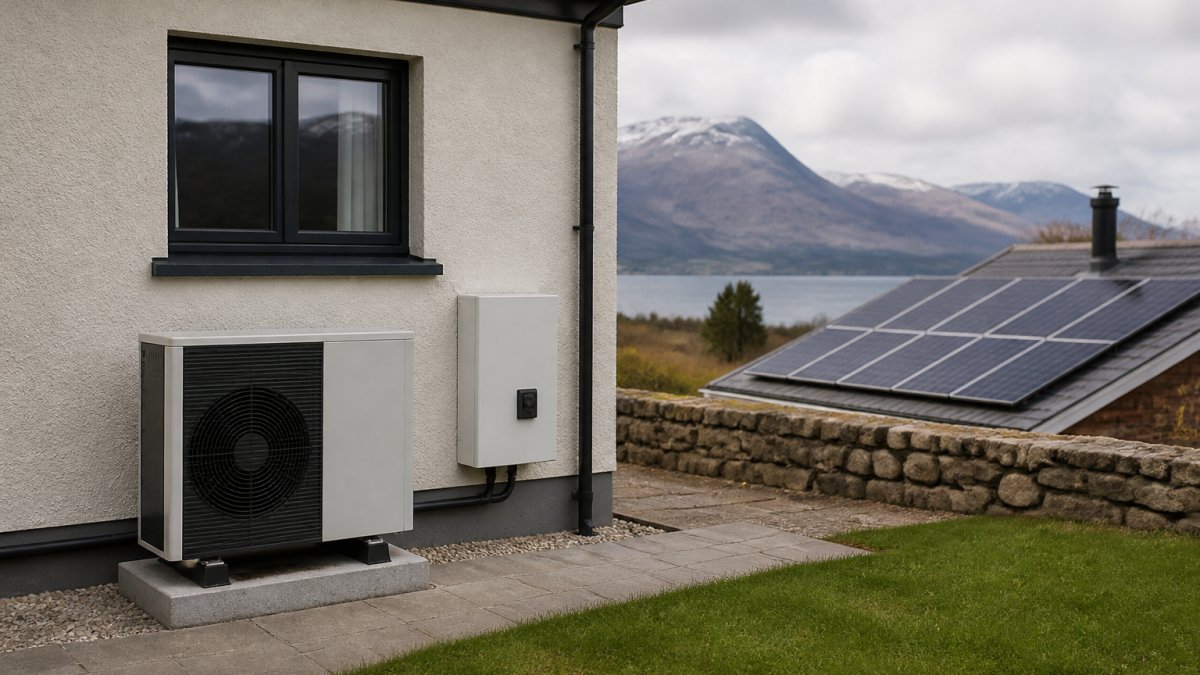
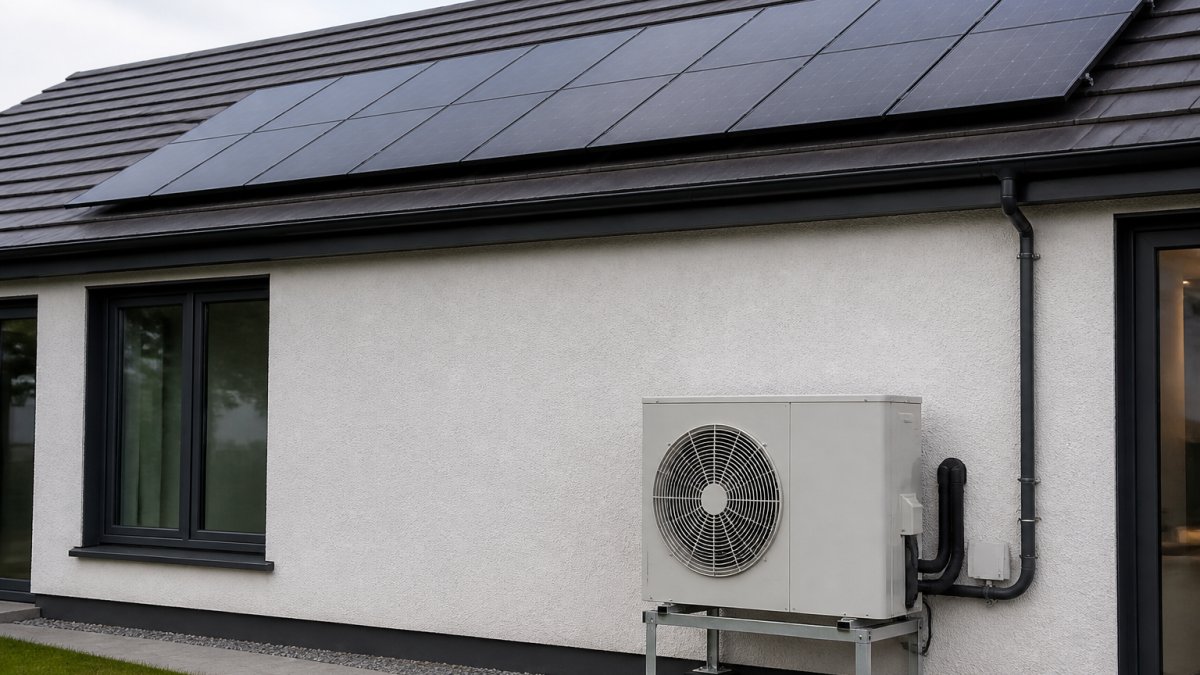
Integrating solar panels with heat pumps in Scotland requires careful attention to electrical compatibility, installation sequence, and system controls. A poorly designed system underperforms and wastes money; a well-designed one runs efficiently for 20+ years.
Electrical requirements and compatibility
Your home's electrical infrastructure must support both the solar array and the heat pump. Most homes have a 100 amp consumer unit (fuse box). A 6-10 kW solar array and a 5-10 kW heat pump together can push this limit.
Before installation, you need:
- Capacity assessment: Your electrician must verify your main fuse box can handle the combined load
- Dedicated circuits: Heat pumps require their own circuit, separate from solar
- Earthing and bonding: Both systems must be properly earthed to meet Building Standards
Many older Scottish properties have outdated panels. A 60 amp service needs an upgrade before adding both systems, costing £1,500-£3,000 but non-negotiable for safety.
Installation sequence and timeline
The order matters: install solar first, then the heat pump. Solar wiring integrates permanently into your home's electrical system, and heat pump installation can then reference the existing solar infrastructure.
Typical timeline for integrating solar panels with heat pumps:
- Electrical survey and upgrade (1-2 weeks): Assess your fuse box; upgrade if needed
- Solar installation (3-5 days): Panels, inverter, battery (if applicable)
- System testing (2-3 days): Verify solar output and battery charging
- Heat pump installation (2-3 days): Unit, pipework, controls
- Final commissioning (1 day): Test the integrated system end-to-end
Total time from survey to operation: 4-8 weeks, though weather and supply chain issues can extend this.
Solar Battery With Heat Pump: Storage and Self-Consumption
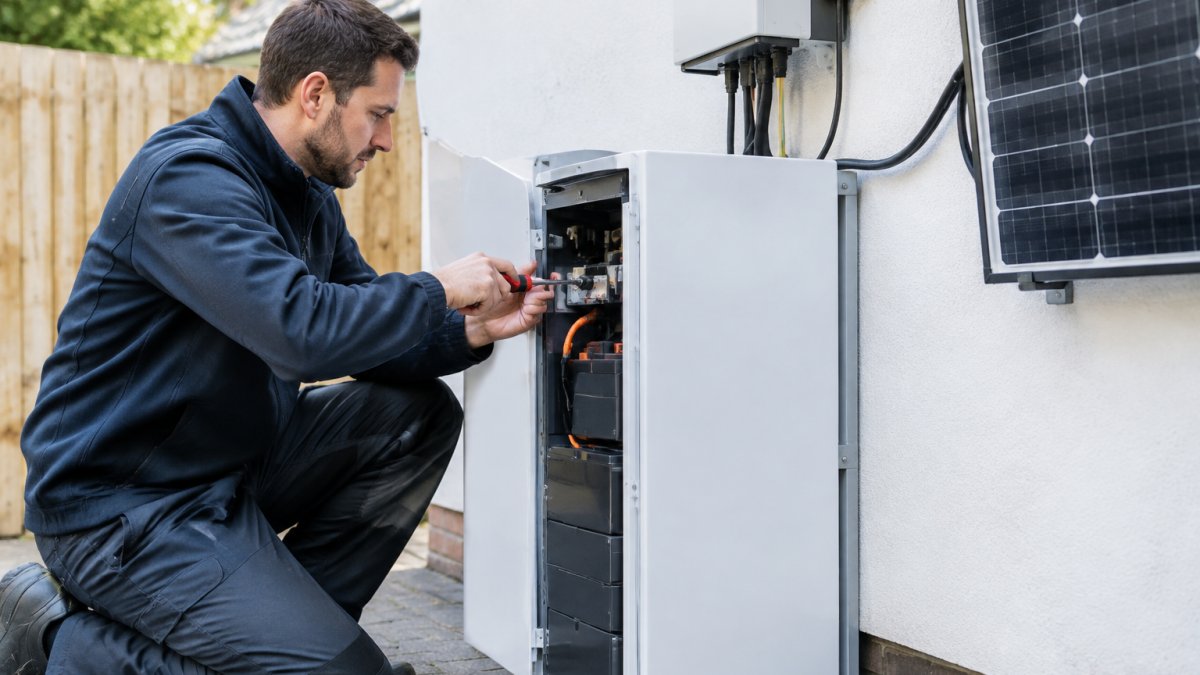
For integrating solar panels with heat pumps, battery storage is essential during winter. Your heat pump runs most in the evening (when heating demand peaks). Solar generation stops by 4 p.m.
Typical battery sizing for a heat pump system:
- Small homes (2-3 bedrooms): 5-8 kWh battery
- Medium homes (4-5 bedrooms): 8-12 kWh battery
- Large homes or high demand: 12-20 kWh battery
The battery charges during daylight from your solar panels. It discharges in the evening to power your heat pump. On cloudy days, the battery depletes faster, you'll draw grid electricity to top up.
Using Solar Electricity to Heat Hot Water
Heat pumps can deliver hot water via immersion heating (electric resistance) or heat pump water heating.
Click HERE for your FREE SURVEY today →
A heat pump water heater pulls warmth from the air into your hot water tank, using roughly 1 kW of electricity to deliver 3-4 kW of heating.
To maximize solar use for hot water:
- Install a timer on your water heating: Heat water during peak solar generation (11 a.m.-3 p.m.)
- Use a hot water tank with good insulation: Reduces reheating cycles and wasted energy
- Pair with battery storage: If clouds block the sun, your battery can power water heating without grid electricity
Many homes waste solar generation by not aligning water heating with solar production. A simple timer synchronizes the two and improves self-consumption by 15-25%.
Controlling Your System for Maximum Solar Use
Smart controls separate a system that wastes solar from one that maximizes it. Modern inverters and heat pump controllers communicate to optimize energy flow.
Your system should operate like this:
- Solar panels generate electricity during daylight
- The inverter checks battery charge level
- If battery is below 80%, charge it from solar
- If battery is full, power the heat pump directly from solar
- If solar output drops below heat pump demand, draw from battery
- If battery depletes, draw from grid
This sequence minimizes grid reliance and maximizes solar self-consumption.
Many homeowners set their heat pump to run on a fixed schedule (e.g., 6 a.m.-10 p.m.). A better approach is demand-responsive control: run the heat pump when solar generation is high, and reduce heating slightly when solar drops.
Smarter Utility configures controls to match your home's heating pattern and solar generation profile.
Funding, Grants, and Running Cost Savings
The upfront cost of integrating solar panels with heat pumps is substantial, and the funding landscape changes frequently. This section sets out the main support routes and a transparent method for estimating running-cost savings, so you can test any installer's figures against your own assumptions.
Current funding routes
Energy Efficient Scotland Area-Based Schemes: Some local authorities run area-based schemes offering funding for properties in eligible postcodes.
MCS Certification: MCS (Microgeneration Certification Scheme) certification is not a grant, but it is a prerequisite for most funding routes and for export payments.
Export payments: The Smart Export Guarantee (SEG) requires licensed electricity suppliers above a certain size to offer a payment for exported electricity.
A transparent method for estimating running-cost savings
Step 1: Establish current heating cost. Take your annual heating fuel consumption and multiply by your current unit rate.
Step 2: Estimate heat pump electricity demand. Divide annual heat demand by the heat pump's SCOP.
Step 4: Add household electricity and standing charges. Include your baseload electricity and any standing charges for both fuels to get a like-for-like comparison.
Tariffs matter as much as hardware
Time-of-use tariffs can materially change the economics. If you can charge the battery from cheap overnight electricity in winter and use it during the evening peak, the effective import cost falls. Conversely, a flat-rate tariff with a high unit rate erodes savings. Before committing, model your system against the tariff you will actually be on, not a headline rate.
What the figures do not include
Running-cost savings exclude the capital cost of the system, replacement of the battery after 10-15 years, and any maintenance. A full financial appraisal should compare the annual saving against the capital outlay and expected system life. It is often advised to treat the solar and battery investment on its own merits and the heat pump on its own merits, rather than relying on a combined payback figure that can obscure weak assumptions.
Getting Started With a Professional Survey
The only reliable way to size and design a system for integrating solar panels with heat pumps in Scotland is a professional survey.
Smarter Utility offers free, no-obligation surveys. Our team:
- Assesses your roof for solar potential (size, angle, shading)
- Reviews your current heating system and energy bills
- Evaluates your electrical infrastructure
A survey takes 1-2 hours. You'll leave with clear answers to your questions and a detailed proposal.
The next step is simple: book a survey with Smarter Utility.
Integrating solar panels with heat pumps in Scotland is an effective way to cut heating costs and carbon emissions.
Frequently Asked Questions
Can solar panels power a heat pump?
Yes. Solar panels generate electricity that can power a heat pump directly during daylight hours. An air source heat pump uses that solar electricity to extract heat from the air and deliver it to your home for space heating and hot water. Without battery storage, the heat pump draws grid electricity when the sun isn't shining. With battery storage, you capture surplus solar generation for use after dark, increasing self-consumption and reducing grid reliance.
How many solar panels do I need to run a heat pump?
Most homes need between 10 and 20 solar panels (3-6 kW system) to meaningfully offset a heat pump's electricity consumption, depending on your home's heating demand, insulation, local climate, and roof orientation. A south-facing roof in good condition generates more electricity per panel. A professional survey assesses your specific heating load, hot water needs, and electricity consumption to size the system correctly. Undersizing wastes the opportunity to save; oversizing costs more upfront without proportional benefit.
Do I need a battery with solar panels and a heat pump?
Battery storage is not mandatory but significantly improves savings. Without a battery, your heat pump uses solar electricity during the day and grid electricity at night and in winter. A battery captures surplus solar generation for evening and winter use, reducing grid purchases. Battery sizing depends on your heat pump's daily consumption and how much solar surplus you generate. A professional system design calculates whether a battery's cost is justified by your specific usage pattern and running-cost savings.
Will solar panels reduce the running costs of a heat pump?
Yes, substantially. A heat pump running on solar electricity costs almost nothing to operate during sunny hours. Over a year, solar PV can cover a significant portion of a heat pump's electricity consumption, depending on system size, battery storage, and seasonal performance. Running-cost savings depend on your current electricity tariff and how much solar generation you self-consume or export. A detailed cost analysis based on your home's energy profile shows realistic payback timescales and long-term savings.