 ultimate-guide
Home Solar and Battery Design Guide 2026
Table of Contents
- How Solar Battery Storage Works
- Is Solar Battery Storage Worth It in 2026
- Solar Battery Sizing: Calculating Your Home's Energy Needs
- Types of Solar Battery Chemistries and Performance
- System Design: AC-Coupled vs DC-Coupled Installation
- DNO Application Process for Solar and Battery Systems
- Cost, ROI, and Payback Period
- Battery Degradation, Cycle Life, and Warranty
- Frequently Asked Questions
Last Updated: September 1, 2026
How Solar Battery Storage Works
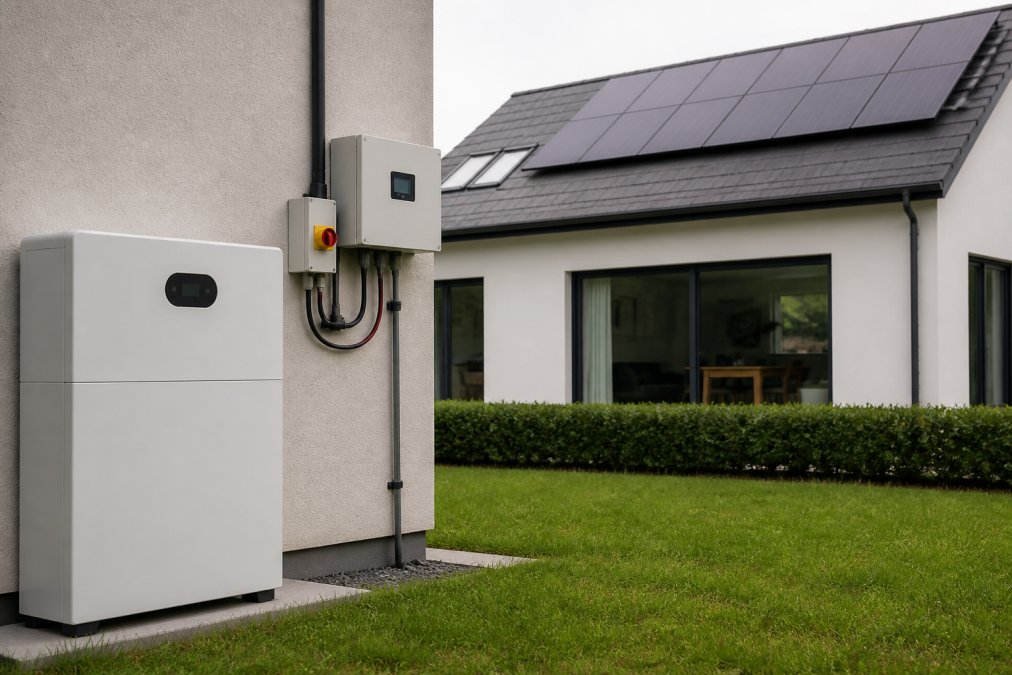
Solar battery storage captures excess energy generated by your photovoltaic (PV) system during daylight hours and releases it during evening peak demand or grid outages. The system sits between your solar array and home electrical panel, storing energy in chemical form and converting it back to usable AC power through an inverter.
Your solar panels generate direct current (DC) electricity. A charge controller regulates this flow into the battery, which stores energy at a specific voltage. When you draw power, an inverter converts the stored DC energy back into alternating current (AC) that your home appliances use. Round-trip efficiency typically ranges from 85-95%, meaning most stored energy returns when needed.
Battery capacity is measured in kilowatt-hours (kWh). A 10 kWh battery can theoretically power a typical household for several hours depending on consumption. The depth of discharge (DoD) determines how much capacity you can safely use. Many lithium systems allow 90-100% DoD, while lead-acid alternatives typically permit only 50% (peer-reviewed research).
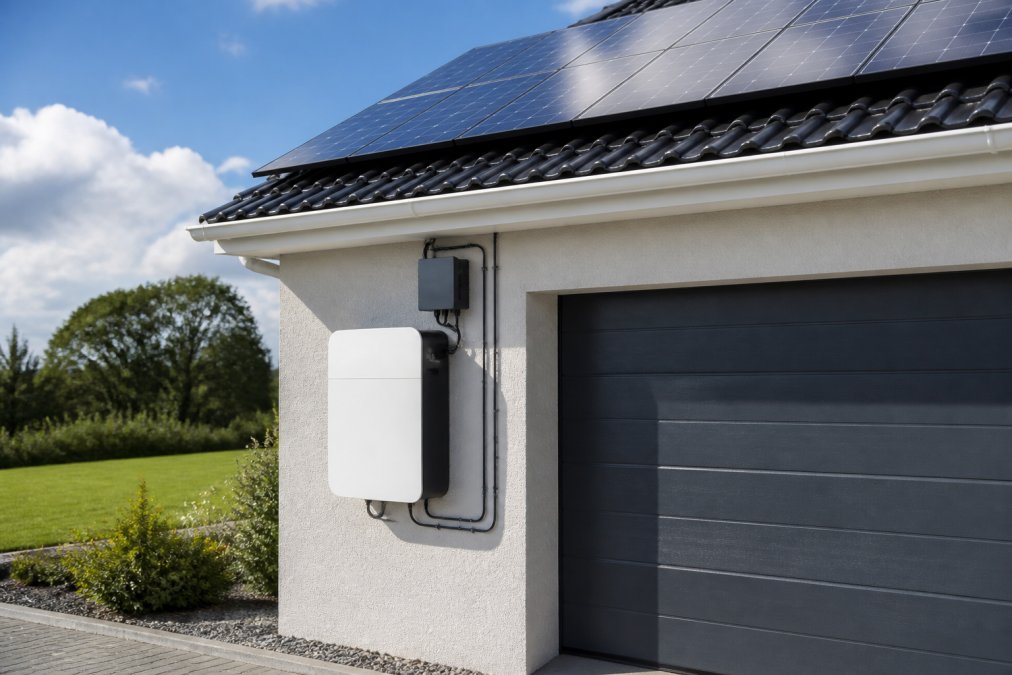
Battery storage enables time-of-use (TOU) rate arbitrage. Peak shaving lets you avoid expensive peak-rate hours by drawing stored energy instead of grid power. Self-consumption increases when you use your own solar energy directly rather than exporting it to the grid at lower feed-in tariff rates.
Is Solar Battery Storage Worth It in 2026
Whether battery storage makes financial sense depends on your electricity costs, consumption profile, and local grid conditions. If your utility charges significantly higher rates during evening hours, or if you have an EV that charges during peak periods, storage becomes economically viable. Households with flat-rate tariffs see slower payback periods.
The financial case centres on peak shaving and TOU rate arbitrage. You're buying the right to use cheaper daytime solar energy during expensive evening hours instead of paying grid rates.
Some regions offer payments for allowing your battery to support the network during peak demand, meaningfully improving your return on investment (ROI). Battery systems require sufficient solar capacity to charge them meaningfully. A modest 4 kW solar array paired with a 15 kWh battery might struggle to fully recharge on cloudy days. System sizing must match both your solar generation potential and actual energy consumption patterns.
Solar Battery Sizing: Calculating Your Home's Energy Needs
Proper sizing requires three data points: your daily energy consumption in kilowatt-hours, your peak power demand in kilowatts, and your desired autonomy (how many days you want to run on battery alone).
Start with your electricity bills. Divide annual consumption by 365 to get daily average. However, daily average masks critical patterns. Your evening consumption might be double your midday consumption. A 20 kWh daily average home might use 30 kWh between 5pm and midnight and only 8 kWh during daylight hours. Your battery needs to cover that evening peak.
Peak power demand matters separately from total energy. A 10 kWh battery is useless if your home simultaneously runs a 15 kW electric shower, heat pump, and EV charger. The battery's power rating must exceed your likely simultaneous loads. Most residential systems range from 5-15 kW continuous power output.
Autonomy is your design choice. Most UK households find 1-2 days adequate given that extended cloudy periods are rare and grid connection remains available. Oversizing for extreme autonomy becomes economically irrational quickly.
Using a Solar Battery Sizing Calculator
Online tools simplify sizing by accounting for seasonal variation, local solar irradiance, and consumption patterns. These calculators typically ask for your postcode, annual electricity consumption, peak load, and desired backup days, then output recommended battery capacity and solar array size.
The limitation: calculators work from averages. A calculator might recommend 12 kWh based on your 20 kWh daily average, but if you charge an EV at home, your actual evening peak might demand 15 kWh. Always review calculator assumptions and adjust upward if your actual usage patterns differ.
Smarter Utility's approach includes a detailed home energy audit during the free survey. Rather than relying on calculator estimates, we measure your actual consumption patterns, identify peak loads, and account for future changes like EV charging or heat pump installation. This precision prevents oversizing or undersizing.
Types of Solar Battery Chemistries and Performance
Lithium-ion batteries dominate new residential installations because they offer superior energy density, longer cycle life, and deeper depth of discharge compared to lead-acid alternatives. Lithium iron phosphate (LiFePO4) chemistry has become the standard for home systems due to its safety profile and thermal stability.
Lead-acid batteries remain cheaper upfront but deteriorate faster. A lead-acid battery rated for 5,000 cycles at 50% DoD might deliver only 2,500 usable cycles in practice. Lithium systems routinely deliver 6,000-10,000 cycles and tolerate 80-100% DoD, meaning you actually use most rated capacity. The effective cost per usable kWh strongly favours lithium over the system lifetime.
Sodium-ion chemistry is emerging but remains expensive and unproven in residential UK installations. These remain niche options for new builds where space isn't constrained.
LiFePO4 systems typically warranty 10 years with capacity fade guarantees (often 70-80% remaining capacity at end of warranty). This warranty structure means the manufacturer guarantees the battery will retain that minimum capacity throughout the period, a meaningful protection that shapes real-world reliability.
System Design: AC-Coupled vs DC-Coupled Installation
The coupling architecture determines how your battery integrates with your existing solar system, affecting efficiency, cost, and future flexibility.
DC-coupled systems connect the battery directly to the solar array's DC circuit before the main inverter. Excess solar generation charges the battery directly at DC voltage, then the battery's inverter converts stored energy to AC when needed. This minimizes conversion steps, improving round-trip efficiency by 3-5 percentage points. DC coupling works best in new installations where you're designing the entire system from scratch.
AC-coupled systems install the battery with its own inverter in parallel with your existing solar inverter. Both feed AC power to your home and grid connection. This approach works brilliantly for retrofitting battery storage into existing solar installations because it requires minimal changes to your current system. The trade-off: energy flowing from solar to battery gets converted DC-to-AC by the solar inverter, then AC-to-DC by the battery charger, reducing efficiency slightly. For most homes, that 3-5% efficiency loss costs less than redesigning an entire working system.
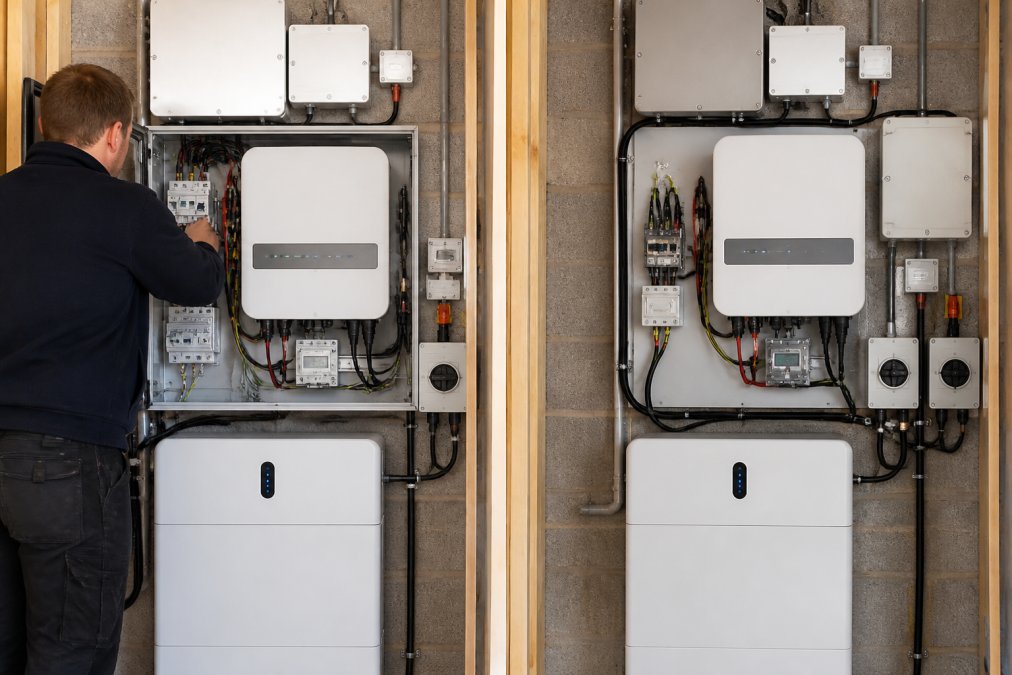
Hybrid inverters combine solar and battery inverter functions in one unit, offering DC-coupling benefits with greater design flexibility. These have become increasingly popular because they reduce component count and simplify installation.
Your choice depends on whether you're retrofitting an existing solar system or designing new. Retrofits almost always favour AC-coupling for simplicity and cost. New builds should evaluate hybrid inverters alongside pure DC-coupling based on component availability and installer expertise.
DNO Application Process for Solar and Battery Systems
Before installing solar and battery systems, you must notify your Distribution Network Operator (DNO), the company that owns and maintains the local electricity network serving your property. This is a legal requirement under the G98 and G99 procedures.
Click HERE for your FREE SURVEY today →
G98 applies to systems up to 3.68 kW (typically single-phase residential solar) (ofgem.gov.uk). This is a simple notification process requiring basic paperwork and a modest application fee. Your DNO has 30 days to respond, though most respond within days.
G99 covers systems between 3.68 kW and 11 kW (or larger systems requesting higher export limits). This requires more detailed technical documentation, including electrical schematics and equipment specifications. G99 applications can take 4-12 weeks depending on your DNO's workload and whether they require additional studies.
Battery storage adds complexity because DNOs treat it as an additional generating asset. You may need separate G99 applications for the solar system and battery system, depending on your DNO's interpretation. Some DNOs now have simplified processes for solar-plus-storage; others treat them as separate assets.
Engage your DNO early. Smarter Utility handles DNO applications as part of our design process, managing timelines and technical documentation so you're not delayed by administrative surprises.
Cost, ROI, and Payback Period
Battery system costs depend on capacity, chemistry, inverter type, and installation complexity. Request quotes from multiple installers and compare total installed cost, not just battery price.
ROI calculation requires understanding your specific electricity tariff. If you pay a flat rate regardless of time of day, battery payback extends significantly. If you're on a TOU tariff with substantial peak-hour premiums, payback accelerates. EV owners see faster payback because they shift charging to off-peak hours when battery energy is cheaper than grid electricity.
A household using 20 kWh daily with a £0.28/kWh evening rate and £0.12/kWh daytime rate (typical TOU structure) saves roughly £3.20 per day by shifting evening consumption to stored solar energy. Over a year, that's approximately £1,168 in avoided peak charges. A 12 kWh system might cost £8,000-12,000 installed, suggesting 7-10 year payback before accounting for system degradation or future tariff changes.
Payback periods are improving as battery costs decline and electricity prices rise. The financial case strengthens considerably when you combine solar with battery storage and EV charging. A home charging an EV during peak hours at grid rates costs roughly £0.25/kWh. The same charging from stored solar costs £0.05/kWh when accounting for system losses. That arbitrage alone justifies battery investment for EV owners.
Battery Degradation, Cycle Life, and Warranty
All batteries degrade. Modern lithium systems degrade slowly and predictably.
Cycle life measures how many charge-discharge cycles a battery completes before reaching 80% of original capacity. A battery rated for 6,000 cycles at 80% DoD typically reaches 80% remaining capacity after 6,000 full discharge cycles. Real-world usage rarely involves full daily discharge cycles. A home using 5 kWh from a 12 kWh battery daily is cycling at 42% DoD. That same battery might deliver 10,000-15,000 such partial cycles before reaching 80% capacity.
Calendar aging compounds cycle aging. A battery degrades slightly even when unused, simply from age. High temperatures accelerate degradation significantly. Most manufacturers design residential systems with temperature management to minimise calendar aging.
Warranty coverage typically guarantees 10 years and 70-80% remaining capacity at end of warranty. Most systems never reach that threshold; LiFePO4 batteries typically retain 85-90% capacity at 10 years. The warranty provides protection against manufacturing defects or premature failure.
A 12 kWh battery installed today will likely deliver 10-11 kWh usable capacity in 2036. That degradation is gradual. If you're designing a system for 25-year home ownership, account for battery replacement around year 12-15. If you're planning to sell in 8 years, the original battery will likely still be under warranty and performing well.
Designing a solar and battery system requires matching your specific energy consumption patterns, tariff structure, and future plans to the right combination of solar capacity, battery size, and inverter architecture. The choices you make during design determine whether your system delivers genuine savings or becomes an expensive installation that underperforms expectations.
Smarter Utility's free home survey includes detailed energy analysis, load profiling, and system recommendations tailored to your actual consumption patterns. Our fully accredited team handles DNO applications, manages installation timelines, and ensures your system integrates properly with any future upgrades like EV charging or heat pump installation.
Get started with your free no-obligation home survey from Smarter Utility and discover the solar and battery design that matches your home's actual energy needs.
Frequently Asked Questions
Is solar battery storage worth it in 2026?
Solar battery storage is worth it if you want to maximise self-consumption of your solar energy, reduce peak-time electricity costs, or gain backup power during outages. The decision depends on your electricity usage patterns, roof space, local feed-in tariff rates, and budget. A professional home survey can assess whether your property and energy needs make battery storage a sound investment for your circumstances.
How do I calculate the right battery capacity for my home?
Start by reviewing your annual electricity bill to find your kWh consumption. A solar battery sizing calculator helps estimate daily energy needs based on your usage profile. Most homes benefit from 5-10 kWh of usable capacity, but this depends on your solar array size, depth of discharge limits, and whether you want full backup power or just peak shaving. A professional survey will size your system to match your actual load requirements and energy goals.
What is the DNO application process for solar installations?
Your Distribution Network Operator (DNO) must approve grid-connected solar systems. For systems under 3.68 kW, you typically use the G98 application process, which is simpler and faster. Larger systems require G99 applications, which involve more detailed technical assessments. Your installer handles this paperwork, but approval can take 4-8 weeks. Early notification ensures your system is properly registered and eligible for export payments or time-of-use tariff benefits.
What is the difference between AC-coupled and DC-coupled battery systems?
DC-coupled systems connect the battery directly to the solar array via a hybrid inverter, offering higher round-trip efficiency (85-95%) and lower component costs. AC-coupled systems connect the battery through a separate inverter to your home's AC circuits, allowing retrofit installations and compatibility with existing solar arrays. AC-coupled is more flexible for older properties; DC-coupled is more efficient for new builds or complete system replacements.
How long does a home solar battery typically last?
Modern lithium-ion batteries are rated for 10-15 years and 3,000-6,000 full charge cycles. Real-world lifespan often exceeds warranty periods because batteries degrade gradually rather than fail suddenly. Cycle life depends on depth of discharge (DoD) settings, limiting discharge to 80% extends lifespan significantly. Most manufacturers offer 10-year warranties covering 70-80% capacity retention, ensuring your battery remains productive well beyond the initial warranty term.
What are the main benefits of adding battery storage to solar panels?
Battery storage increases self-consumption of solar energy, reduces reliance on grid electricity during peak-rate hours, provides backup power during outages, and maximises your return on investment through load shifting and peak shaving. Combined with time-of-use tariffs, batteries help you store cheap solar energy and use it when grid rates are highest, lowering your electricity bills significantly while improving energy independence.
Can I retrofit a battery system to an existing solar installation?
Yes, retrofitting is possible with AC-coupled battery systems, which connect independently to your home's electrical panel. However, your existing inverter and wiring must support the additional load. An AC-coupled retrofit is simpler than replacing your entire system but typically less efficient than DC-coupled new builds. A professional survey will assess whether your current setup can accommodate battery storage or whether system upgrades are necessary.
What happens to solar batteries at end of life?
Lithium-ion batteries are recycled to recover lithium, cobalt, nickel, and other valuable materials, reducing environmental impact and mining demand. Many manufacturers and installers participate in take-back schemes. Recycled materials are used in new batteries or other products, creating a circular economy. Responsible recycling ensures hazardous materials are handled safely and valuable resources are recovered rather than sent to landfill.
This article was written using GrandRanker
Frequently Asked Questions
Is solar battery storage worth it in 2026?
Solar battery storage is worth it if you want to maximise self-consumption of your solar energy, reduce peak-time electricity costs, or gain backup power during outages. The decision depends on your electricity usage patterns, roof space, local feed-in tariff rates, and budget. A professional home survey can assess whether your property and energy needs make battery storage a sound investment for your circumstances.
How do I calculate the right battery capacity for my home?
Start by reviewing your annual electricity bill to find your kWh consumption. A solar battery sizing calculator helps estimate daily energy needs based on your usage profile. Most homes benefit from 5-10 kWh of usable capacity, but this depends on your solar array size, depth of discharge limits, and whether you want full backup power or just peak shaving. A professional survey will size your system to match your actual load requirements and energy goals.
What is the DNO application process for solar installations?
Your Distribution Network Operator (DNO) must approve grid-connected solar systems. For systems under 3.68 kW, you typically use the G98 application process, which is simpler and faster. Larger systems require G99 applications, which involve more detailed technical assessments. Your installer handles this paperwork, but approval can take 4-8 weeks. Early notification ensures your system is properly registered and eligible for export payments or time-of-use tariff benefits.
What is the difference between AC-coupled and DC-coupled battery systems?
DC-coupled systems connect the battery directly to the solar array via a hybrid inverter, offering higher round-trip efficiency (85-95%) and lower component costs. AC-coupled systems connect the battery through a separate inverter to your home's AC circuits, allowing retrofit installations and compatibility with existing solar arrays. AC-coupled is more flexible for older properties; DC-coupled is more efficient for new builds or complete system replacements.
How long does a home solar battery typically last?
Modern lithium-ion batteries are rated for 10-15 years and 3,000-6,000 full charge cycles. Real-world lifespan often exceeds warranty periods because batteries degrade gradually rather than fail suddenly. Cycle life depends on depth of discharge (DoD) settings—limiting discharge to 80% extends lifespan significantly. Most manufacturers offer 10-year warranties covering 70-80% capacity retention, ensuring your battery remains productive well beyond the initial warranty term.
What are the main benefits of adding battery storage to solar panels?
Battery storage increases self-consumption of solar energy, reduces reliance on grid electricity during peak-rate hours, provides backup power during outages, and maximises your return on investment through load shifting and peak shaving. Combined with time-of-use tariffs, batteries help you store cheap solar energy and use it when grid rates are highest, lowering your electricity bills significantly while improving energy independence.
Can I retrofit a battery system to an existing solar installation?
Yes, retrofitting is possible with AC-coupled battery systems, which connect independently to your home's electrical panel. However, your existing inverter and wiring must support the additional load. An AC-coupled retrofit is simpler than replacing your entire system but typically less efficient than DC-coupled new builds. A professional survey will assess whether your current setup can accommodate battery storage or whether system upgrades are necessary.
What happens to solar batteries at end of life?
Lithium-ion batteries are recycled to recover lithium, cobalt, nickel, and other valuable materials, reducing environmental impact and mining demand. Many manufacturers and installers participate in take-back schemes. Recycled materials are used in new batteries or other products, creating a circular economy. Responsible recycling ensures hazardous materials are handled safely and valuable resources are recovered rather than sent to landfill.