 how-to
Solar on a North Facing Roof: Is It Worth It?
Table of Contents
- Can You Install Solar Panels on a North Facing Roof?
- North Facing vs. South Facing: The Real Output Difference
- How Roof Pitch and Shading Change the Calculation
- Does Solar Panel Efficiency on North Facing Roofs Matter More?
- Modern Inverters and Solar Battery Storage Benefits
- So, Is Solar Worth It in Scotland on a North Facing Roof?
- Your Next Step: Book a Professional Roof Assessment
- Frequently Asked Questions
Last Updated: September 6, 2026
Can You Install Solar Panels on a North Facing Roof?
Yes, you can install solar panels on a north facing roof, and it is often a far more sensible option than many homeowners in Scotland assume. The question of can I install solar on north facing roof surfaces constantly in consultations, usually because a homeowner has been told that only south-facing roofs are worth the investment. That advice is outdated. Our fully accredited MCS team regularly demonstrates that a north facing roof can still deliver meaningful savings on electricity bills and a solid reduction in carbon footprint.
While a south-facing array will always capture more total sunlight, the gap is closing thanks to modern photovoltaic efficiency and smarter inverter technology. The real calculation involves your specific roof pitch, local shading, and how much of your generated power you can use on-site rather than export to the grid.
North Facing vs. South Facing: The Real Output Difference
A north-facing roof produces roughly 15 to 20 percent less annual energy than an equivalent south-facing system in the UK. In Scotland, with its lower solar irradiance and frequent overcast conditions, that difference can feel more pronounced during winter. However, a north-facing array does not stop producing electricity; it simply produces less during peak midday hours and generates a flatter, more distributed curve of output across the day.
Because the panels are angled away from the sun's direct path, they capture more diffuse light, the scattered sunlight that penetrates cloud cover. This means generation starts earlier in the morning and extends later into the afternoon, which often aligns better with a household's actual consumption pattern. A south-facing system might produce a spike of power at midday when you are out at work, whereas a north-facing system producing a steadier trickle across the day can improve your self-consumption ratio, the metric that actually determines your payback period.
How Roof Pitch and Shading Change the Calculation
Roof pitch is arguably more important than orientation when assessing a north-facing installation. A shallow north-facing roof at around 15 to 20 degrees will perform significantly better than a steep one at 40 to 45 degrees, because the angle of incidence to the sun is less severe. According to guidance on solar panel orientation and performance from the Energy Saving Trust on solar panel orientation, the ideal roof pitch for solar in the UK sits between 30 and 40 degrees, but systems installed on shallower north-facing slopes still capture a respectable amount of annual irradiance.
The Pitch-Viability Curve
In summer, the sun rises in the north-east and sets in the north-west, reaching a maximum elevation of roughly 58 degrees in southern England and 52 degrees in northern Scotland. A north-facing roof at a 15-degree pitch is nearly flat, meaning the angle between the panel surface and the sun's rays at midday is not as severe as you might expect. The panel still captures a meaningful share of direct irradiance during the long summer evenings when the sun dips into the northern sky.
A 40-degree north-facing pitch tilts the panels away from the sun's path for most of the day, so the panels rely almost entirely on diffuse light, which typically accounts for 50 to 60 percent of total annual irradiance in the UK. This is why a north-facing roof at 15 degrees can produce as much as 80 percent of a south-facing equivalent, while a north-facing roof at 45 degrees may only achieve 60 percent.
The Critical Distinction: North-Facing vs. North-Facing with Shade
The single most important question in a north-facing roof assessment is not whether the roof faces north, it is whether that north-facing slope is clear of obstructions. This distinction is the difference between a system that pays for itself in 12 years and one that never does.
A clean north-facing roof, free of chimneys, dormers, and neighbouring trees, receives diffuse light from the entire sky hemisphere. A north-facing roof with a large tree to the west, however, loses the afternoon diffuse light as well as any late-day direct sun. The result is not a 15 percent reduction in output, it is often a 40 to 50 percent reduction, because the obstruction removes a significant portion of the sky dome that the panels would otherwise harvest.
How to Assess Shading Before You Commit
Most installers will conduct a site survey using a solar pathfinder or a drone-based 3D model, but you can do a rough assessment yourself. Stand at the base of the roof and look up at the north-facing slope. If you can see at least 70 percent of the sky from the centre of the proposed array area, the roof is likely viable.
A more precise method is to use the 'four-season rule'. Mark the position of the sun at 9:00, 12:00, and 15:00 on the 21st of March, June, September, and December. If any obstruction casts a shadow across the proposed array area during those times, you have identified a generation loss window. In the UK, the winter months (November to February) are the most critical, because the sun is already low in the sky and a north-facing roof receives almost no direct light anyway.
The Interaction Between Pitch and Shading
Pitch and shading interact in ways that generic advice misses. A shallow-pitched north-facing roof (15 degrees) is more forgiving of shading because it can capture light from a wider portion of the sky. A steep north-facing roof (40 degrees) has a narrower field of view and is more vulnerable to even minor obstructions.
When professional home surveys are conducted, solar potential modelling that accounts for your exact roof slope, azimuth, and the path of the sun across your specific property is used. The output is a year-by-year generation estimate that separates the impact of orientation from the impact of shading, because those two factors require very different mitigation strategies. Orientation is fixed, but shading can sometimes be addressed by trimming trees, relocating panels to a different roof plane, or using micro-inverters to isolate the shaded panels from the rest of the array. solar roof ventilation.
Does Solar Panel Efficiency on North Facing Roofs Matter More?
Solar panel efficiency matters more on a north facing roof than on any other orientation, because you are working with a smaller window of direct sunlight and a larger share of diffuse light. High-efficiency panels, typically monocrystalline models with efficiency ratings above 21 percent, will capture more of that scattered irradiance than older polycrystalline panels.
System sizing is another lever. On a north-facing roof, installers often compensate for reduced irradiance by adding one or two additional panels to the solar array, provided your roof space allows it. This brings total energy generation closer to what a smaller south-facing system would produce, and because panel costs have fallen steadily, the additional upfront expense is often justified by the long-term return on investment.
Modern Inverters and Solar Battery Storage Benefits
The technology that makes north-facing solar genuinely viable is the modern inverter, and specifically the choice between string inverters and micro-inverters. A standard string inverter on a north-facing roof can suffer from startup voltage issues in low-light conditions. Micro-inverters, attached to each individual panel, eliminate this problem. They allow each panel to operate independently, so a shaded panel does not drag down the whole array, and they begin generating earlier in the morning and later into the evening.
The Low-Light Startup Problem, Explained
Most string inverters used in UK domestic installations require a minimum DC input voltage, typically between 100V and 150V, before they will boot up and begin converting power. On a north-facing roof, the array receives only diffuse, scattered light for the first hour or two after dawn, and the voltage build-up is slower. If your string is configured with panels in series, the weakest panel in the chain limits the current of the entire string.
Micro-inverters change this calculus entirely. Each panel has its own inverter rated at 250W to 400W, and the startup threshold is per-panel rather than per-array. A single panel receiving 50W of diffuse light will begin producing usable AC power, even if the panel next to it is fully shaded. This per-panel independence is the single most important technical feature for north-facing installations.
DC optimisers, fitted at each panel but feeding a central string inverter, offer a middle ground. They perform maximum power point tracking (MPPT) at the panel level, so each panel operates at its own optimal voltage and current. This solves the shading and mismatch problem but does not fully solve the low-light startup issue, because the central inverter still needs to reach its minimum input voltage before it switches on. For a north-facing roof, micro-inverters are generally the safer recommendation.
Battery Charging Profiles and the North-Facing Advantage
Solar battery storage benefits amplify this advantage considerably, but the mechanism is often misunderstood. A south-facing array produces a sharp bell curve of generation, peaking between 11:00 and 14:00. If your battery is already full by midday, which is common in summer, the excess generation is exported to the grid at the UK's typical export rate of 5.5p to 15p per kWh. A north-facing array produces a flatter, wider curve, which means the battery charges more gradually and is less likely to hit full capacity before the evening peak.
This matters because the economics of a north-facing system are driven almost entirely by self-consumption, not by export. The [UK Government guidance on solar PV and battery(/home-solar-and-battery-design-guide-2026) storage | gov.uk] notes that increasing self-consumption through battery storage is one of the most effective ways to cut energy bills. For a north-facing system, a battery can lift self-consumption from roughly 40 percent (without storage) to 75 percent or higher, because the generation curve aligns more naturally with morning and evening household demand.
There is also a specific interaction with time-of-use tariffs such as Octopus Flux or Intelligent Octopus Go. These tariffs offer cheaper off-peak rates overnight, typically between 23:30 and 05:30. A north-facing array paired with a battery allows you to charge the battery from the grid at the cheap overnight rate, then use that stored energy during the day when your panels are producing only modest amounts. This 'grid-charging' strategy is less effective with a south-facing array, because the panels are likely to fill the battery anyway by early afternoon.
Battery Sizing for North-Facing Arrays
Battery capacity should be sized differently for a north-facing roof. A typical rule of thumb for a south-facing 4kWp system is a 5kWh usable battery. For a north-facing system of the same size, the flatter generation curve means you are less likely to over-generate, so a smaller battery, around 4kWh usable, may suffice. However, if you are using the battery for grid arbitrage on a time-of-use tariff, larger is better. The key metric is the ratio of battery capacity to your daily evening consumption.
For EV owners, the calculation shifts again. Charging an EV at 7.4kW from a battery requires a battery with a high continuous discharge rate, typically at least 5kWh usable capacity. A north-facing array producing a steady 2kW to 3kW across the afternoon can keep the battery topped up for an evening charge session.
So, Is Solar Worth It in Scotland on a North Facing Roof?
Is solar worth it in Scotland on a north facing roof? The honest answer is that it depends, but it is worth it far more often than most homeowners expect. The decision comes down to three variables: whether your roof has a shallow pitch, whether it is free from heavy shading, and whether you can pair the array with a battery to maximise self-consumption.
That said, there are honest limitations. A north-facing roof is rarely the best possible location for solar if you have an unshaded south or west-facing alternative. The seasonal output will be lower in winter, when the sun barely clears the horizon, and your system may take a year or two longer to pay for itself. But for many Scottish homes, the north-facing slope is the only viable roof space, or it is the roof that faces the street and is therefore the most visible. In those cases, dismissing solar entirely because of orientation is a missed opportunity. The Microgeneration Certification Scheme standards for solar installation require certified installers to model expected generation accurately, so a qualified survey will give you a realistic picture of what your specific roof will produce before you commit any money.
| Key Factor | North Facing Roof | South Facing Roof |
|---|---|---|
| Annual energy generation | 15-20% lower | Baseline maximum |
| Peak output timing | Spread across the day | Midday spike |
| Best roof pitch | 15-30 degrees | 30-40 degrees |
| Diffuse light capture | Strong | Moderate |
| Battery storage benefit | High | Moderate |
| Best for | Self-consumption, EV charging | Maximum grid export |
Your Next Step: Book a Professional Roof Assessment
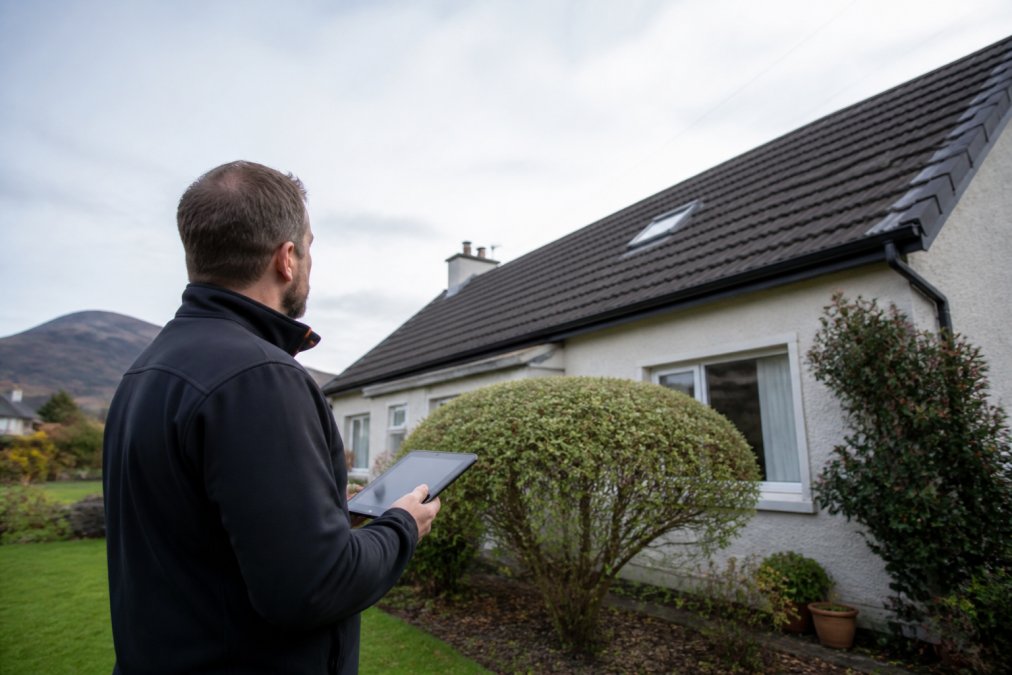
A professional roof assessment is the only way to answer the question of whether your specific north facing roof is worth installing on, because every property is different. Generic online calculators cannot account for your local shading, your roof's exact slope, or the way the sun tracks across your particular street.
At Smarter Utility, we offer a free, no-obligation home survey across Scotland. Our fully accredited MCS team will assess your roof orientation, pitch, shading, and your household's energy consumption patterns to design a tailored solar and battery installation that fits your needs. We also design with the future in mind, so if you plan to add a heat pump or an EV charger down the line, your system can be sized to handle that additional load.
Frequently Asked Questions
Is it worth putting solar panels on a north facing roof?
Yes, it can be worth it, but the economics differ from a south facing installation. A north facing roof will produce roughly 15-25% less energy than the ideal south facing option. This means a longer payback period. However, with modern high-efficiency panels, a well-designed system can still offset a meaningful portion of your electricity bills. The decision depends on your energy usage, roof pitch, and whether you can add battery storage to maximise self-consumption of the energy you do generate.
What is the 33% rule for solar panels?
The '33% rule' is a general guideline some installers use to advise against installations on less-than-ideal roof orientations. It suggests that if a roof faces a direction that produces less than 33% of the output of a south facing roof, it is likely not worth the installation cost. A north facing roof in the UK typically produces around 70-80% of a south facing one, which is well above this threshold. Therefore, this rule does not automatically rule out a north facing installation.
How much energy do north facing solar panels produce compared to south facing?
In the UK, a north facing roof will typically produce between 70% and 85% of the energy of a south facing roof with the same pitch and system size. The exact figure depends on the roof's angle. A steep north facing roof will perform worse than a shallower one. While a 4kW south facing system might generate around 3,400 kWh per year, the same system on a north facing roof might generate closer to 2,700 kWh, depending on your specific location in Scotland.
What roofs are not suitable for solar panels?
Most roofs can support solar panels, but some are not suitable. This includes roofs in very poor structural condition that cannot support the weight, roofs heavily shaded for most of the day by trees or taller buildings, and those covered by listed building restrictions that prevent alterations. An east or west facing roof is often a better option than a north facing one for energy generation. A professional surveyor can confirm if your specific roof is viable.
The decision to install solar on a north facing roof should be based on data, not dogma. The technology has moved on, and a well-designed north-facing system with modern micro-inverters and battery storage can still cut your energy bills and carbon footprint meaningfully. Book your free survey with Smarter Utility today and get a clear, honest answer about what your roof can deliver.
Frequently Asked Questions
Is it worth putting solar panels on a north facing roof?
Yes, it can be worth it, but the economics differ from a south facing installation. A north facing roof will produce roughly 15-25% less energy than the ideal south facing option. This means a longer payback period. However, with modern high-efficiency panels, a well-designed system can still offset a meaningful portion of your electricity bills. The decision depends on your energy usage, roof pitch, and whether you can add battery storage to maximise self-consumption of the energy you do generate.
What is the 33% rule for solar panels?
The '33% rule' is a general guideline some installers use to advise against installations on less-than-ideal roof orientations. It suggests that if a roof faces a direction that produces less than 33% of the output of a south facing roof, it is likely not worth the installation cost. A north facing roof in the UK typically produces around 70-80% of a south facing one, which is well above this threshold. Therefore, this rule does not automatically rule out a north facing installation.
How much energy do north facing solar panels produce compared to south facing?
In the UK, a north facing roof will typically produce between 70% and 85% of the energy of a south facing roof with the same pitch and system size. The exact figure depends on the roof's angle. A steep north facing roof will perform worse than a shallower one. While a 4kW south facing system might generate around 3,400 kWh per year, the same system on a north facing roof might generate closer to 2,700 kWh, depending on your specific location in Scotland.
What roofs are not suitable for solar panels?
Most roofs can support solar panels, but some are not suitable. This includes roofs in very poor structural condition that cannot support the weight, roofs heavily shaded for most of the day by trees or taller buildings, and those covered by listed building restrictions that prevent alterations. An east or west facing roof is often a better option than a north facing one for energy generation. A professional surveyor can confirm if your specific roof is viable.