 ultimate-guide
Solar Panel Efficiency in Scottish Weather: A Complete Guide
Table of Contents
- How Solar Panels Perform in Cloudy Conditions
- Solar Panel Output in Winter: What to Expect
- Temperature and Efficiency: Why Cold Weather Helps
- Best Solar Panels for Low Light Performance
- Solar Battery Storage Benefits for Year-Round Energy
- Roof Orientation, Shading and System Sizing
- Making the Investment Work: Cost-Benefit Reality
- Conclusion
- Frequently Asked Questions
Last Updated: September 3, 2026
How Solar Panels Perform in Cloudy Conditions
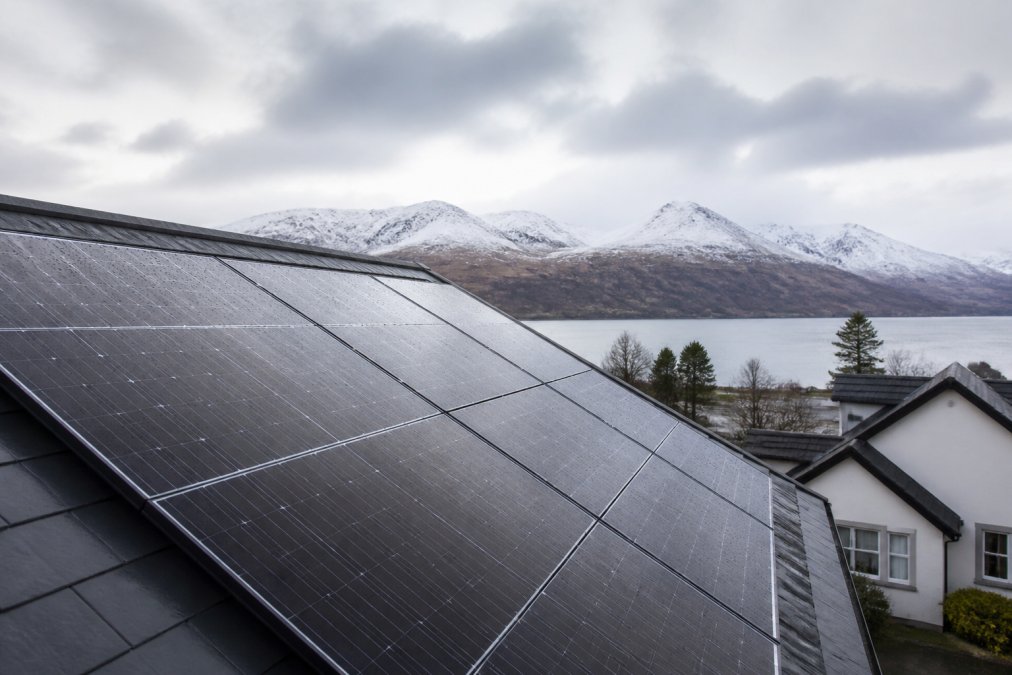
Solar panel efficiency in Scottish weather is higher than most homeowners assume. Cloudy skies don't stop photovoltaic systems from generating electricity, diffuse light, the scattered radiation that penetrates cloud cover, still triggers the photovoltaic effect. Modern solar PV systems typically generate 10-25% of their peak capacity on overcast days, depending on cloud density.
This matters because Scottish weather means frequent cloud cover, yet panels still work. What makes this practical is temperature: cloudy conditions often bring cooler ambient temperatures, which actually improves panel performance. A solar array operating at 15°C generates more electricity per watt than the same array at 25°C (peer-reviewed research). This temperature coefficient advantage means Scottish winters, despite lower irradiance, don't penalise efficiency the way hot, sunny climates might.
Solar Panel Output in Winter: What to Expect
Winter output in Scottish conditions typically ranges from 30-50% of summer generation. A residential system rated at 4 kilowatt-peak (kWp) might generate 2,500-3,000 kWh annually in a typical Scottish location, with winter months (December through February) accounting for roughly 15-20% of that annual yield despite representing 25% of the calendar year.
The reason winter output isn't proportional to daylight hours comes down to irradiance intensity. Peak sun hours drop from 3-4 hours per day in summer to 1-1.5 hours in winter across most Scottish locations. Lower azimuth angles mean sunlight travels through more atmosphere before reaching the panels.
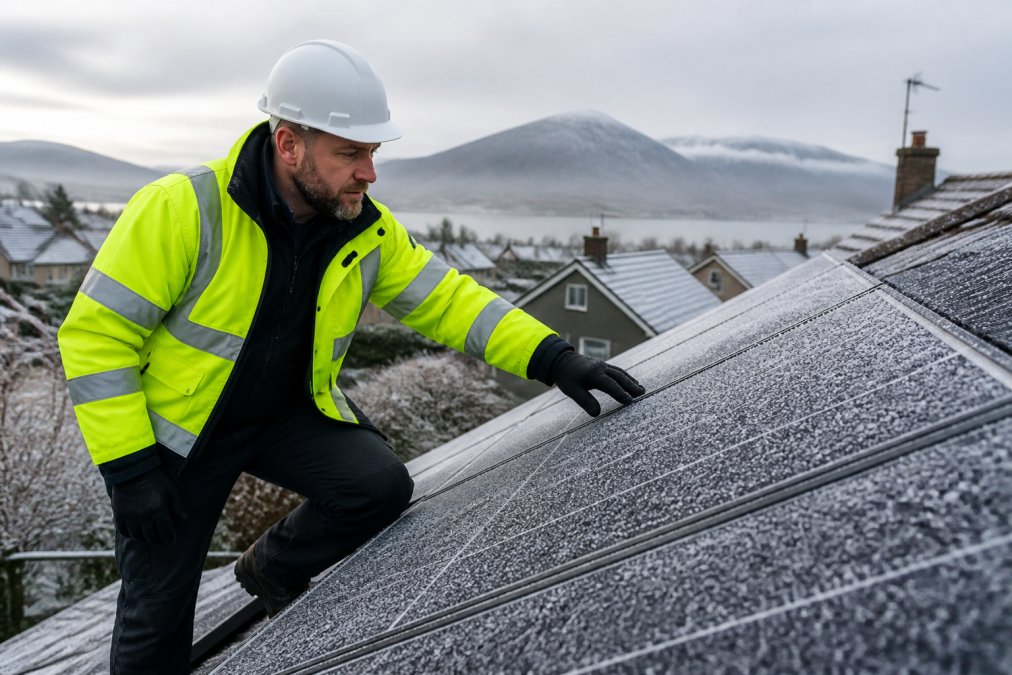
Winter's consistent cloud cover is actually more predictable than summer's variable conditions. A system designed for winter performance will consistently meet expectations year-round. Battery storage transforms winter economics by capturing daytime generation and shifting it to evening peak consumption, significantly improving self-consumption patterns.
Temperature and Efficiency: Why Cold Weather Helps
Cold weather improves solar panel efficiency through the temperature coefficient. Most modern panels have a negative temperature coefficient of around -0.4% per degree Celsius above 25°C. A panel operating at 15°C performs at roughly 104% of its rated efficiency, while the same panel at 35°C performs at 96%. Scottish winter temperatures of 5-10°C push panels toward their optimal efficiency range.
This thermal performance advantage partially offsets the irradiance disadvantage. Inverter efficiency also improves in cooler conditions, with most grid-tied inverters operating at peak efficiency between 15-25°C. For a typical residential solar PV system, this might represent 1-2% additional output during winter months.
Panel longevity actually improves in cooler climates because thermal cycling stress is reduced. A panel that never exceeds 40°C experiences less material degradation than a panel regularly hitting 60°C in hotter regions.
Best Solar Panels for Low Light Performance
Modern monocrystalline panels consistently outperform polycrystalline alternatives in diffuse light conditions because their higher cell efficiency translates to better performance when irradiance is weak. When irradiance drops to 500 W/m² (typical for Scottish cloud cover), monocrystalline panels maintain roughly 60-70% of their rated output.
Half-cut cell technology, where each cell is divided into two segments, improves low-light performance by reducing resistance losses. Bifacial panels capture light reflected from the roof surface, adding 5-15% extra output depending on roof albedo and surroundings.
Panel choice should match your roof characteristics. If your roof has significant shading risk, invest in quality monocrystalline panels with half-cut cell technology. If your roof is unshaded, standard high-efficiency monocrystalline panels deliver the best value. The difference in annual yield between premium and mid-range panels might be 8-12%, which typically justifies the higher upfront cost over a 25-year lifespan.
Solar Battery Storage Benefits for Year-Round Energy
Battery storage fundamentally changes how Scottish solar systems work. Without batteries, winter solar output goes unused during daylight hours. With battery storage, you capture winter generation and use it when you need it. impact of shading.
A 5kWh battery system in a Scottish home might deliver 15-25% additional self-consumption throughout the year by storing surplus generation for later use. Rather than matching battery capacity to peak daily solar output, Scottish systems often size batteries for evening consumption coverage. A typical household consuming 2-3 kWh during evening hours needs a 5-8 kWh usable battery to cover winter evenings reliably.
Smart export guarantee (SEG) payments add another layer to the economics. Battery storage reduces exports but increases self-consumption value, typically favouring battery storage in Scottish conditions because self-consumption rates are higher than SEG payment rates.
Heat pump integration is where battery storage becomes essential for future-proofing. If you plan to install an air-source heat pump within 3-5 years, battery storage sized accordingly prevents the need for complete system redesign. Grid-tied systems with batteries also provide resilience during power cuts, which justifies investment for agricultural properties and rural businesses.
Roof Orientation, Shading and System Sizing
The optimal pitch for annual energy generation in Scottish latitudes is roughly 35-40 degrees. South-facing roofs are ideal, capturing maximum irradiance across all seasons. South-west or south-east facing roofs perform at 90-95% of south-facing capacity. West-facing and east-facing roofs perform at 75-85%, while north-facing roofs generate only 30-40% of south-facing capacity.
Many Scottish properties face north-west or north-east due to historical building patterns. A north-west facing roof needs roughly 25-30% more installed capacity than a south-facing roof to generate equivalent annual output.
Shading analysis is non-negotiable. A shadow covering just 10% of a string of panels can reduce that string's output by 50-80% (peer-reviewed research). Professional shading analysis uses solar pathfinding software to identify shadows by hour and season, determining whether shading is a winter-only issue or year-round problem.
System sizing for Scottish conditions should assume 40-50% of theoretical peak capacity during winter months and 70-80% during summer. A 4kWp system in optimal conditions generates roughly 3,500-4,000 kWh annually, while the same system on a north-west facing roof with partial shading might generate 2,500-2,800 kWh.
Click HERE for your FREE SURVEY today →
Making the Investment Work: Cost-Benefit Reality
Solar panel efficiency in Scottish weather translates to financial returns when system design matches actual site conditions. Payback periods typically range from 7-12 years for well-designed residential systems, depending on electricity consumption patterns and installation cost. Systems with battery storage might extend payback to 10-15 years but increase total financial benefit over 25 years.
Smart export guarantee (SEG) payments provide modest income for surplus generation, typically ranging from 5-15p per kWh exported. Self-consumption value matters more, electricity you consume yourself is worth your full retail rate (typically 25-30p per kWh), whereas exported electricity earns SEG rates.
A typical 4kWp system prevents roughly 4-5 tonnes of CO2 emissions annually (gov.uk). Over 25 years, a single system prevents 100-125 tonnes of emissions.
Electric vehicle charging economics shift the entire equation. Solar-generated electricity used to charge an EV is worth 25-30p per kWh in avoided cost. Battery storage allows you to capture solar generation during daylight and use it for evening EV charging, dramatically improving system economics.
The investment works when you match system design to your actual consumption patterns. Smarter Utility's design process ensures your system is sized for your specific situation, not a generic formula.
Conclusion
Solar panel efficiency in Scottish weather is fundamentally misunderstood. Systems don't require constant sunshine to generate valuable electricity. Diffuse light penetrates cloud cover, cooler temperatures improve panel efficiency, and seasonal irradiance patterns are predictable enough to design for.
A well-designed system with proper battery storage integration can reduce your electricity bills by 40-60%, provide resilience during grid disruptions, and future-proof your home for heat pump and EV charger installation.
Smarter Utility's fully accredited team designs systems tailored to your property's actual conditions. Our free home survey includes shading analysis, roof assessment, and consumption pattern review that determines whether solar is right for your situation and what configuration delivers the best return. Click HERE for your FREE SURVEY today and discover how much you could save with a solar PV and battery storage system designed specifically for Scottish weather.
Common Questions About Solar in Scottish Conditions
Does solar work in Scotland's cloudy climate? Yes. Modern solar panels generate electricity from diffuse light that penetrates cloud cover. Scottish systems typically generate 10-25% of peak capacity on cloudy days and 30-50% of summer output during winter months.
How much does a solar installation cost? Pricing varies significantly based on system size, roof characteristics, battery storage, and installation complexity. Contact Smarter Utility for a personalised quote based on your property's specific requirements and energy goals.
What's the difference between my roof and a south-facing roof? North-west or north-east facing roofs receive 25-30% less annual irradiance than south-facing roofs, requiring larger systems to achieve equivalent output. Shading analysis determines whether your specific roof position is viable for solar investment.
Will battery storage make financial sense for my home? Battery storage improves self-consumption and provides resilience, but the financial case depends on your consumption patterns and planned future upgrades (heat pump, EV charger). A professional survey determines whether battery storage is justified for your situation.
How long does installation take? Installation timelines vary based on system complexity and weather conditions. Smarter Utility provides clear project schedules during the design phase.
Can I add solar if I have an older electrical panel? Many older properties can accommodate solar installations with panel upgrades if necessary. A professional survey identifies any electrical work required and factors it into your project plan.
Frequently Asked Questions
Do solar panels need direct sunlight to generate electricity?
No. Solar panels generate electricity from diffuse light on cloudy days, though output is lower than in direct sunlight. Photovoltaic cells respond to irradiance from any visible light source. On overcast days, a typical solar PV system produces 10-25% of its peak capacity. This is why panel placement and technology choice matter more in low-light climates than in sunnier regions.
What is solar panel output in winter, and how much should I expect?
Winter output typically drops to 20-30% of summer levels due to lower sun angles and shorter daylight hours. However, cooler temperatures actually improve photovoltaic efficiency, panels lose performance in heat. A well-sized system with battery storage captures winter generation and stores it for use when the sun sets. Annual yield calculations account for seasonal distribution across all months.
What are the main solar battery storage benefits?
Battery storage allows you to use solar energy after dark and during cloudy periods, maximising self-consumption and reducing grid reliance. In winter, storage bridges the gap between low daytime generation and evening demand. Storage also protects you from grid outages and can help you benefit from smart export guarantee payments by storing excess generation for peak-rate periods. Sizing the battery correctly ensures you capture real financial benefit.
How cold weather affects solar panel efficiency, and is that good or bad?
Paradoxically, cold weather improves efficiency. Solar panels have a negative temperature coefficient, meaning they perform better in cooler conditions. A panel rated at 100% efficiency at 25°C may reach 105-108% efficiency at 5°C. Snow and rainfall do reduce output temporarily by blocking light, but panels typically self-clean as snow slides off pitched roofs. The real efficiency challenge is cloud cover and low irradiance, not temperature itself.
This article was written using GrandRanker
Frequently Asked Questions
Do solar panels need direct sunlight to generate electricity?
No. Solar panels generate electricity from diffuse light on cloudy days, though output is lower than in direct sunlight. Photovoltaic cells respond to irradiance from any visible light source. On overcast days, a typical solar PV system produces 10-25% of its peak capacity. This is why panel placement and technology choice matter more in low-light climates than in sunnier regions.
What is solar panel output in winter, and how much should I expect?
Winter output typically drops to 20-30% of summer levels due to lower sun angles and shorter daylight hours. However, cooler temperatures actually improve photovoltaic efficiency—panels lose performance in heat. A well-sized system with battery storage captures winter generation and stores it for use when the sun sets. Annual yield calculations account for seasonal distribution across all months.
What are the main solar battery storage benefits?
Battery storage allows you to use solar energy after dark and during cloudy periods, maximising self-consumption and reducing grid reliance. In winter, storage bridges the gap between low daytime generation and evening demand. Storage also protects you from grid outages and can help you benefit from smart export guarantee payments by storing excess generation for peak-rate periods. Sizing the battery correctly ensures you capture real financial benefit.
How cold weather affects solar panel efficiency, and is that good or bad?
Paradoxically, cold weather improves efficiency. Solar panels have a negative temperature coefficient, meaning they perform better in cooler conditions. A panel rated at 100% efficiency at 25°C may reach 105-108% efficiency at 5°C. Snow and rainfall do reduce output temporarily by blocking light, but panels typically self-clean as snow slides off pitched roofs. The real efficiency challenge is cloud cover and low irradiance, not temperature itself.