 listicle
Top 5 Solar Panel Installers Scotland 2026: MCS Guide
Table of Contents
- How We Chose the Top Solar Panel Installers in Scotland
- 1. Smarter Utility: Best for Integrated Solar and EV Charging
- 2. Greener Energy Group: Best for Regional Climate Expertise
- 3. The Edinburgh Boiler Company: Best for Customer Satisfaction
- 4. Ceiba Renewables Ltd: Best for Bespoke Technical Design
- 5. Perfect Sense Energy: Best for Holistic Energy Management
- Is Solar Worth It in Scotland? Understanding the Real Returns
- Solar Panel Grants Scotland 2026: Funding Your Installation
- The Bottom Line
- Frequently Asked Questions
Last Updated: September 13, 2026
How We Chose the Top Solar Panel Installers in Scotland
Choosing between solar panel installers in Scotland comes down to four filters: MCS certification, regional climate expertise, transparent survey practices, and post-installation support. This guide applies those filters to five strong options for 2026.
The single most important credential is MCS certification. The Microgeneration Certification Scheme (MCS) is the UK standard that certifies renewable energy products and installers against consistent quality criteria, and it is what makes a system eligible for government-backed smart export payments (mcs.org.uk). Without it, an installer cannot sign off a system for those payments, however competitive the quote.
Our ranking weighs five factors:
- MCS and RECC accreditation status
- Depth of experience with Scottish roof types and weather
- Whether surveys are free and genuinely no-obligation
- Breadth of service, from solar PV to battery storage and EV charging
- Warranty coverage and workmanship guarantees
Below are the five installers that held up best against those criteria.
1. Smarter Utility: Best for Integrated Solar and EV Charging
Smarter Utility is Scotland's leading installer of solar PV, battery storage, and EV charging, and a strong pick for homeowners who want one accredited team to handle the whole system. As a fully accredited MCS solar and battery storage installer, it designs and fits systems that work together rather than as separate add-ons.
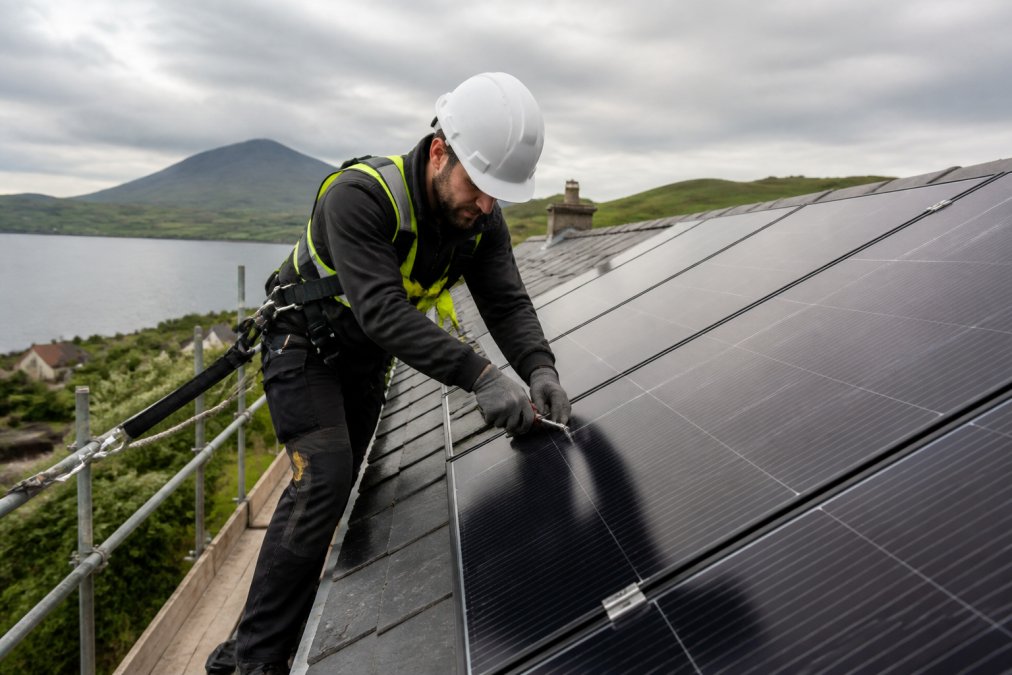
The advantage shows up when you add an EV charger later. Because design starts with a free, no-obligation home survey, the system is sized around your actual consumption and future plans rather than a generic panel count, so the battery and inverter can handle an EV charger without a rebuild.
Pros:
- MCS accredited for solar and battery storage
- Free, no-obligation home survey before any commitment
- Tailored system design covering solar, battery, and EV charging
- Expert design and installation services under one roof
Cons:
- Pricing depends on system size and roof specifics, so figures come after survey
2. Greener Energy Group: Best for Regional Climate Expertise
Greener Energy Group is a specialist renewable energy installer with a strong regional presence and a focus on integrated battery storage.
Its regional expertise is a draw. Battery storage integration is handled in-house rather than subcontracted.
Pros:
- Strong regional presence
- Specialised in integrated battery storage
- MCS-certified installation services
Cons:
- Pricing requires an individual site survey before any figure is given
3. The Edinburgh Boiler Company: Best for Customer Satisfaction
The Edinburgh Boiler Company has built its reputation on customer service rather than scale.
What sets it apart is the heating integration angle. Accredited technicians handle both solar PV and heating work.
Pros:
- Top-ranked for customer satisfaction in the region
- Full-service solar PV and heating system integration
- Proven track record in residential installations
Cons:
- High demand can affect scheduling times
4. Ceiba Renewables Ltd: Best for Bespoke Technical Design
Ceiba Renewables Ltd focuses on technical precision for properties that do not fit a standard template. Both MCS and RECC accredited, it designs custom systems for varying roof types.
This is a pick for awkward roofs, listed buildings, or commercial premises where a one-size-fits-all design will not work. Remote areas may fall outside its service range, so check coverage before requesting a survey.
Pros:
- MCS and RECC accredited
- Custom system design for varying roof types
- Post-installation monitoring and support
Cons:
- Limited availability in remote areas
5. Perfect Sense Energy: Best for Holistic Energy Management
Perfect Sense Energy takes a whole-home approach, starting with a comprehensive energy efficiency audit before specifying any panels.
For homeowners who want solar to fit into a wider energy plan, including smart home energy management systems, this is a strong fit.
Pros:
Click HERE for your FREE SURVEY today →
- Expertise in energy efficiency
- Comprehensive service offering
- Integration with smart home energy management systems
Cons:
- Pricing varies significantly based on system size
Is Solar Worth It in Scotland? Understanding the Real Returns
Solar is worth it in Scotland for most homes with a reasonably oriented roof, despite the weather reputation. Panels generate from daylight, not heat, and cooler temperatures improve panel efficiency, a genuine advantage in a Scottish summer, where a 20°C afternoon can outperform a 35°C one further south.
Scottish yield is lower than the south of England, but the gap is smaller than most homeowners assume. Installers report that a well-oriented 4 kWp array in the central belt produces around 3,200-3,600 kWh a year, while the same array on a good site in the south-west of England might reach 4,000 kWh. The difference is real but a matter of degree, not viability, offset by the fact that Scottish homes tend to have higher heating and evening loads, exactly when self-consumed solar is worth most.
What Scottish weather actually does to output
Three seasonal effects matter more here than in most of the UK:
- Winter output is low but not zero. Short days and low sun angles mean a December day might deliver 5-10% of a June day's yield. This is why battery sizing matters more than panel count for Scottish homes, you are storing a summer surplus, not a winter one.
- Cloud cover reduces, but does not eliminate, generation. Diffuse light still produces meaningful output. Overcast days typically yield a fraction of clear-sky days, but the annual figure is driven by the many partly-cloudy days in between, not by the worst ones.
- Long summer days are a genuine asset. Scotland's high-latitude summers give very early sunrises and late sunsets, which stretches the generation window in exactly the months when household demand is lowest and export potential is highest.
The economics rest on three levers: how much you generate, how much you use on site, and what you export. The Smart Export Guarantee (SEG) requires licensed electricity suppliers to pay you for surplus electricity exported to the grid (ofgem.gov.uk). Because self-consumed power saves more than exported power earns, battery storage improves returns more than extra panels usually do.
Payback periods vary widely by system size, roof orientation, and usage pattern, so treat any single figure with suspicion. A home energy audit and shading analysis give you a realistic annual yield estimate rather than a guess. Maximizing the utility of these solar yields often requires integrating home energy storage to capture excess generation for use during peak evening demand.
The paperwork nobody warns you about: grid connection and DNO approval
This is the part of a Scottish installation that generic UK guides skip, and where projects most often stall. Before your system can be connected and export payments can flow, your installer must apply to your Distribution Network Operator (DNO) for permission to connect. In Scotland the DNO is either SP Energy Networks (central and southern Scotland) or Scottish and Southern Electricity Networks (SSEN) (north Scotland and the islands).
The process works in tiers, and the tier your system falls into determines how long it takes:
- Smaller domestic systems usually qualify for a fast-track or notify-and-proceed route, where the installer submits the application and can proceed once the DNO confirms no reinforcement is needed. This is typically the quickest path.
- Larger arrays, or systems with a big battery inverter, may need a formal application and approval before installation. If the local network is already constrained, the DNO can require a connection study, which adds weeks.
- Island and rural networks are more likely to be constrained, so approval can take longer and, in rare cases, a connection offer may come with conditions or a cost.
A competent MCS installer handles this and builds the timeline into the project plan. If a quote does not mention DNO application or grid connection, treat that as a warning sign, it usually means you will be the one chasing it later.
Solar Panel Grants Scotland 2026: Funding Your Installation
Funding for solar in Scotland in 2026 comes mainly through two routes: the Smart Export Guarantee for ongoing export payments, and Home Energy Scotland grants and interest-free loans for eligible energy efficiency and renewable upgrades. Home Energy Scotland is the official source for current eligibility rules and amounts, so confirm figures there before you budget.
How the two routes actually differ
It helps to separate them, because they do different jobs:
- The Smart Export Guarantee (SEG) is not a grant. It obliges licensed electricity suppliers to pay you for surplus electricity you export. Rates vary by supplier and tariff, and some pay considerably more than others, so compare offers rather than accepting the first one your installer suggests.
- Home Energy Scotland grants and loans are the capital-side support. Grants reduce the upfront cost for eligible households, while interest-free loans spread the remainder. Eligibility is means-tested and tied to the property and the measure, so two neighbours can qualify for different amounts.
The application process rewards preparation: you will typically need an Energy Performance Certificate (EPC), a quote from an MCS certified installer, and proof the property meets scheme criteria. Because amounts and eligibility change, confirm current terms on the official Home Energy Scotland site before budgeting.
One practical warning: grants are tied to MCS-certified installation. If you accept a cheaper quote from a non-certified installer, you can lose access to funding and to export payments entirely.
Planning permission: the Scottish rules most guides get wrong
This is the local detail generic UK articles skip, and it catches out a surprising number of Scottish homeowners. In most cases, domestic solar panels are permitted development, so you do not need planning permission. But those rights are not unlimited, and several Scottish-specific exceptions matter:
- Conservation areas and listed buildings. If your home sits in a conservation area, is listed, or is in a World Heritage Site, permitted development rights are typically removed or heavily restricted. You will usually need to apply to your local planning authority, and the visual impact on the roofscape is the main test.
- Flats and tenements. Scotland has a large stock of tenement flats and shared-roof buildings. If you do not own the roof, or the building is in shared ownership, you will need the consent of the other owners or the factor before any work can proceed, regardless of planning rules.
- Roof-mounted vs. free-standing. Panels mounted on a dwelling roof are treated differently from free-standing arrays in a garden or on land, which are more likely to need permission.
- Article 4 directions. Some local authorities have removed permitted development rights in specific areas through Article 4 directions, which means you need permission even for a standard roof installation.
The practical rule: check with your local planning authority before assuming permitted development covers you, and ask your installer whether they have worked in your area before. One who has fitted systems in a neighbouring conservation area will know the local authority's expectations and can save weeks of back-and-forth.
The Bottom Line
Solar in Scotland works when the system is designed around your actual roof and consumption, not sold from a template. Check MCS certification first, insist on a proper survey, and size the battery around your evening usage rather than the panel count.
At Smarter Utility, every project starts with a free, no-obligation home survey so the design is tailored to your property. As a fully accredited MCS solar and battery storage installer, we handle solar PV, battery storage, and EV charging as one integrated system, ready for an EV charger or heat pump later without starting over. Get started with Smarter Utility and Click HERE for your FREE SURVEY today.
Frequently Asked Questions
Are solar panels worth it in Scotland in 2026?
Solar panels can be worth it in Scotland despite the weather. Modern photovoltaic systems generate electricity from daylight, not just direct sunshine, so they still produce power on cloudy days. With rising energy costs and schemes like the Smart Export Guarantee, you can reduce your bills and earn money for excess power. A professional survey will confirm the potential annual yield for your specific roof orientation and shading.
What accreditations should I look for in a solar installer?
You should prioritise MCS certification, which proves the installer meets industry standards for quality and safety. This is essential for accessing government grants and Smart Export Guarantee payments. Also check for RECC membership for consumer protection and ensure they are approved by a relevant Competent Person Scheme. Always verify their credentials on the official MCS and RECC databases before signing a contract.
How much do solar panels cost to install in Scotland?
The cost of installing solar panels in Scotland varies based on system size, panel type, and whether you include battery storage. Pricing depends on the specific requirements of your property, such as roof complexity and the need for scaffolding. To get an accurate figure, you should request a free, no-obligation home survey from a qualified installer who can design a system tailored to your energy needs.
What is the Home Energy Scotland grant for solar panels?
Home Energy Scotland offers funding through various grant programs. For 2026, you may be eligible for a grant to cover part of the installation cost. The best way to find out what you qualify for is to contact Home Energy Scotland directly or ask your installer during the survey.